RSS

Category Archives: British Theatre

Jimmy and Cook at AWL

2014-07-14 AWL 010Having left the safe confines of Canberra’s tightly-knit theatre community, London posed certain challenges. Not least of which is where to make connections in the world’s theatre capital. Performing in The Inner Life of Sophie Taylor was a great start, but I was also lucky to have found very early in my time here Actors and Writers London.

AWL holds moved readings of full length plays every fortnight, and provides an environment for actors and writers to meet and share their work. They’re also a friendly and welcoming community, who made me feel very welcome right from the beginning.

At the end of each season, they hold a competition for ten minute plays, and given how much I have enjoyed being part of the Short+Sweet festivals in Australia, I of course put in a piece.

Out of quite a number of plays, Jimmy and Cook was selected to be among the eight read in the Summer competition, which was a great boost to my confidence. They organised a cast and a director, and we all showed up before the meeting on Monday and ran through it a few times. I’m not sure I was a great accent coach for Ben Owora‘s Aboriginal Australian English, but I was pretty impressed with the final result after such a quick rehearsal.

Amongst the other finalists there was one play that really stood out to me, which was Liam O’Grady‘s Tea With Aunty Suzy. Bravely stepping out from the comic mould that plagues writers of ten minute plays, O’Grady wrote a great script focused on a younger person’s visit to her aunt with dementia. The play evoked some deep emotions, possibly largely to do with my own experiences with my grandmother in her later years, and was a courageous and impressive piece in this context.

Most of all, it was great to find myself in the middle of such a great group. The atmosphere reminded me most of our Crash Test Drama nights in Canberra, and I felt just at much as home as I do there.

If you would like to read the script for Jimmy and Cook, it’s available on my Scripts page.

2014-07-14 AWL 005


Tags: , , , ,

Matilda

matildaWhen I left my job at the ACT Chamber of Commerce in March, my colleagues kindly presented me with some cash with which I was to take my daughter to a West End show when we arrived in London. Although I fully intended to do this anyway, it was hardly going to be possible to see every show worth seeing here. The decision, I’m almost ashamed to admit, came down to celebrity. Once I’d seen Tim Minchin‘s name, there was no doubt about whether I would see this show.

I booked for a date early in June shortly after arriving in London, but then found myself cast in The Inner Life of Sophie Taylor, and the performance dates clashed. Reorganising myself around the production company’s overly draconian ticketing rules, I tried again for early July, and promptly forgot about the booking until a little message popped up on my phone a couple of days beforehand. It really is nice to encounter surprises you plant for yourself!

My girl wasn’t all that keen in the lead up. She is, after all, almost a teenager, and therefore doesn’t like things planned for her. I attempted to appeal to her baser instincts by locating a purveyor of chips and gravy (a rare find in London, and never of notable quality), but even then, as we queued for the cheap seats in the nose-bleed section, I endured the Scorn of the Adolescent. Right up until the show started, of course. For a girl who is accustomed much more to fringe and pro-am theatre, it was an engaging spectacle, and the show held her attention throughout (though she denies it).

As one would expect from a show that sells premium tickets in the £100+ range, it was technically brilliant. The continual transformation of the set was enthralling, the performers were almost as hilarious and engaging as Tim Minchin usually is, and though I’d never encountered this particular Roald Dahl tale in literary form, it conveyed all the magic of his other works. Best of all, it was absolutely hilarious! Though the theme is serious, and delivers a strong message about personal efficacy and justice, it is nonetheless an absolute romp.

Matilda does suffer from some of the more common ills of musicals. The characters could use more development, and spectacle sometimes overtakes the story. Nonetheless, I could certainly relate the image of the headmistress, Miss Trunchbull, to my frustrations with my daughter’s current school, and their staff’s attitude to students. It opened up some conversation afterwards about the poor behaviour of her teachers, which was of course valuable, as I was able to remind her that teachers aren’t always right and utilise Matilda’s admonition that sometimes you’ve got to be a bit naughty.

We two, before going in.

We two, before going in.

I would love to have been able to engage with the character of Matilda more fully, though. As much as I felt her journey, I wanted to see more humanity, and I have to hold myself back from excusing this shortcoming simply because the actor, Cara Jenkins, is barely 10 years old. Her performance is impeccable in technical terms, and of course that alone is an achievement at such an age, but as much as she had me on her side, I didn’t quite engage with her as a character as much as I engaged with her as an actor. And that’s a real problem. That there is the crux of the matter; to suspend disbelief we must forget that there is an actor involved at all; otherwise it’s a mere spectacle, and not a story.

But maybe I saw her on a bad night. Jenkins is otherwise the living embodiment of Matilda’s line “you mustn’t let a little thing like ‘little’ stop you”, and gets ten points just for that. She is cheering on my side and though the performance may not have moved me at the gut level as it might have, she absolutely engaged me as an educator disgusted by the modern obsession with denying students their humanity. The story’s railing against the mock latin motto by which the British and Australian Ministers for Education pursue their evil plans, bambinatum est maggitum, or ‘children are maggots’ is entirely necessary. It really was a spectacular evening overall, and unlike most musicals, it tells a necessary story.

My Musical Theatre playlist just got bigger, and by the time I return to Oz, I expect I will have the best numbers memorised.

My daughter’s post is over on our walkabout blog.

 

Tags: , , , , , , , , , , , , , , , , , , , , , , , , , , , , , , , , , , , , , , , , , , , , , , , , , , , , , , , , , ,

The Merry Wives of Windsor

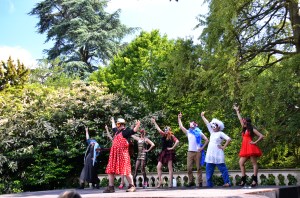
2014 06 21_0864aSo of course I couldn’t come to England without making a pilgrimage to the Bard’s hometown. Of course the lure of Shakespeare’s Birthplace, Holy Trinity Church and a clever little exhibition of props from the Royal Shakespeare Company’s collection were too much to resist, but with the throng of tourists getting in the way of the atmosphere, the most pleasant part of our afternoon was definitely plonking ourselves down in The Dell with a pint of cider for a lively performance of The Merry Wives of Windsor.
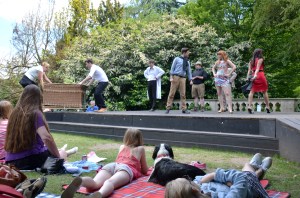
The company, Greater Fool, was formed specifcally to perform for the Royal Shakespeare Company at The Dell in Stratford Upon Avon, and they certainly deliver. Lewis Allcock worked up a sweat playing four different characters, and David Rankine’s brilliantly angsty Mister Ford had the eager audience in stitches.

Possibly the only decision that left me wondering whether it was a good one was the decision to utilise the fame of Modern Family to improve accessibility. Taya De La Cruz‘s Mistress Page was highly amusing as a Mexican housewife, but the reference was heavy-handed and I just wondered if there was a more nuanced way to achieve the same effect. My twelve-year-old daughter has never seen much Modern Family, so the references went over her head, but she still engaged with the story well, despite having had no exposure to this play before either.

Whether this was too much or not was neither here nor there in the end, as the performance was light, engaging, and thoroughly entertaining. Falstaff (Adam Diggle) was suitably depicted as a football-obsessed larrikin, and his engagement with the audience flowed into the atmosphere of the outdoor space, punctuated, as it was, during the performance we attended, by loud speaker announcements from across the river and actual real-life larrikins who had already removed their jerseys to soak up the sunshine and talk on their phones behind the stage. The cast, however, were impressive in their determination to hold our attention, and their toil paid off. These are perhaps the most undervalued performers in England (it was free, though they do pass a basket around afterwards).

2014 06 21_0861aI did consider swapping our days so we could be at Stonehenge for the solstice, but I actually think this was the best activity for summer’s longest day ever devised. And to enjoy a play is a much more suitable activity for a visit to Stratford than battling to catch a glimpse of the bed in Shakespeare’s parents’ room over the shoulders of other pilgrims.



1 Comment

Posted by on Saturday, 21 June 2014 in British Theatre, Theatre


Tags: , , , , , , , , , , , , , , , , , , , , , ,

Sandel

sandelIt is always refreshing to see a new take on an old theme, especially when the characters involved manage to shine through more clearly because of that new take. So with Sandel, I was impressed to find a play that told a story about three people’s love in circumstances where politics would normally get in the way, but are surprisingly held at bay.

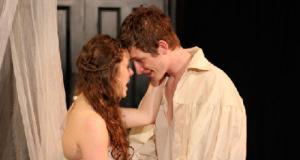
Sandel is a stage adaptation of a 1960s novel by Angus Stewart that tells the story of a love affair between an Oxford college undergraduate, David Rogers, and a choirboy, Antony Sandel, with an intriguing subplot featuring Rogers’ friend Bruce, who is also in love with Rogers.

I suspect this script skims over some of the novel’s more intriguing moments, and while this treatment might be fine for film, I think there are some elements of the relationship between Rogers and Sandel that warranted a deeper exploration for the stage (by which I am suggesting a more courageous departure from the novel might have better represented the characters’ experiences). However, the performances delivered by Ashley Cousins and Joseph Lindoe certainly make the most of a solid script with witty dialogue.

Ashley Cousins’ voice was entirely appropriate for Sandel, though its high-pitched demands did start to grate by the end of the play. This, though, added to the climax that developed gently as the play progressed. This voice not only demanded the attention of Rogers; accompanied by the very rich characters drawn by all three performers, it held me in its grip and gave me that experience that makes theatre worthwhile; I had to know what was going to happen.

Sandel is a noteworthy play, mostly, I think, because it focuses solidly on the human experiences of its protagonists without excessive moralising or even legitimising. The legal and moral circumstances, though considered, are almost a side note to the depth of empathy the story elicits for its protagonists, and this is where it really stands out. I was enthralled throughout.

 
Leave a comment

Posted by on Thursday, 12 June 2014 in British Theatre, Theatre


Tags: , , , , , , ,

Artists, prams and halls

It has felt like something of a whirlwind for me, being caught up in a production pretty much as soon as I arrived in London. When I saw an ad on Arts Jobs at the end of April for actors with Prams in the Hall, I was immediately struck by the aims of the company and how necessary this kind of opportunity is for parents. Of course at that stage I wasn’t familiar with Roisin Rae’s play, and how much the story resonated with both the aims of the company, and my own experience as a father who, by necessity, has needed to treat his greatest passion, playwriting, as a hobby for so long.

For my friends back in Canberra, who were all too lazy to come to the antipodes to see the play, The Inner Life of Sophie Taylor presents the story of an artist who has put her career on hold to raise children. A new opportunity draws out her inner, artistic life, and shakes up this lifestyle. So the play explores how she pursues this opportunity and the impact that pursuit has on her and her family.
Sound familiar? Those who know me know that I’ve had to deal with similar challenges, just like many of the creatives I’ve worked with over my years in Canberra.

For me, the production wasn’t an easy one. Two of the four characters I played presented substantial challenges. Andrew, husband to Sophie, had to be presented in a way that made him neither guilty nor innocent in the difficulties Sophie faced, and his similarity to my own circumstances often made it difficult for me to allow for a reading of the script hat wandered from my own experience.

And the other challenging character, their son, was five! While I had thought it would be fun to play a child since seeing a documentary about Company B’s London run of Cloudstreet over a decade ago, I hadn’t expected I would actually do so. It was, of course, a lot of fun. And a number of rehearsals were genuinely cathartic, as Karin Fisher-Potisk, our movement director, helped us discover our children by taking us back to childhood memories. I found myself quite wistful following one rehearsal in particular, due to the vividness with with I was able to remember my father, who I lost almost a decade ago now.

The Space

The Space

The performance venue was likewise both challenging and exciting. The Space is a performance venue on London’s Isle of Dogs, a former Presbyterian church repurposed as a theatre. It is full of character and has a quaint little stage with a marvellous proscenium. In the week before our performance I came with my daughter to see a production of Romeo and Juliet where the space was used in reverse, with the audience crossing the stage to enter it; it really is a nice performance space, even if you need to put up with the noise of a busy cafe kitchen in the wings!

I certainly didn’t expect that I would be treading the boards during my short stint in London, but I’m glad I did. This experience introduced me to some great creatives and the production was a blast from start to end.

Cast plus director for The Inner Life of Sophie Taylor.

Cast plus director for The Inner Life of Sophie Taylor.


Tags: , , , , , , , , , , , ,

Romeo & Juliet

romeo and julietIn less than a week I will be taking the stage in London for the first time at The Space on the Isle of Dogs. The Space is a quaint repurposed venue full of character and the first thing I noticed on my arrival was that Romeo and Juliet is currently in production, so of course I had to pop along.

I love Romeo and Juliet principally, I think, because though its plot plays hard and fast with the willing suspension of disbelief, its characters are drawn with impeccable honesty.

Tonight, I was treated to one of those brilliant experiences where the familiar becomes new again. The performers delivered deliciously light renditions of Shakespeare’s characters, while also delving richly into the great stock of pathos Shakespeare provided.

I was particularly taken with Lucy Bailey, who took us on the Nurse’s amusing and moving journey of joys and sorrows. Juliet was also given an unusually engaging lightness by Rebecca Burnett that provided the space for joining her on her highs and lows.

There was some novel (and very clever) casting in the form of turning Benvolio into a Benvolia, and Gregory also underwent a sex change. Both characters benefited from finding their feminine side, I thought, though it didn’t seem to serve much of a purpose other than utilising the eternal glut of female actors and relieving the difficulty of fielding a male cast.

And herein lies my one reservation about this production. Despite a couple of interesting choices such as this, and despite some commendable performances, there’s no spark of brilliance to make it truly noteworthy.

These qualities don’t quite compensate for a rather staid envisioning of a text with such broad possibilities. It just seemed far too constrained to its conventional setting, and despite the freshness of the performances, I just wanted something more to sink my teeth into.


Tags: , , , , , , , , , , , , , , , , , , , ,

Two Gentlemen of Verona and Kupenga Kwa Hamlet

Two GentsThe Street Theatre has brought to Canberra two of the cleverest interpreters of Shakespeare’s work who ever trotted the globe. Two Gents Productions hails from London, and are being hailed the world over for their intense physical rendering of The Two Gentlemen of Verona and Hamlet, which play in repertory this week at The Street Theatre.

For The Two Gentlemen of Verona the two performers, Denton Chikura and Tonderai Munyebvu, change between characters using the convention of a single costume piece to indicate each character. In the early stages they also call the name of the character as they take on this piece, and the custom is charming, and breaks down some of the nervousness about being able to follow such a pared down rendering…

The rest of this post is published on Australian Stage.


Tags: , , , , , , , , , , , , , , , , , , , , ,

Frankenstein

A friend’s intention to go see the National Theatre Live screening of Frankenstein this afternoon prompted me to tag along, and am I ever glad I didn’t miss this masterpiece! I’ve been a fan of this story since reading Mary Shelley‘s novel while at uni (this was extra-curricular and yes, I’m that big a nerd!). I have also been impressed by a film adaptation, namely Kenneth Branagh‘s 1994 one, which really brought the novel to life, but I cannot say that either of these seemed more pertinent to my own experience of the world than this play.

Nick Dear‘s script is a fascinating piece of material. A long portion of the beginning of the play proceeds with very few words, and as a playwright I know how difficult it is to craft a play without words. It is, in this instance, essential that this portion of the play not be crowded with words, not only for the sake of the story, but also to draw the focus to Frankenstein’s creation, rather than Frankenstein. It establishes a connection with this character that grounds the rest of the story, and really does take it to a different place from where Mary Shelley positioned her reader.

And it is this positioning that really establishes Nick Dear’s play as a twenty-first century product. The play insists that the audient be confronted by the ethics of creation and the assumption of scientific logic as the supreme voice of reason. And yet, it does this in the absence of a divine. Humankind, refreshingly, is not repositioned as god (as seems to be the fashion), but instead as a more humble, responsible denizen of the world, such as would not have been considered in the early 19th century. Several critical moments of realisation for Victor Frankenstein, played superbly by Benedict Cumberbatch in the version I saw, underpin this reading, and it is the sign of a talented playwright that the character can be so fully formed, and yet still embody such lofty notions without a little compromise.

But all that is very philosophical for a Sunday afternoon. The real joy is seeing these themes explored with such unassuming grace. The set seems to remodel itself with ease (which of course indicates that there is nothing at all easy about it), and the music likewise supports these amazing performers to create magic. The NT Live recording of course doesn’t quite emulate what must be an amazing effect created by what must be thousands of incandescent globes above the stage and auditorium.

What’s really impressive, though, is that a stage production is able to be translated to screen as well as this. Apart from a few moments when the editing left me feeling that a cut had been rushed, and what even the most pedestrian of actors (which these performers certainly are not) would have treated as a pause or silence was instead cut abruptly to the next bit of action, the translation of a stage production into, essentially, a film that can be screened anywhere around the world, is remarkable. I am astounded by the way it has worked, and although I had some hesitation about jumping on the NT Live bandwagon, if this is an indication of what they’re doing, I’m a convert.


Tags: , , , , , , , ,