 I was more than impressed by the set when I entered the Playhouse for tonight’s performance of Talk. Two levels and three separate spaces fill the stage, and I anticipate a masterpiece, judging by this work of art.
By halfway through, I’m disappointed.
Jonathan Biggins’ script deals with heady themes that are particularly pertinent in the current climate. News cycles, declining newspaper sales, irresponsible journalism and public broadcasters all come under scrutiny. And the resulting cacophony is as vague and impenetrable as the world it attempts to critique.
The complex set, while impressive, doesn’t help matters. It is broken, really, into three ‘panes’, which don’t interact with each other. Granted, the story takes place in three separate spheres that barely intersect, but the end result is a disjointed plot, and that’s something I don’t really find endearing.
Biggins’ naturalistic and humorous dialogue, even when it was delivered so well by the talented cast, doesn’t quite overcome the disjointed nature of the piece, and although I was engrossed enough to want to know what happens, I’m not sure I really cared that much about any of the characters.
Talk is a valiant attempt to critique this point in our history, and the journalistic forces that are shaping it, but it falls a long way short of a masterpiece.
Tags: Andrew Tighe, Ben Wood, Canberra Theatre Centre, Hannah Waterman, Helen Christinson, John Waters, Jonathan Biggins, Kenneth Moraleda, Lucia Mastrantone, Mark Thompson, Paige Gardiner, Peter Kowitz, Playhouse, Steve Francis, Sydney Theatre Company, Talk, Trent Suidgeest, Valerie Bader
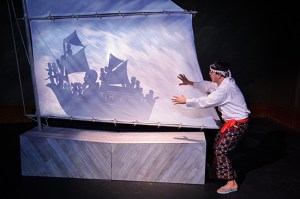 On an island at the eastern end of the Indonesian archipelago, a boy complains that his mother feeds him only rice, and is sent fishing. When he doesn’t return, the distraught parents enlist the help of an ageing local fisherman with a reputation for knowing his way around the sea. So begins a compelling retelling of a story that got lost in the 24 hour news cycle.
Sandra Thibodeaux’s engaging script was developed with the help of the Indonesian families unwittingly caught up in a political game that could hardly be more remote from their world. Rather than a land girt by sea, this Australia, as experienced by this unprepared boy, is as confusing and hostile as a sea girt by ocean. Thibodeaux’s play utilises both Indonesian and Australian traditions and iconography as reference points, anchoring this confused boy’s experience for the audience.
The result is stunning. Set, costumes, video and puppetry combine smoothly to create a sense of simplicity that belies the many modes of communication being employed. The old narrator’s declining memory and eyesight provide slapstick relief from the story’s tragic ebbs and flows, and help to link us back in to the unfolding tragedy. Indeed, the play as a whole is inviting and riveting, and truly a joy to see.
You don’t have long left to get in to see it in Canberra, but if you miss it, you’ll be able to see it in Sydney next week. Don’t muck about.
Tags: Alex Galeazzi, Budi Laksana, C Block Theatre, Dann Barber, Deri Efwanto, Ella Watson-Russell, Gorman Arts Centre, Imam Setia Hagi, Imas Sobariah, Iswadi Pratama, Jaman Belulang, Kadek Hobman, Kadek Krishna Adidharma, Made Gunanta, Mic Gruchy, Mohammad Gandi Maulana, Panos Couros, Performing Lines, Philip Lethlean, Pippa Bailey, Sandra Thibodeaux, Teater Satu, The Age of Bones
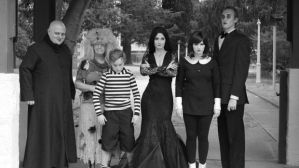 I laughed along heartily at The Addams Family, mainly because the cast worked so well to engage their audience. If only the musical itself was a little more innovative, this would be a brilliant show.
There was a palpable shift a little way into this opening night. It felt to me like nerves were very raw at first, but within twenty minutes or so, that was gone, and the receptive audience had warmed them up. Tim Stiles, in the role of Uncle Fester, seemed to be at centre stage when they clicked into gear, but the whole cast rallied beautifully as an ensemble and it was a beautiful thing to see this shift.
I loved the sharp attitude Lainie Hart brought to Morticia, and Gordon Nicholson delivered plenty of laughs as a trapped Gomez (I am impressed that he balanced the script’s stereotypes with some more subtle characterisation). In all, the cast and orchestra delivered a receptive audience with a truly engaging night of entertainment, despite working with a second-rate script.
I felt slightly uncomfortable about the paradox of a Spanish-American family who’d apparently migrated in the eighteenth century but still had a a Spanish accent and identified themselves as immigrants two hundred years later. Writing in 2009, I think Marshall Brickman and Rick Elice could have attempted to be more respectful, but it probably didn’t occur to anyone involved to consider the imperialism inherent in classifying anyone who isn’t an Anglo American as an immigrant. And it’s hardly a central element of the plot.
Regardless of the unfortunate stereotyping, the story and the values it espouses remain strong, and this, after all, is a light, fluffy musical comedy that trades on the reputation of a classic sitcom rather than the competence or cultural awareness of the writers for its success. It’s not an exploration of metaphysical significance or even a reimagining of a classic, but a vaguely-reasonable attempt to capitalise on nostalgia and turn a profit. It’s fun, and this cast enjoyed themselves enough to take the opening night crowd on a bit of a romp.
Perhaps these characters don’t ring completely true to the TV show I grew up with, but do we really expect them to? In the fifty years since The Addams Family ceased filming, our culture has shifted dramatically. Certain values have held fast, and this musical makes a valiant effort to be relevant… I’m just not convinced that remaking classics just for the nostalgia value is a worthwhile pursuit. Profitable, perhaps: but hardly insightful. And as much as I appreciate the odd bit of fluff, these times call for insight. And the book just doesn’t deliver however much the cast attempts to redeem it.
Tags: Andrew Howes, Andrew Lippa, Anglo American, Annette Sharp, Barbara Denham, Brian Sudding, Caitlin Schilg, Callum Doherty, Casey Minns, Charles Addams, Christine Pawlicki, cultural imperialism, Deanna Gibbs, Eclipse Lighting and Sound, Emily Geyer, Gomez Addams, Gordon Nicholson, Hamish McConchie, immigration, Jesse Sewell, Joseph McGrail-Bateup, Joyanne Gough, Lachy Agett, Lainie Hart, Liam Downing, Liam Jackson, Madelyn White, Marshall Brickman, Matt Black, Matthew Webster, Miriam Miley-Read, Morticia Addams, Nathan Patreach, Nathan Rutups, Queanbeyan, Rachel Thornton, Rick Elice, Siodhan Hansen, Sophie Hopkins, Spanish American, Stephen Pike, The Addams Family, The Q, Tim Stiles, Tristan Davies, Uncle Fester, Wednesday Addams
I grew up in Sydney. I recall studying World War II in the western suburbs like it was a distant memory. I recall hearing about the Holocaust as if it was a side note to the war at school and at home as if it were an isolated and unrepeatable atrocity. I don’t recall ever contemplating whether such inhumanity could be perpetrated in the Sydney I lived in: it was simply beyond my conception.
.
And yet, on so many nights when my parents tucked me safely into bed, men were beaten or murdered on the other side of the city because they were gay. The proximity of the horror is sobering. And it’s proximity that makes
Member such a deeply moving piece of theatre.
.
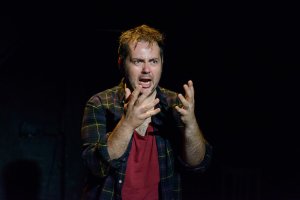
The protagonist is Corey, and we encounter him in an emergency ward, by the side of his adult son, who has been severely beaten. Encouraged by a pretty nurse to talk to his son, Corey describes a moment in his childhood that shaped his understanding of gay men, and determined his response to his son’s coming out.
.
Ben Noble, who plays Corey in this one man show, delivers a brilliant, raw performance with his gut-wrenching script. He evokes a broad range of characters, many of them recognisable as archetypes and deftly held back from becoming stereotypes.
.
Fairly Lucid Productions have failed, in this intstance, to live down to the standard their name describes. Indeed, the clarity with which this performance delivers its punch is amazing. I found it particularly difficult to walk out into the merriment of the bar, where everyone seemed oblivious to the horror that was just brought to life for us. I’ve long thought Sydney an ugly city with a heart of gold, but the Sydney I stumbled back into after seeing Member felt every bit as nasty as her neglected streetscapes have always looked.
.
For me, the proximity of this story to my childhood home is deeply troubling. It further upsets my memory of what I perceived as a relatively tolerant and diverse society. But it also reminds us, and I think this is the intention of the title, that we are members of this society, and the responsibility for change rests with us.
.
Plays like this are why theatre matters.
Tags: Ben Noble, Blood Moon Theatre, Casey Gould, crime, Fairly Lucid Productions, gay, gay hate, Kings Cross, LGBT, LGBTIQ, Manly, Member, murder, North Head, Sydney, The World Bar, Theatre
 As the audience applauded outrageously, drawing the cast out for a well-earned third bow, I wondered whether it would be more appropriate, in this instance, for the cast to stand on stage as we all observed silence in honour of those who’d paid the ultimate price for their love. But of course, that would hardly work, given how deeply entrenched our social norms are.
And that, largely, is the point of Larry Kramer‘s play, very aptly titled The Normal Heart.
The ‘normality’ of the love portrayed is juxtaposed against the initial onset of the AIDS epidemic in the United States, where cultural norms prevented an expedient or even a compassionate response to research and prevention. The play portrays an increasing fear, and an increasing urgency to find a way to stop the as-yet unnamed disease, pitting allies against each other in their fight to arrest the disease’s spread.
The play broadly centres on the efforts of Ned Weeks, a character based on the writer himself, to spur both the gay community and governments to action. After failing to gain traction with the media, he manages to get a group together to establish an organisation aimed at building awareness of and fighting the growing epidemic. He is also spurred by Doctor Emma Brookner, a character based on Doctor Linda Laubenstein, a pioneering researcher into the epidemic. Weeks finds himself pushed in one direction by Brookner, and held back by his organisation, who seek to use more diplomacy than Weeks thinks appropriate.
The resulting conflict drives the play forward, and would present Weeks in a very ineffectual light, were it not for the love story that underlies his trajectory. While seeking media attention, Weeks instead elicits the attention of Felix Turner, and they develop a rather conventional (or as the title suggests, normal) affection, that grounds Weeks, and is, perhaps, the only thing that truly humanises the character. Inasmuch as The Normal Heart veers precariously close to being a mere polemic, Felix is most certainly the play’s salvation.
Will Huang honoured the role of Felix with a brilliant performance. His decline is measured, and his self-pity deeply empathic. I found myself often wishing the more polemic of scenes would zip by a little faster so Felix would come back. But then, in perhaps the most polemic scene, Michael Sparks delivers one of the most moving and convincing monologues I have ever heard, in the character of Mickey Marcus. This moment presented presents Weeks with his most articulate and encyclopædic challenge, and he is silenced. It is a truly remarkable monologue, if Weeks really is based on the author: moving and tragic, and so highly critical of its own writer that it stands out as distinctly un-American in its candour.
Indeed, the second act is awash with noteworthy speeches that cover the range of positions the characters took in response to the epidemic. Jordan Best brilliantly and emotively portrays the frustration of the medical fraternity. Christopher Zuber (as Bruce Niles) puts Weeks in his place without ever writing him off. And Jarrad West’s Weeks, increasingly frustrated and ineffective in his purpose, demonstrates the centrality of the heart, the element that shows this play to be something other than a mere documentation of a sad and sorry moment in human history.
This is a tragedy of Sophoclean proportions, and it is a story Karen Vickery should take immense pride in having directed.
So as this brilliant cast took their bows, I applauded along with the rest of the audience, and began to process the remarkable piece of theatre I’d just witnessed. The irony of being unable to honour both the performance and the story was not lost on me, and though the deep tragedy of the story had cut me to the core, I nonetheless felt it was entirely appropriate for the cast to be honoured as they were.
Still, it would be nice, just once, to forego the applause at the end of as tragedy such as this. To instead stand and honour the dead with a cast that has done them such an honour in presenting their story, would be a cathartic experience I suspect.
Tags: AIDS, AIDS epidemic, Benjamin Trabinger, Canberra Theatre Centre, Christopher Carroll, Christopher Zuber, Courtyard, Dave McCarthy, Everyman Theatre, Fran Tapia, HIV/AIDS, Jarrad West, Jordan Best, Karen Vickery, Larry Kramer, Linda Laubenstein, Marie Donnell, Marion West, Marya Glyn-Daniel, Michael Sparks, New York, Nikki Fitzgerald, Riley Bell, Robert deFries, Roni Wilkinson, Teig Sadhana, The Courtyard Studio, The Normal Heart, Will Huang
 As far as modernisations of classical mythology go, Educating Rita is a valiant effort. It has the pathos of Ovid’s tale, the wit of Shaw’s, and it’s nicely focused on the essential characters, so it almost works as a parable. To date, though, I’ve not seen a production that quite lives up to the ideal I suspect Willy Russell hoped for.
Maybe it was the timing. Written in 1980, Educating Rita sits at the very tail end of Britain’s kitchen sink era, where the profound was muted by reality.
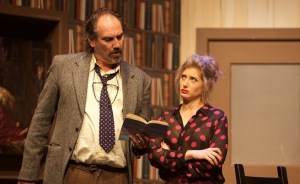
Well, that’s certainly what HIT Productions have here. Though some of the books are clearly painted on the walls, we are in all other senses transported to a rather ordinary office in a rather ordinary institution, in a rather ordinary part of the British Isles, and presented with an extremely ordinary professor of literature. A rather ordinary woman walks through the door, and is gradually transformed into an extraordinary one, while the professor proceeds down a path of self-loathing that apparently leads to Australia.
While I might not be especially enamoured of Russell’s treatment of Ovid’s ancient myth, I nonetheless find it interesting, and it is made moreso in this instance by two brilliantly-talented actors. Colin Moody leaves no room to doubt Frank’s sad reality, and Francesca Bianchi is likewise entirely convincing as Rita. Their see-saw-like transitions through the play are presented with verisimilitude and they build into a brilliantly balanced crescendo.
Regardless of the flaws I see in the script, this is certainly an excellent production of it. It shows a strong commitment to character development on the part of director, Denny Lawrence.
In my wild, erratic fancy, I imagine a production of Educating Rita staged as Greek tragedy, with Frank as a rather sodden Plato, and Rita his Aristotle. The set an olive grove or agora, and among the poets they discuss, Ovid, just for the irony. But can I be bothered? Probably not. I don’t think this tale, as Russell has portrayed it, quite does justice to Ovid’s Pygmalion the way Shaw did. And so, maybe I’ll leave that idea for one of Russell’s true believers.
Tags: Aristotle, Christine Harris, Colin Moody, Denny Lawrence, Educating Rita, Francesca Bianchi, George Bernard Shaw, HIT Productions, Jacob Battista, Ovid, Plato, Pygmalion, Queanbeyan Performing Arts Centre, Shaw, Sophie Woodward, The Q, Willy Russell
 I’ve heard of Death and the Maiden for many years, but I had never seen it, so it was fitting that my first exposure to it occurred at the ANU Drama Lab, where I enjoyed so many lectures as an undergraduate (and a member of NUTS). I really had no idea what I was missing: what a thrilling little psychodrama it turned out to be!
Though it is set in the aftermath of Augusto Pinochet’s removal as president of Chile, it deals with universal themes of forgiveness and the pursuit of justice. Dorfman’s script is astutely sparse, leaving a lot of room for creatives to work these themes through.
And Sammy Moynihan has taken on that challenge admirably.
This production is suitably spartan, with white walls allowing for characters to play in the shadows throughout, a perfect symbol for their shadowy dealings and the uncertainty of their histories. In this era of dodgy dealings and questionable political machinations throughout the Anglosphere, this play is eerily relevant, and mildly disturbing.
Daniel Greiss gives a stand-out performance as Roberto in this production. He manages to elicit pathos without quite nailing down his innocence (or otherwise) for the audience. Georgia-Cate Westcott’s Paulina is suitably unstable and unnerving, and Regis Hiljekamp, as her husband Gerardo, meets her unbalanced mind with unnerving appropriateness and an increasing imbalance of his own.
While the timing was off for lighting changes and occasionally for dialogue, the cast maintained an air of uncertainty, aided impeccably by a spectacular string quartet directed by Enrica Wong. Actually, even if it weren’t for Dorfman’s script and some lovely performances, this production would be worth the effort just to hear the quartet.
This is an impressive production for NUTS, and I’m glad I got to see it.
Tags: ANU Drama Lab, Ariel Dorfman, Clare Coman, Clare Lo, Daniel Greiss, Death and the Maiden, Enrica Wong, Georgia-Cate Westcott, Mackinlay Tikoft, Madeline Collings, NUTS, Pinochet, Regis Hiljekamp, Sammy Moynihan, Sari Tollenaar, Tim Willett
 It’s with some discomfort that I admit, despite reading it at uni quite some time ago, I never followed the story of Antigone. I have, I think, nodded my way through many conversations, wishing I knew what people were talking about (and I apologise, dear reader, if you’ve been the speaker and interpreted my nodding as comprehension rather than a timid shame). The truth is, apart from some vague awareness that Antigone is the centre of a great tragedy and that she epitomised the Ancient Greek ideal of womanly virtue, I never managed to follow the plot.
Until now.
Canberra Youth Theatre’s production is an engaging and moving piece of theatre that liberates the story and presents it in a manner that is accessible and clear to a twenty-first century audience. It also gives me the impression of being truly believable as a 2,500 year-old play from our antipodes. That in itself is an impressive paradox.
Kitty Malam, in the role of Antigone, is technically solid and anchors the action brilliantly. I would have appreciated, given how much the Thebans honoured her, stronger engagement with the audience. Richard Cotta’s Creon, on the other hand, was brilliantly balanced: truly arrogant and inaccessible one moment, he nonetheless elicited true moments of sympathy, having had his own pride back him into a corner. This was a theme that resonated particularly well this week in this city, as we’ve watched our prime minister severely humbled in circumstances that should have been within his control.
Between these two contenders for our sympathy, the remaining cast engage brilliantly. The decision to present as much of the story physically (eschewing the Ancients’ love of just saying many words while standing still, much like the aforementioned prime minister) was the right one: it liberates the story from the weight of words it was originally created with. Given the collaborative nature of the project, the production truly shows this to be an accomplished cast. Their performance skills do much to affirm the quality of actors coming from Canberra Youth Theatre’s brilliant program. None moreso, perhaps, than Isha Menon, who strikes just the right chord as the paternally-authoritative Tiresias.
But what is truly impressive is the depth of expression these young people have developed in presenting this story in modern Canberra. They have not merely been led by someone older and wiser to portray Sophocles’ characters, but have explored them with the curiosity and drive that most young Canberrans reserve exclusively for hunting Pokémon. Canberra Youth Theatre has done the hard yards, and no longer will I nod pretentiously: thanks to this production, my nods about Antigone will either be deeply meaningful or superficially polite, but nevermore pretentious.
Tags: Ainslie and Gorman, Alana Teasdale, Alexander Castello, Alicia Watt, Alison Plevey, Ancient Greek theatre, Antigone, Brynn Somerville, C Block Theatre, Canberra, Canberra Youth Theatre, Casey Elder, Cathy Breen, Claudia Howarth, CYT, Ethan Hamill, Gillian Schwabb, Greek, Isha Menon, Jessica Baker, Kate Llewellyn, Katie Cawthorne, Kimmo Vennonen, Kitty Malam, Loren Nimmo, Mia Tuco, Richard Cotta, Sophocles, Stefanie Lekkas, Stephen Crossley, The Greek Project, Theatre, Thomas Mifsud, William Malam, Xavier Izzard
 It’s truly inspiring when a design just breathes new life into an old script. Michael Hankin’s design for this production has as much to do with its success as the brilliant performers who embody Tennessee Williams’ dark and soulful characters.
Like Shakespeare did so many times, Williams has landed on some truly universal human themes. No matter how far removed from the American south we might be, we recognise the mother whose concern for her children and whose disappointment in her own life leads her to place unreasonable pressure on her son and fail to recognise when her daughter is overwhelmed. We recognise the futility of an existence that provides just enough comfort to persist with, but doesn’t offer enough hope to spur us to action.
Pamela Rabe’s portrayal of Amanda Wingfield, the faded southern belle, is energetic and ugly. She truly manages to balance portraying the caring mother with the desperately incompetent. This balance is in turn critical for Luke Mullins’ deeply moving portrayal of the hapless Tom.
Even at the point when Tom drags his mother to the floor and confronts her with her ugliness, it’s hard to criticise him. He bears her histrionics with patience until he no longer can, and we can only watch as their fate unfolds. All of these characters are worthy of both compassion and criticism. Victims of circumstance, their pursuit of their dreams is as valiant as it is futile.
This futility is beautifully presented by a truly exceptional cast, and demonstrated by the use of a set that isolates the action into an apartment that sits on the stage like a rigid box, then lets us inside with the use of cameras and screens, presenting images unmistakably reminiscent of Hollywood’s golden age. The melodrama, ironically undermined by drawing the audience’s attention to film techniques, holds a grain of truth that justifies the emotive excesses of the dialogue.
Perhaps it is simply the case that Laura’s life, spent obsessing over her long-gone father’s records and her collection of glass animals, is the most complete of them all, the interruptions of her family merely pointless intrusions on the only thing that brings her peace.
Tags: Damien Cooper, Eamon Flack, Harry Greenwood, Jada Alberts, Luke Mullins, Mel Page, Michael Hankin, Pamela Rabe, Rose Riley, Sean Bacon, Stefan Gregory, Tennessee Williams, The Glass Menagerie
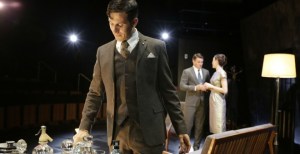
Contrasting the closeted lives of gay men in the twentieth century with the more open lives of gay men in the twenty-first has become something of a sport. There’s a lot to celebrate, more to change, and of course, plenty we can learn. But I think we need to be careful about the sensitivities involved.
The Pride is not insensitive, but it does come a little too close to preaching for my liking. A symptom, perhaps, of biting off more than can be chewed in a single play.
.
Two stories, one about a pair of gay men who have an affair in the 1950s, and the other about a gay couple who break up because of infidelity in the present day, are interwoven to present the contrast. Alexi Kaye Campbell’s play is at once a celebration of the liberation of sexual identities, and a polemic against the cultural relics of the closeted past.
.
Though possibly a little on the static side (events are often described rather than enacted), the dialogue is thoughtful and engaging. There is enough left to subtext to give the play’s five main characters some real depth, and to let Matt Minto, Simon London and Alexi Kaye Campbell show us their considerable talents. Unfortunately, Kyle Kazmarzik isn’t given the same opportunity, as his three characters are little more than caricatures.
.
Minto in particular shows marvellous sensitivity in transitioning between his discreet 1950s character Oliver, and his rather more raging queen, also called Oliver, in the present day. The use of the same name is, I think, a clever device to remind us that the way we live our lives is largely determined by our cultural millieux. Minto certainly carries this well.
.
Against Simon London as Philip, his closest friend and possibly even his conscience in the present day, he is brilliantly vulnerable and empowered. The 1950s Oliver also finds Geraldine Hakewill’s Sylvia, as the wife of his lover, a surprising ally in his weakness. Her weakness in this context as a straight woman is likewise measured and exuding wisdom. It is a well-balanced nuance to give her the final voice in the play.
.
Despite some brilliantly nuanced characters, in building a picture of the damage caused by centuries of community denial of gay identities, I fear The Pride has become overly negative. It lacks, to some degree, sensitivity to the positive lives that the queer community have eeked out for themselves since they were sent into the closets. It does explore with both sensitivity and cynicism the lingering cultural relics of the closeted centuries, such as cruising and cottaging, but it walks a fine line between preaching and remonstrating, which I think labours the point somewhat.
.
Overall, The Pride is an engaging story, and it has enjoyed a very sensitive and thoughtful production at the hands of Shane Bosher.
Tags: Alexi Kaye Campbell, Darlinghurst, Darlinghurst Theatre, Geraldine Hakewill, Kyle Kazmarzik, Mardi Gras Festival, Matt Minto, Simon London, Sydney, Sydney Gay and Lesbian Mardi Gras, The Pride
 Some Australians reject rural and remote Australia as irrelevant to modern life, while others seem to hold onto a nostalgic view of the country as a rough and rugged pastoral wonderland no matter how urbane the populace becomes. The truth, as usual, is somewhere between the opposing perceptions.
It’s surprising, in this context, that a 1990s film focused on a group of drag queens bridged the gap between outback Australia and urban Australia, busting outback mythology while also humanising and endearing the queer community to the rest of the country.
By contrasting the glitz of drag with the rugged beauty of the continent’s interior, Priscilla positioned the urbane and somewhat vacuous queens of Sydbourne and Melney as quintessentially Australian. As Australian, if you like, as pubs, red sandy deserts and big red rocks.
Alana Valentine’s Ladies Day builds on Priscilla‘s success in bringing these diverse experiences of Australia together. The plot centres on the experience of Mike, who is invited to shake things up on Ladies Day at the Broome Races by gracing the catwalk in drag. And grace it he does. Wade Briggs, as Mike, is spectacular in pink, with precarious gold stilettos and a fascinator that lives up to its name. The motive behind this unusual invitation is his friend’s mission to build Broome’s economy through queer tourism by uniting businesses in a fledgling organisation called Pink Broome. Liam, complete with a broom he painted pink, is really the driving force behind the entire plot, and Matthew Backer, who plays him, is the core energy on stage. He makes it easy to suspend disbelief, and along with the rest of the cast he delivers Valentine’s impeccable dialogue with the sophistication of a seasoned performer.
It’s not only Valentine’s dialogue that positions this play well. The interspersing of acapella vocals and direct address monologues, all of which are integral to the developing narrative, weave a complex picture of Australia’s political and cultural millieux at this point in history. Valentine doesn’t shy away from presenting the horror of sexual abuse, and I found myself so deeply engaged in the story at one point that I almost found myself shouting from the auditorium. I did have my wits sufficiently about me to remember that I was in a theatre, and that these were actors and that I should stay in my seat and keep my mouth shut (though I’m not entirely sure these customs are universally appropriate in the theatre: Shakespeare would probably have felt a sense of failure if he saw how modern audiences respond (or fail to respond) to his work).
I am impressed, more than anything else, with Valentine’s positioning of her characters’ experiences. No experience has a higher value than any other. Straight characters can be as damaged by assault as queer. Melney and Sydbourne are as risky and as endearing as Broome. But what matters is how we grow, either from our experiences, or in spite of them.
While I have some reservations about plot decisions late in the play that risk confusing the core narrative, this is truly one of the most vital and engaging works I have seen on stage this century.
Tags: Alana Valentine, Cara Woods, Darren Yap, Elan Zavelsky, Griffin Theatre, Hugh Hamilton, James Browne, Lucia Mastrantone, Mardi Gras Festival, Matthew Backer, Max Lambert, Stables Theatre, Sydney Gay and Lesbian Mardi Gras, Wade Briggs
 I’m not sure what I’ve just seen, but I think I like it. I suspect, and I might just be a little dazed and confused, but it seems it was probably Facebook the Musical.
It’s certainly the closest thing I’ve ever seen to Facebook on a stage: a maze of garbled messages written in sentence fragments, political diatribes interspersed with soft porn and 39 Renaissance Babies Who Can’t Even. It’s the first time someone’s actually read a BuzzFeed post to me, and I kinda liked it. I’m no closer to knowing how to even, but I’ve certainly been convinced that we are all doomed by our inability to communicate.
The show is less play and more, well, I don’t know what it is. Five acts, apparently connected, featuring every kind of performance art from beatboxing to interpretive dance. Harriet and Pierce do everything themselves, it seems. The blackouts operated from a lighting desk on stage and a remote control, and the frequent use of a laptop and projector to remind us that we’re really focused on the internet’s true bottom feeders.
And dull moments? There were quite a few. Perhaps not as many as featured on the actual internet, but the odd creaking hinge could not have more potently reminded me of those moments when I find myself scrolling through masses of absolute rubbish on Facebook until I find myself wondering why I’m looking at something with yet another title like he churns butter in a suit, but when he clenches his buttocks… unbelievable! when there are far more interesting things to do.
I’ve certainly experienced more coherent shows. And more interesting shows. But I’m not at all ready to write this one off. Harriet and Pierce have a point. I’m just not sure what the point is.
Whatever the point is, the show is sure to get you thinking, and is an entertaining way to spend an hour.
Tags: 39 Renaissance Babies Who Can't Even, BuzzFeed, Facebook, Facebook the Musical, Harriet Gillies, internet, Pierce Wilcox, They've Already Won
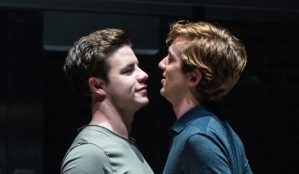 Though somewhat confused, Teddy Ferrara is an engaging piece with some intriguing characters and an excellent cast.
Set on a university campus that sees more than it’s fair share of suicide, it explores the lives of a range of gay and not-so-gay characters and how they intersect around stigma and social activism. It’s absolutely engaging, deals with important issues that must be addressed, but it doesn’t quite manage to hold together as well as I wanted it to.
I fear it may be too politically-minded to be of any practical good. It covers, I think, too much ground, and delves into so many political issues that its narrative is mired and somewhat unclear. It wants to be at once a story while also being a missive, and in trying to be both, it succeeds at being neither. The missive’s premise, it seems, is articulated by a minor character, rather than, as should be the case on stage, demonstrated by the central plot. The very title itself obfuscates the drama by implying that the central plot is that of Teddy Ferrara, which it is not, by any means. Far prettier characters (I’m not just talking about the actors portraying them, but also these characters’ charisma) steal the show, with Teddy ending up little more than a plot device. Or perhaps that’s not true: the stories they tell are also compelling.
And this is the play’s biggest flaw. The playwright, Christopher Shinn, has developed several compelling stories, all of them worth telling:
- Gabe’s somewhat pragmatic romance with Drew, interrupted by personal traumas and mild betrayals, would make a brilliant variation on the usual romantic play where the central characters, instead of falling madly in love, fall gently into a mixture of like and lust.
- Jay’s interest in Gabe could be more than a mere subplot to that story.
- Teddy Ferrara could also warrant a play that was actually about him, exploring the multiple personas of those who live online to escape the trauma of actual human interaction.
- The ostensibly platonic relationship between Gabe and Tim would be an interesting drama.
- The university president, with his hilarious working relationship with the provost, and their interactions with student representative groups could make a brilliant comedy.
As it stands, none of these narratives really take centre stage.
Despite the mild confusion of the competing sub-plots, Gabe, portrayed annoyingly (which is entirely appropriate) by Luke Newberry, was front and centre as a character. He is a wet handkerchief. Ostensibly altruistic and kind, but born with the benefits of good looks, and white male privilege, and displaying them in the worst possible way. His membership of the LGBTIQ minority is really the only reason he comes across with any sense of altruism at all. He is a poor choice for the university’s diversity panel, and of course endears himself to the establishment.
He is supported by the noteworthy performances of Ryan McParland, who is brilliantly awkward and absolutely endearing as the Teddy of the title, Nathan Wiley as his closeted questioning friend Tim, and Oliver Johnstone, whose irksome portrayal of the principled and very controlling boyfriend is not in any way endearing but nonetheless very recognisable and absolutely believable.
So I am left a little flat. The play was engaging and the performances brilliant. But at the risk of being as annoyingly principled as Drew, I must remind myself that although a politician may articulate, a playwright must demonstrate. It is something I always try to remember when writing, though I, too, fail.
Tags: Abubakar Salim, Anjli Mohindra, Carolyn Downing, Christopher Imbrosciano, Christopher Shinn, Dominic Cooke, Donmar, Donmar Warehouse, Griffyn Gilligan, Hildegard Bechtler, Kadiff Kirwan, London, Luke Newberry, Matthew Marsh, Nancy Crane, Nathan Wiley, Nick Harris, Oliver Johnstone, Pamela Nomvete, Ryan McParland, Seven Dials
 Some days just come together, don’t they? I wasn’t thinking of doing anything terribly interesting today, but my housemate suggested trying for last minute tickets for The Winter’s Tale. I was going to say no thanks, but I struggle to say no to Shakespeare at the best of times, and I thought it was a good idea to get off my great lumbering arse. As she was queuing, though, she changed her mind and asked if I’d like to see Husbands & Sons instead. I’d not heard of the show, and knew nothing about it. So of course I said yes. And right glad I am that I did, too!
Husbands & Sons creates a deeply engrossing story by interweaving three of D.H.Lawrence’s plays. The Widowing of Mrs Holroyd, A Collier’s Friday Night, and The Daughter-in-Law sit splendidly side-by-side, woven together delicately by Ben Power. I’m not sure I’d have bothered to make the effort if my housemate hadn’t suggested it. Three plays simultaneously just sounds like asking for trouble! But the skillful manner in which these three have been brought together is quite remarkable.
The action shifts, often distractingly, between the three spaces that have been created, three collier’s houses in a northern English village, as it were. And while the characters hear each other, they interact little until the latter part of the play. Their stories, while separate, are far from independent, though. Power has carefully brought the themes of the plays together, so that the stories complement and enhance one another.
Bunny Christie’s design is remarkable, in that it appears, at first glance to be predictable. It reflects the Kitchen Sink style D.H.Lawrence’s scripts were ultimately categorised with, until the play begins. Projections cast an industrial shadow over domestic imagery, and the four-sided performance space of the Dorfman Theatre oozes atmospheres domestic and industrial, damp and cold, tense and cosy throughout the lengthy passage of the play’s action.
Lengthy though it may be, this production is far from a labour. We were lucky enough to find ourselves upstairs, at the rear of the auditorium high above the stage. I was able to sit back or forward, and even to stand when the mood took me. This position truly added to the experience, which was engaging enough as it was, thanks also to a brilliant cast that had benefited from impeccable direction by Marianne Elliott.
There are so many things to love about this play, but the highest praise I can offer is that it was one of those theatrical experiences where, walking outside afterwards feels like stepping into a duller, less real reality. This is the reason theatre remains so vital, so visceral, experiences like this. Even the glorious dusk light over the Thames, shining brilliantly on St. Paul’s, seemed dun in comparison to the vibrant humanity of the stories I’d just been through.
Perfect theatre. Simply perfect.
Tags: A Collier's Friday Night, Adrian Sutton, Anne-Marie Duff, Ben Power, Bunny Christie, Cassie Bradley, D H Lawrence, Dorfman Theatre, Flynn Allen, Husbands & Sons, Husbands and Sons, Ian Dickinson, Jeannette Nelson, Joe Armstrong, John Biggins, Johnny Gibbon, Josie Walker, Julia Ford, Kate Waters, Katherine Pearce, Katy Rudd, Lloyd Hutchinson, Louise Brealey, Lucy Carter, Marianne Elliott, Martin Marquez, Matthew Barker, National Theatre, NT, Oliver Finnegan, Penny Dyer, Philip McGinley, Scott Graham, Sue Wallace, Susan Brown, Tal Rosner, Tala Gouveia, The Daughter-in-Law, The Widowing of Mrs Holroyd, Tommy Rodger

Director, Hayward B. Morse, photo by Paddy Gormley
Tonight, my play The Ballad of Hobart Jones was honoured with a reading at Actors and Writers London‘s regular meeting. Actors and Writers London is an organisation that helps actors build their careers while helping writers develop their scripts, and that’s certainly how I have experienced the organisation since I joined in 2014.
When I was contacted about this script, one of the first suggestions that was given to me was to remove the narrator. The feedback I’d had prior to this had been equally for and against narration, and I’d followed a more moderate piece of advice in developing the third draft, which had led me to connect the narrator to the story more closely by making her an elderly version of the play’s heroine. But in order to reduce the length of the play to meet the requirements of Actors and Writers London, I reluctantly produced a fourth draft with no narration. Though I lost some exquisite turns of phrase, I still think this improved the work. I was forced to rethink quite a few scenes and find ways of bringing action to the stage that had previously been merely described (something I always thought was cheating anyway). So the work began before the reading was even cast.

Keith Warren as Hobart Jones. Photo by Paddy Gormley.
I was surprised, while working with Hayward Morse, the director assigned to my play, that he, having read only the fourth draft, sought some narration to clarify the settings and the passage of time. While most of the difficulties in this regard would be readily solved in a feature production by the change of a set or a mere lighting state or a sound effect, in the minimalist context of a rehearsed reading the narration had every reason to exist. So, small snippets of the original voice of the luminary were reinstated, for one night only, as it were, and I was very glad an audience got to hear them. There’s still a question in my mind as to whether or not they’re needed. Various members of the group gave me suggestions both for and against the narration, with more of them in favour of it, but I’m still favouring doing some work to exclude it altogether.
That audience was very receptive. Within a few seconds of the play commencing, I was relieved to hear some titters amongst the crowd. Within a minute, there’d been a chortle, and it wasn’t long before proper belly laughs flowed. This was a relief. I’ve written a drama and found out through skilful direction that it was actually a comedy, which is good; but to write a comedy and find out it’s a drama is no laughing matter, pardon the pun. The laughs came thick and fast through the first act, but slowed too much in the second, so there’s a little work to do there, too.
The comments from the meeting after the performance were all very positive. I was somewhat overwhelmed by how enthusiastic some of the members were, and took down their suggestions for draft five. The most useful of these, I think, were comments on the one female character. From the beginning, this character was always intended to be the real protagonist despite there being a superficial focus on the hero named in the title. The action still allows her to take a back seat, and remain something of a passive participant rather than the protagonist I always intended her to be.

Henry Lawson introduces Sydney to Miss Adelaide Harris. Photo by Paddy Gormley.
Of course, there can be no greater praise than to hear an audience laugh at the moments that were actually intended to be funny, and aww at the moments that are intended to inspire an aww. In addition to the very thoughtful and helpful criticism I had from my peers at AWL, these almost involuntary reactions are extremely encouraging, and give me confidence in the value of what I’ve created.
I’m really very proud of how this script works on stage. It jumps along at a merry pace (as attested to by several members of AWL), and allows the characters to shine. There are only a few adjustments to make, most of which revolve around Ada, the would-be protagonist. So, I set to preparing a fifth rendition of my Ballad. And then all I need is a producer. Anyone interested?
Tags: Actors and Writers London, Adelaide Harris, Alexander Jonas, Andrew Barton 'The Banjo' Paterson, ballad, Banjo Paterson, development, Gerard Manley Hopkins, Hayward B. Morse, Hayward Morse, Henry Lawson, hero, heroine, Hobart Jones, Keith Warren, Laurence Binyon, Lee Peck, Lianne Tucker, Melbourne Romsey, Paddy Gormley, Peter Mair, Protagonist, Rick Alancroft, script development, Sidney Ross, Sir Henry Parkes, The Ballad of Hobart Jones, William Topaz MacGonagall
 In 1945, one of Noël Coward’s great successes hit the big screen. Brief Encounter centred on the romance between a married man and a married woman, whose love is an impossible dream. Phil Willmot’s Encounter reimagines this story as a romance between Lawrence, a doctor who passes through Vauxhall Station each week, and Arthur, the station master. A chance encounter leads to a developing romance that is hindered by external pressures. However strong their connection, the barriers to their happiness in post war London seem insurmountable.
Both of the main characters are exquisitely developed and spring out from the stage through sparky, intelligent dialogue and magnificent performances from Adam Lilley as Lawrence and Alexander Huetson as Arthur. The supporting roles are somewhat more flat, with four additional characters played by two actors. These four just don’t have the depth of the central characters, and occasionally undermine the pathos of the whole, though they retain some comic value and drive the plot along.
One of the great achievements here is the way in which the tiny set transforms so readily to so many locations. That, and the sense of a filmic style that carries well in Above the Stag‘s tiny space under the overground.
Encounter, it is suggested, is the play Noël Coward wanted to write, but couldn’t: I think it presumptuous to suggest so. Coward never saw his private life, especially his sexuality, as a suitable topic for public conversation. But Willmot’s play, nonetheless, is a perfectly executed reimagining of Brief Encounter. It acknowledges the past and celebrates the present in a subtle but powerful way.
This is a deeply moving piece of theatre, with characters who quickly warm your heart and hold it enthralled until its chilling conclusion.
Tags: Above the Stag, Adam Lilley, Alexander Huetson, Christopher Hines, Noel Coward, Phil Willmot, Vauxhall
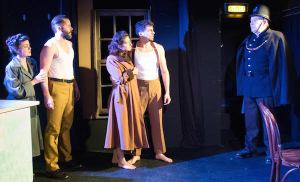 Setting a fictional story in a real history can be a challenge. In doing that myself, I’ve built up intricate scenarios only to realise I’ve overlooked a minor historical fact that makes a big difference to the plot. In Saffron Hill, Penny Culliford triples the challenge for herself, and still delivers a script that engages and elicits the necessary empathy for the characters.
Beginning with the migration of the Italian Musetti family to London in 1872, the play marks the journey of the family in their new country over three different periods in the coming century. Observing the struggles of the migrants in the 1870s, the generation that faced the heartache of being an Italian Briton during the Second World War, and those who continued to hold an Italian identity almost a hundred years after their ancestors migrated, the play takes a broad look at the family’s fortunes.
With the same cast delivering a range of roles over the three periods, a strong bond develops and it is easy to remain engaged with the family across what is essentially three stories. The use of radio news broadcasts to highlight the passing of time creates a great atmosphere and marks the passage of time leading into the next stage of the story.
In all, I found the play engaging and insightful, and I admire the skill involved in bringing the story to life.
Tags: Anthony Comerford, Anthony Shrubsall, Edmund Dehn, Edmund Sutton, Fed Zanni, Fiona McKeon, Maeve Leahy, Nadia Ostacchini, Penny Culliford, Roseanna Frascona, Tricolore Theatre Company
After missing a year, it has been a great feeling being involved in Short+Sweet again this year. The competition, as always, is eclectic.
.
I think one of the highlights this week has been
The Adventures of Captain Midnight, in which Captain Midnight, a widower, describes his experience of moving to a retirement village and finding himself the centre of all the ladies’ attention. Don Smith as Captain Midnight strikes a very dignified presence with an air of David Attenborough examining the sex lives of the elderly.
.
I’ve also been enjoying The Truth About Mum and Dad, yet another great piece by Greg Gould with some snappy one-liners and very relatable adult siblings who enjoy making a scene while learning that their parents may not be quite as prudish as they thought.
.
Harriet Elvin’s Untitled was in good company with these offerings, too. What seems to be an art critic being harangued by a less appreciative gallery visitor turns out to be something far more amusing.
.
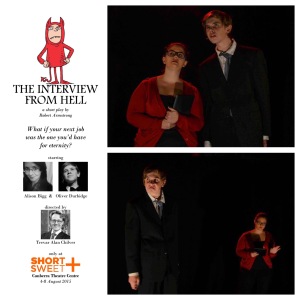
I had the privilege of directing two very talented and committed performers in Robert Armstrong’s zippy little piece, The Interview from Hell. Alison Bigg and Oliver Durbidge took the production very seriously, and made the whole process very enjoyable. I also think the result was spectacular, but I’m biased!
.
But the image that will stay with me after this year’s festival will certainly be that of Alison McGregor’s ‘Sparkles’, whose homage to love and chicken was simply gut-wrenching, especially the third time you see it! This one certainly deserved to take home People’s Choice!
.
If this is the Top 20, there’s no way of predicting what will be in the Wildcards!
Tags: Alison Bigg, Alison McGregor, Canberra Theatre Centre, Don Smith, Greg Gould, Harriet Elvin, Oliver Durbidge, Short+Sweet
I’m not a big fan of sports. I did audient at a game once when I was young, but I found the plot far too predictable and the characters quite superficial. It has always seemed to me that if you’ve seen one game, you’ve seen them all. I am generally in the habit of going straight to the sports pages in a newspaper when I need to clean the windows or if I have to deal with a puppy’s nuggets of joy. Instead of sport, for most of my life I’ve turned my attention to production styles with more drama, intrigue and three dimensional characters, but just this week, I’ve found it very interesting to note the strange audience responses to a mime act by an Aboriginal footsport player, especially given the controversy sparked by his performance.

Lewis Jetta’s enthusiastic mime, a subtle inspiration for so much Bogan ire.
For those living in the rest of the world, or for Australians who live in their own little bubble, what happened was essentially this: last Sunday, during a game of sportsball staged by Australia’s largest sportsball producer, the AFL, a group of Bogans in the auditorium were taunting one of the Aboriginal performers: Adam Goodes of the Adnyamathanha and Narungga peoples in South Australia. Following a plot crescendo during which one of the protagonists, an Aboriginal performer by the name of Lewis Jetta, had apparently sportsed very well, he stopped sportsing for an improvised aside in which he mimed the throwing of a spear. It was a gesture of excitement following a small victory that took its inspiration from the performer’s heritage. The mime, it seems, was very convincing: the Bogans in the auditorium were so terrified of the mimed spear that they booed ever louder, and they’ve been booing all week.
The performance, luckily, was recorded and plastered everywhere, so I have had the opportunity of viewing it on television and the interwebs approximately seven hundred and eighty four thousand, six hundred and fifty times. My considered opinion is that the mime, though solid, was not of Marcel Marceau’s calibre (though his blackface was certainly convincing). Don’t get me wrong: it was a fine mime, but so brief, and with so little development of plot or establishment of environment, that it really doesn’t appear sufficient to warrant such fear. I would have thought a prop spear may well have had such an effect, but the mime? I’m not so sure there was much to be afraid of. But the Bogans were very afraid, and the official spokesperson of Boganhood has been making it known just how frightened they were by it.
Ever since the event, the entire country has been discussing whether the mime was appropriate for this performance space. Apparently, sportsfoot games are usually a very vocal environment: performers and audiences are both encouraged to be very vocal about their feelings, so a mime is quite an unusual piece of performance art in this environment. I suspect a part of the Bogan response is the unfamiliarity of the audience with the subtlety of the protagonist’s choice of mime.
The conflict has been heated. Many Australians feel that miming an aggressive action such as throwing a spear is not appropriate, though apparently punching the air is acceptable, as is dressing in ancient Polynesian armory and screaming threatening words in a language even more frightening than German. Heck, even punching other people is apparently okay! But according to the Bogan Lord, miming the throwing of a spear is never acceptable. A good number of other middle aged white men of European heritage have also expressed their disappointment that an Aboriginal man would do Aboriginal things in Australia, and have railed at the suggestion that their response is racist. They’re even saying that pointing at racism and calling it racism is not in the spirit of the game. No wonder I don’t have an affinity with sport. According to these commentators, the Australian race who have suffered the greatest degree of racial vilification over the last 227½ years just aren’t qualified to identify racism when they see it.
Now, it is clear that Australians are more conservative about violence than most cultures, and we don’t get terribly emotional about sports. British fans of boring sports, for instance, have been known to go to more extreme lengths than Jetta, and rather than miming the throwing of a spear, the British Bogan is more inclined to kill children when he gets bored of watching a game. Brazilians also tend to throw actual things, rather than miming things to throw when they play sportsball. Thank goodness Australian players draw the line at gang rape and only mime violent acts.
As a very astute friend of mine remarked on the Book of Face, in most theatres, an audient behaving in a disruptive manner like the Bogans at Subiaco Oval would be asked to leave by one of the ushers to allow the rest of the audience to enjoy the performance. It seems to me that the failure of the venue to expel the disruptive audients is the most egregious error here. But perhaps Western Australian theatres are just more tolerant of poor behaviour in auditoria. I hear there were even people using a mobile phone during the performance! I certainly hope that custom doesn’t migrate to the eastern states; I can’t think of anything more disrespectful.
Now, I’m no expert on performances in this kind of context: I don’t usually find the plot in footsport games interesting enough to warrant any analysis on my theatre blog. But with so many people speculating about whether booing an individual for expressing their excitement in a manner appropriate for their race is racist, and since quite a few of my friends who I didn’t think were racist have been saying racist or at best just plain ignorant things this week, I felt it might be useful to describe the controversy from a different perspective. And as a dramatist, I can confirm that this is certainly the most interesting thing to happen on a sportsing paddock since the fitba riots in Europe in the 1980s led to the development of crowd control as a field of academic inquiry.

Goodes summoning the sportsing gods, or maybe just walking along with an arm outstretched, I’m not sure.
A mime in a shouty context doesn’t necessarily play well, but neither does it warrant this kind of response. I think begrudging an Aboriginal man his Aboriginality and asking him to act like a Gubba instead is definitely more than just a little bit racist. Getting upset about the miming of a violent act in an environment characterised by actual violence is, I think, equally ridiculous.
If you read nothing else about this sorry affair, give Stan Grant’s remarkable piece a go.
And if you’re not a reader, Waleed Aly debunks the two most profound myths surrounding the ever-so-apty-named Mister Goodes in this video.
Tags: Adam Goodes, Adnyamathanha, AFL, aggression, Alan Jones, Andrew Bolt, Brazil, controversy, everyone's a little bit racist, football, football violence, Lewis Jetta, little bit racist, mime, Narunnga, Perth, racism, riots, spear, sport, sportsball, Stan Grant, Subiaco, violence, Waleed Aly, Western Australia
 The expression on the faces of the three actors after their opening night performance said it all: they’d put their whole heart and soul into it!
And why wouldn’t they? The Compleat Wrks of Wllm Shkspr (Abridged), despite being abridged, is one of the most amusing responses to the Bard’s works ever penned. It has been entertaining both Shakespeare enthusiasts and the partners they drag along to the theatre for almost 30 years, and so far it has failed to age.
Covering all 37 of Shakespeare’s dramatic works in under two hours is no mean feat. Granted, they do cover 16 comedies all at once (because they’re all the same anyway), and they merely name a few rather than delving into them, but still, you can understand them experiencing some fatigue at the end of such a night. Truly, if any actor has earned the right to collapse at the end of a performance, it’s an actor in this hilarious show.
And this cast has certainly done it justice.
Ryan Pemberton introduces James Scott as the bumbling scholar, who in turn calls on Brendan Kelly, drawing him into the debacle. The pace begins rather more slowly than I think this piece calls for, but the three certainly picked it up. Perhaps not quite enough to hold the energy where it needs to be, but that will probably slot into place as the run continues and the cast get a better feel for audience reactions.
A great production that both needs and deserves a high quality audience!
Tags: Brendan Kelly, Complete Works of William Shakespeare (Abridged), James Scott, Reduced Shakespeare Company, Ryan Pemberton, The Compleat Wrks of Wllm Shkspr

 Foyer Talk