About Trevar Alan Skillicorn-Chilver
Trevar Alan Skillicorn-Chilver is an authorised celebrant, a playwright, a teacher and quite a few other things!
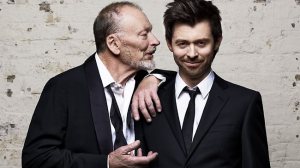 A post-industrial landscape meets a little Brit kitsch in Bell Shakespeare’s latest work to grace the stage of Canberra’s Playhouse. Opening with the dissonance of early Brit Rock and the destruction of a massive Union Jack (a very pleasing sight), Bell’s Henry IV is young, pithy and full of the muck, mire and joy of life.
Not one of Shakespeare’s better-known plays, Henry IV, which was written in two parts but is here presented by Bell in one, tells the story of King Henry IV’s efforts to restabilise his kingdom and rein in his recalcitrant son and heir. Led astray by the inimitable Falstaff, Prince Hal confides…
The rest of this post is published on Australian Stage.
- Ron Cerabona’s view, as published in the Canberra Times and the Age
- John McCallum drools a little over JB, less so over Matthew Moore, published in The Australian
- Frank McKone articulates his disappointment with the production, over on Canberra Critics Circle
- The Barefoot Review by Deborah Hawke
Tags: Arky Michael, Bell Shakespeare, Ben Wood, Canberra, David Whitney, Falstaff, Felix Jozeps, Henry IV, Henry V, Jason Klarwein, John Bell, Kelly Ryall, King Henry, Matilda Ridgeway, Matt Scott, Matthew Moore, Nathan Lovejoy, Prince Hal, Scott Witt, Sean O'Shea, Stephen Curtis, Terry Bader, Tony Llewellyn-Jones, Wendy Strehlow, William Shakespeare, Yalin Ozucelik
There isn’t much as satisfying as spending a night mucking around with scripts with a bunch of other people who like mucking around with scripts! I had a ball at Crash Test Drama, and I still would have, even if I didn’t come home with a couple of awards! Yes, two awards! Best Director, and People’s Choice award for my new short play The Boat Person.
It is really encouraging to hear that The Boat Person took people’s choice by a big margin, and I’m thinking that this year I will try to get it into Short+Sweet Canberra as an independent production. Its themes, which centre on the Laboral parties’ entirely immoral asylum seeker policies, will be especially relevant (and of course (because it’s me writing) irreverent) during the August festival as we bear headlong into the September election. I want to be right in the middle of this one.
Congratulations to everyone else who took home either an award, or just a pat on the back. It was great to spend the evening playing and watching, and I can’t wait to join you for the next one.
If you have no idea what Crash Test Drama is all about, head over to the website at www.crashtestdramacanberra.com.au
Tags: Crash Test Drama, Short+Sweet
 In preview tonight at Theatreworks, Love Me Tender explores a grab-bag of vaguely-related themes through a series of stories told sometimes in dramatic dialogue, and other times in literary monologue. The characters are mostly plagued by a lack of control of their circumstances and a sense of helplessness, and much of the exploration is a cavalcade of questions and of doubt, which doesn’t exactly make for riveting theatre.
At a rather fundamental level, I have an objection to the mode of storytelling employed by Tim Holloway in much of Love Me Tender. This is theatre, but the events in the narratives are not actually performed on stage. Instead, performers tell their story, often in metaphor, mostly in direct address to the audience. The result is that what the audience encounters is not strictly speaking dramatic, but tends more towards the literary arts. We lose, as an audience, the capacity to read between the lines, the capacity to read the characters’ relationships, and the capacity to engage with the characters’ experiences as they experience them. Instead, we’re left with…
The rest of this post is published on Australian Stage.
Tags: Brendan Barnett, Drama, James Tresise, Literature, Love Me Tender, Matthew Epps, Nick Pelomis, Patrick McCarthy, Sarah Ogden, Theatre, Tim Holloway
 I was really looking forward to seeing Lincoln. His figure looms large over American history, and the particular juncture at which he held office in American history makes his story ever more relevant to a broad international audience. So when I found it so disappointing, I decided to wait a while and process it more before posting on it. And it’s been a worthwhile exercise, even if only for the study of historical narratives.
What this film suffers from the most is trying to tell the whole story of Abraham Lincoln’s final, event-filled years. It’s a common mistake for makers of historical films; to attempt to cram into a film of a couple of hours the full breadth and depth of several eventful years. The first two scenes illustrate the problem with this film perfectly. We begin with Lincoln being treated as a major celebrity by loyal soldiers, who for some inexplicable reason quote one of the president’s speeches back at him. Granted it’s a great speech, but I’m not convinced he’d forgotten it and needed the reminder, nor am I enamoured of the pathetic doe-eyed image of the American soldier so besotted with the president as to do such a thing. This scene is followed by the one thing screenwright Tony Kushner made a perfect call on; to use Mrs Lincoln to humanise and ground the celebrity. Had the story been mostly told through her eyes or in her presence, it would have made a much stronger impact, it would have held together more consistently as a narrative. Mrs Lincoln plays a significant role as the story progresses, but this role is too small for the attempt to narrate and humanise what is otherwise a docudrama mainly suitable for a midday slot on television. And of course, it isn’t helped by the longish written history lesson viewers are subjected to before the first scene even begins!
Whatever the creators have failed at, they have at least put to rest the myth of Honest Abe. Instead, Lincoln is depicted as the consummate politician, manipulative and conniving enough to achieve his goal, demonstrating both his leadership and his conviction. The mythical hero of history is in this film depicted as we know modern politicians; distrusting of democracy and determined to do good in spite of democracy’s aversion to good. It is a demonstration of the futility of democracy to see Lincoln connive and subvert the democratic process, only to turn the accusation of these ‘evils’ against Jefferson Davis.
This paradox, though, leaves me a little confused. I am not sure if the creators intended to depict Lincoln as a hypocrite, because he is otherwise shown as the consummate hero. I’m no fan of Westminster democracies, nor of the American congressional system. Both are subject to extreme subversion (in fact without subversion they’re entirely dysfunctional), and I like the way this film depicts that. But I am not convinced this was the intention of the screenwright. Too often the system is praised. Too often these characters have me convinced that they believe in their democratic processes. At the end of the film, I remain unsure as to what is being communicated.
This is a valiant attempt to tell an epic story, but it is unfortunately clouded by too many spectres of issues: democracy’s flaws; racial equality; gender equality and power all get a run, but none of them quite come into focus as well as they ought, mainly because the central character is a hypocrite, and his hypocrisy is not quite justified (not in the context of the film, that is; the historical figure of Lincoln had very good reasons for his lying, cheating and scheming).
So despite some great performances from the cast, fine characterisation and a rich plot, I found Lincoln struggled to deliver on clarity.
I think the magic bullet, the thing that would truly make this American history come to life in film, would be for it to be created by a foreigner. Americans take either too emotional or too factual a view of their complex history, and as a result, they slim down their historical figures to two dimensions. A foreigner would have enough distance from the material (and from the mythology Americans have built up around their history) to do it properly, and avoid these pitfalls. It would require a sympathetic foreigner, so a Canadian probably wouldn’t do. I suspect that if the story of America’s biggest political hero were to be told by an Aussie or a Brit, they’d hit the nail on the head. For my money, Lincoln is too confused a film to be worthy of the praise it’s getting.
So as you look for great films on this period of American history, I think Django Unchained the better choice.
Tags: Abraham Lincoln, Daniel Day-Lewis, History, History of the United States, Jefferson Davis, Lincoln, Tony Kushner
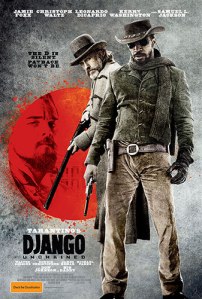 I’ve never been a big fan of Quentin Tarantino‘s films. Most offend on my most cherished traditions of storytelling — character and plot — so I pay them less heed than I might otherwise do, but Django Unchained is a true exception. Sure, I liked True Romance, and Pulp Fiction isn’t without its charms. Inglorious Basterds is a fine piece of cinema too, but Django Unchained is a refined, glorious masterpiece. A film worthy of the attention Tarantino usually gets for the more flimsy of his work. I will give three reasons why I think this film alone is worthy of all the praise that has been lavished on Tarantino for all of his lesser films put together.
First, it has a plot. And not just an “I need an excuse to shoot so many scenes of blood and gore” kind of plot. It has a narrative. As in its central characters have a context in which to be, and not a flimsy one, but a solid, relatable, engaging one. A slave — Django — is bought in Texas by an anti-slavery German bounty hunter for the knowledge he has of the bounty hunter’s target. In exchange for Django’s help, he agrees to free him and share his earnings. The two become friends and colleagues and the German learns the story of Django’s wife, and they set out to free her from slavery also.
Second, it has characters that speak like real people. Not all of them, mind you, but a whopping majority, which is more than can be said for most of Tarantino’s characters (it’s also more than can be said for half of the movies made in the United States in the last 50 years). Most of them tend instead to opt for trite one-liners or metaphors or abbreviations of concepts that are supposed to make us think they’re really cool, but these characters are so damn cool they don’t need the pretence and can speak in full sentences like human beings. I like that. It gives them depth and develops relationships and shows me people I can relate to.
Third and best of all, Django Unchained has that wonderful quirk of Tarantino’s; the ability to draw us into the violence as if it is the realisation of our deepest, darkest instincts. It’s the karma we westerners of the 21st century wish we could exact upon the evil of the past. The wish that we could punish slave-owners for their sins, or take revenge on Hitler or upon that bully who just wouldn’t let up. I think this is what has sold so many of Tarantino’s films (that and truly beautiful cinematography that doesn’t just glorify, but truly beautifies, violence), and why I’ve often been willing to forgive the lack of plot or the superficiality of the characters or the ridiculous illogicality of the combat. Someone who deserves to suffer the full force of their victim’s fury is getting even more than the full force of it. Payback’s not just a bitch, she’s a tsunami of violence, desolating everything in her path.
And while this has always been the element I’ve liked in Tarantino’s films, in this instance, he doesn’t sacrifice character and plot to deliver it. And that is why Django Unchained is the film that redeems his ouvre.
Tags: blood, Christoph Waltz, Django, Django Unchained, Film, Jamie Foxx, karma, Kerry Washington, Leonardo DiCaprio, Payback, Pulp Fiction, revenge, slavery, Tarantino, violence
 This is a romance story for those who don’t tolerate a lot of nonsense. And it is seriously one of the best romance films I’ve ever seen.
We meet Patrick, played by Bradley Cooper, in a mental institution as his mother delivers a court order for his release. It is soon revealed that he was institutionalised with bi-polar disorder following an incident following his discovery of his wife’s infidelity. Now on a restraining order to stay away from her, he seeks to prove that he’s worthy of his wife’s love and trust through positive living and a few trite aphorisms.
Before long, he encounters Tiffany, a widow suffering depression with whom he strikes a strong and immediate bond. From there the plot is basically predictable; they fall in love, he denies it, eventually changes his mind, yada yada yada. But it doesn’t matter, because these characters are so strong. Characters like these are hard to come by. There’s something so much more genuine than the average romance film offers.
The characters with the apparent mental illness offer great insights into humanity, and those without a diagnosis are shown to waver in their ability to control their senses also. We need more stories that depict varying degrees of mental health, rather than the old paradigm of being either sane or insane. This film does it beautifully, and is well worth a look.
Tags: Bradley Cooper, Chris Tucker, Jackie Weaver, Jennifer Lawrence, Robert DeNiro
The fourth week of Short+Sweet’s Sydney festival opened tonight, and it was an opening I could hardly wait for. My play, The Commuter, is in this week’s line up, so it was always going to be an exciting night.
It surprises me how deep the emotion runs of seeing my vision for a play realised on stage. The cast Luke Berman pulled together for The Commuter gave me one of the greatest buzzes I’ve experienced in a long time, and I think Adam O’Brien captures beautifully the nervous white guilt phenomenon I was exploring in this play. It doesn’t wear off, that cathartic feeling of seeing something you imagined into existence come to life on stage, and I feel truly indebted to these performers for the work they’ve put into the play.
I knew Geoff Sirmai from his performances in Canberra of Joanna Weinberg’s Every Single Saturday, and was very pleased to see him deliver the American Tourist in The Commuter with such great energy. Charlotte Connor admirably balances the manic and focused nature of the mother, and Nik Nikitenko is amazing as the eight-year-old boy whose instincts spark the commuter’s catharsis.
I have something of a bias perhaps, but I think The Commuter is a great way to end this week’s Short+Sweet offering. It is preceded by some excellent plays, particularly Jilted, which starts the second act. Kerrie Spicer’s script is hilarious and it is delivered with great timing by its cast. Sarah Knowles in particular should be commended for the difficult task of delivering her character’s pathos honestly enough for Sam Smith’s humour to shine.
I was also particularly taken with Hide, a very dark comedy that blurs notions of shelter and protection, in which Laura Holmes and Chris Miller keep the audience on edge for just the right amount of time (which in a ten-minute play festival is probably about nine minutes). Josh Hartwell’s script for A Different Client is both raw and heart-warming, which is a rare and challenging combination, and Greg Wilken and Roberto Zenca have drawn Hartwell’s characters out wonderfully.
But nothing outshines the joy of seeing my script come to life again, and its position at the end of the evening just adds to the pleasure of seeing the thing realised.
This week’s offering from Short+Sweet runs til Sunday, and there are four more weeks of short plays before the Gala Finals in March. Bookings and more info from Short+Sweet.
- Short+Sweet Sydney 2013 (Week 1) (chilver.net.au)
- Short & Sweet 4 review by Bronwyn Fullerton (Sydney Arts Guide)
Tags: Adam O'Brien, catharsis, Charlotte Connor, Chris Miller, Geoff Sirmai, Greg Wilken, Joanna Weinberg, Josh Hartwell, Kerrie Spicer, Laura Holmes, Luke Berman, Nik Nikitenko, racism, Roberto Zenca, Sam Smith, Sarah Knowles, short plays, Short+Sweet, The Commuter, white guilt
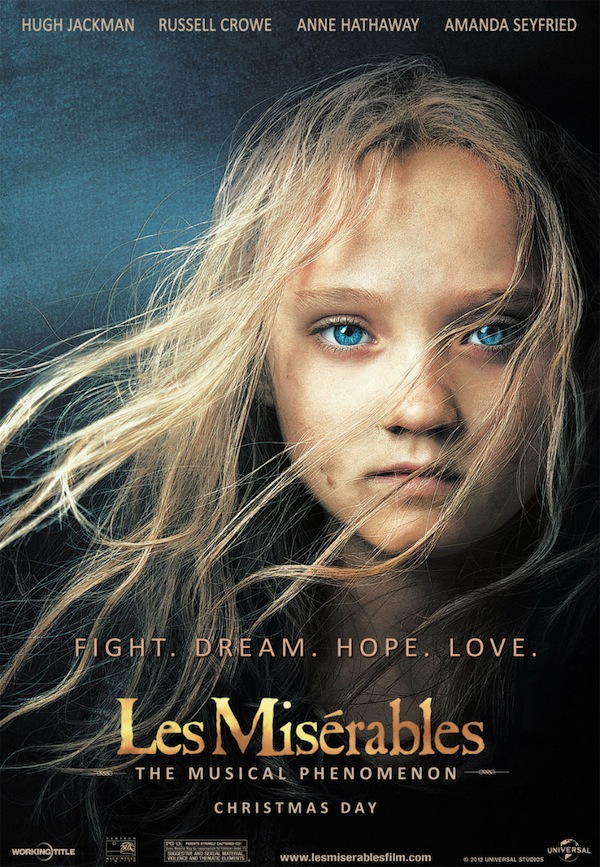
 I’ve just been to see Les Misérables and it seems the angst-ridden trailers that I’ve seen everywhere for this film would have been sufficient. It seems the marketers were given very little to work with and all the best bits of the film were used in the trailer, so there’s not really a need to pop along and see it.
I really hate to say it, but it’s the Australasians that let the film down (yes, New Zealand, when he does badly, Russell Crowe is a Kiwi; we’ll only claim him as an Aussie when he does well). Hugh Jackman is a little awkward but tolerable; the problem is that whenever he’s on screen, I’m seeing Hugh Jackman do Jean Valjean, rather than seeing Jean Valjean. The awkwardness with which he carries the role just undermines the suspension of disbelief.
I fully concur with those who have criticised the choice of Russell Crowe for the role of Javert. He is not entirely inappropriate, but it seems that although he can hold a tune, he can’t hold both a tune and a character at the same time. I believe he could have carried the character well enough were this not a sung-through musical, and I also have a feeling that there is scope for a film version of Les Misérables adapted to prose rather than the musical, which doesn’t really do the story any favours.
The film does have a few redeeming points, though. Whenever Anne Hathaway is on screen, I forget the awkwardness of Jackman and Crowe; she is engaging and poetic in every sense. Edward Redmayne is likewise convincing as Marius, and his chemistry with Amanda Seyfried‘s adult Cosette is palpable. Along with Isabelle Allen, these performers almost manage to redeem the film from the clunky performances of the two Australasians commanding the big dollars.
Whatever its faults, this film does one thing particularly well, in my opinion; while most productions that I’ve seen, whether for stage or screen, position Les Misérables as a quintessentially French story, this film sets the story amidst the mere backdrop of revolutionary France, allowing the characters greater autonomy from their political circumstances. It is my opinion that the story would sit just as well in front of any struggle for independence and liberty. It would be as at home before the Battle of the Chesapeake, the Eureka Stockade, the Myall Creek Massacre or Tiananmen Square, because the focus in this story is the journey of the individual characters within a particular political context. And of course, this being a story originally written by a Frenchman, its French context is de rigueur.
And perhaps that’s the big thing to learn from this rather expensive mistake of a film. What the world needs is an adaptation that takes the story of Les Misérables and depicts some fictional Aboriginal characters going through the same experience in the lead up to the Myall Creek Massacre… with prose dialogue to ram home the point. I’ll take that one. Anyone want to pick up Tiananmen Square?
- One of the more interesting posts I’ve seen is Why I walked out of Les Miserables (telegraph.co.uk)
- A particularly entertaining rant from The Movie Mind
- And for a bit of contrast, this person seems to have liked Les Misérables (2012) (canadiancinephile.com)
Tags: adaptation, Amanda Seyfried, Anne Hathaway, Edward Redmayne, Eureka Stockade, French Revolution, Hugh Jackman, Javert, Jean Valjean, Les Misérables, Myall Creek Massacre, Russell Crowe, Tiananmen Square, willing suspension of disbelief
 Few theatre-goers will struggle to relate to the experiences of bullying the protagonist of Fag Boy and the Married Guy recounts for audiences at La Mama over the next few days. This is a strongly developed story that explores – not terribly subtly – both bullying and the gay dating scene.
Now an adult living the dream with a great job, great house, and the means for a business-class tour of Europe apparently, William arranges a rendezvous with…
The rest of this post is published on Australian Stage.
Tags: Benji Groenewegen, bullying, La Mama, Matthew Candeland, Wayne Tunks
So my first venture into a theatre in 2013 ended better than it began. Have you ever tried to find King Street Theatre in Newtown? Talk about hidden away; it’s not even on King Street! But I made it, on time (which is more than can be said for some), and the hunt for the theatre turned out to be a real treasure hunt.
So this first week of Short+Sweet Sydney for 2013 started with a lot of energy. Pete Malicki’s Checkout is a little preachy perhaps, but nonetheless engaging and its four performers delivered Malicki’s strong characters with integrity, making for a strong start to the evening. I was impressed by Kerry Bowden’s monologue Handyman, which has forever given me a new (and improved) association for the Bunnings jingle. Emily Kivilcin hit just the right note between ditzy and cunning, which I’m not sure is a note I’ve ever heard before.
Miranda Drake delivered an impressive monologue also, and though its focus was a distinctly female experience, I was impressed with the manner in which it engaged male audients in the female perspective of the experience.
Though there was a lot to like, the two greatest moments came immediately before and after interval. The last play before interval was My Name is Cine-Ma, which was devised by Stray Factory and has been awarded in the Mumbai, Chennai and Kuala Lumpur Festivals. Taking the Bollywood tradition as its inspiration, this energetic piece focused on the story of a girl who was a little too obsessed with film. Somewhat reminiscent of the Chooky Dancers in flavour if not style, the exotic and prosaic sit hilariously side by side, which always tickles my fancy.
The Fox and the Hunter, though, is a truly inspired piece of theatre. Taking the mickey out of English sacred cows always gets me laughing (see what I did there?), but I think Simon Godfrey’s script is a work of pure genius, taking the moment when a clever fox meets the hunter who has pursued him for an eternity, and exploring just what happens when gentlemen and foxes engage in a truly meaningful dialogue. It rides splendidly on the talents of James Hartley as the pompous hunter and Tom Green, whose fox genuinely inspired the willing suspension of disbelief.
If you haven’t been to see Short+Sweet Sydney 2013 in week one, it’s too late and you’ve missed out, but don’t despair; there are several more weeks, including the presumably perfect week 4, when my play The Commuter gets another airing.
Tags: Ajay Ayyappan, Bollywood, Bunnings, Chennai, Chooky Dancers, Emily Kivilcin, James Hartley, Kerry Bowden, King Street Theatre, Kuala Lumpur, Mathivanan Rejendran, Miranda Drake, Mumbai, My Name is Cine-Ma, Newtown, Nikhil Sriram, Pete Malicki, Pooja Balu, Rajiv Rajaram, Short+Sweet, Simon Godfrey, Stray Factory, The Commuter, The Fox and the Hunter, Tom Green, Venkatesh Harinathan, willing suspension of disbelief
Whoa! Just when you think it’s safe to go to the theatre!
One thing needs to be said right up front: The Bird Man’s Wife is not a bedtime story. The Bird Man, for one thing, is not the pilot my mum sang to me about who had the penchant for flying upside down. And I think we can safely assume his wife is no Amelia Earhart, either!
Rachel Hogan’s psychodrama starts very slowly, but it heats up much like an Alfred Hitchcock film. The birds, however, are not the aggressors in this tangled web of psychoses. Drawn a little too deeply into a patient’s troubled and convoluted past, Doctor Walton (Adam Salter) finds himself embroiled in a web of deceit. His concern for his patient’s welfare drags him deeper into the futility, with tragic consequences.
The play explores a most interesting period in the history of psychotherapy, and questions the validity of many of our assumptions about mental health. Those with a stronger understanding of Freud may find themselves with something to argue about, but even for the ignoramus (yes, I fit this category, as, I suspect, did Freud himself) the theme is engaging and pertinent.
The exceptional cast of four is led by Alexandra Howard as Daphne, the bird man’s wife herself. The role is demanding and intense, and she carries it well. She is well accompanied by Phillip Meddows, whose dramatic intensity was fine, even if the pair needed a little more coaching in combat.
There is little I can say without divulging too much of the plot, but I found the play to be very engaging and well worth the excursion to Canberra’s far side… which is now even more deserving of that name for having hosted this play.
The Bird Man’s Wife closed in Belconnen tonight, but is said to be opening in Sydney in 2013. I haven’t been able to find the details, but if you like Lexx Productions’ page on Facethingy I’m sure you’ll hear about it in good time.
Tags: Adam Salter, Alexandra Howard, Alfred Hitchcock, Amelia Earhart, Belconnen, Bird, Canberra, Jess Waterhouse, Phillip Meddows, Rachel Hogan, The Bird Man's Wife
 Everyman Theatre has opened a fine production of a modern classic at the Courtyard.
The story of a group of impoverished friends struggling to make their name in New York under the shadow of HIV/AIDS, Rent is among the longest-running Broadway musicals, having been performed at the Nederlander Theatre from 1996 to 2008. Its historical significance (both social and theatrical) is great, and it is starting to show its age, with a few obscure lines now highlighting the changes that have come about in western society’s responses to HIV/AIDS and homosexuality in the last decade. It remains, however, a very poignant story, highly developed in character and plot; qualities that are extremely rare in musical theatre.
It can’t be denied that Rent is a big show. Nothing about it is intimate; its themes are as lofty as its music is histrionic. And its characters, while well-developed, are nonetheless representatives of archetypes more than they are individual personae. So to squeeze this vast musical into the Courtyard at the Canberra Theatre Centre is a curious choice. Perhaps it is the bite…
The rest of this post is published on Australian Stage.
Tags: Adrian Flor, AIDS, Alexander O'Sullivan, Amy Fitzpatrick, Chris Neil, Christine Pawlicki, Christopher Pappas, Dave Collins, Duncan Driver, Eliza Shephard, Everyman Theatre, James McPherson, Jarrad West, Jason Henderson, Joanna Licuanan, Jordan Kelly, Julia Jenkins, Kate Graham, Lachlan Ruffy, Laura Dawson, Louiza Blomfield, Marion West, Mathew Chardon O'Dea, Max Gambale, Musical theatre, Nathan Fernandez, Nathan Patrech, Nederlander Theatre, New York, Nick Griffin, Nick Valois, Nikki Fitzgerald, Nyasha Nyakuengama, Rent, Ronnie Flor, Sarah Pritchard, Sophie Stanton, Taimus Werner-Gibbons, Vanessa De Jager, Will Huang
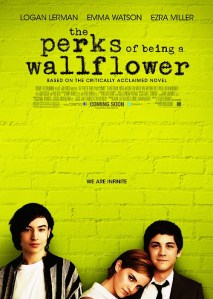 Stories can broaden your horizons or deepen your insight. Many of them fail to do either, and this is what I would call a dud movie, though my bar isn’t very high really; even Quantum of Solace broadened my horizons a little! It’s only occasionally that you encounter a story that so closely aligns with your own experience—whether in the abstract or in the literal sense—that you just find yourself completely immersed in it. I haven’t encountered it for some time, and I may have forgotten what it was like, because The Perks of Being a Wallflower just took my breath away.
The story of a quiet kid with a troubled past who finds the beginning of high school difficult is hardly new; in fact it’s just about as cliché as they come, but this film provides such a rich backstory and such expertly-developed characters that there is no sense of the cliché about it. It doesn’t take this Pollyanna approach that fools us into thinking that everything will be alright, but it still takes a glass-half-full sort of attitude to life’s dark periods.
The cast, led by an older-than-his-years Logan Lerman, are each one perfectly cast and wonderfully directed. Emma Watson shakes off completely the stain of Hermione Grainger and is the glue drawing attention back to the somewhat depressed protagonist. They are immersed in a world of 1990s grunge-esque culture that doesn’t allow any room for stereotypes without banning them altogether.
The nineties is something of a nondescript decade. Its specific characteristics are not instantly recognisable, and because of a slowed birth rate in developed countries in the 1970s, there are a relatively small proportion of us who think of it as our coming-of-age era, making it an unpopular choice for writers of historical fiction. The decade was characterised by a nervousness that resulted from financial downturns and shifting cultural values. This was the first decade when a critical mass of westerners came to see discrimination on the basis of race, sex, sexual orientation or political alignment as intolerable evils, and actually ceased to tolerate them. It was a time of flux, and as such, it defies the kind of definition and clarity the preceding decades enjoy. Add to that the prevailing winds of artistic expression and fashion being a postmodernism that borrowed and redefined aesthetics and oeuvres from the past century, and it really isn’t an easy time to narrow down. The Perks of Being a Wallflower is, I think, the first film made after the nineties that depicts the decade faithfully.
And how! I was 18 again. I felt like I knew these characters and belonged in these spaces. And there was nothing so distinctly American as to be foreign, which really is an achievement for an American film.
The Perks of Being a Wallflower hits that amazing balance of being perfectly mainstream in aesthetic, but with those deeper qualities of impeccable characterisation, a thoroughly engaging story, and a deep moral purpose. And not your deep-as-whale-poo kind of deep; deep like plays-your-heart-like-a-violin deep. Most American films find these qualities elusive, and it is a great relief to enjoy an American film that takes storytelling seriously.
Tags: Emma Watson, Ezra Miller, indie, Logan Lerman, Stephen Chbosky, The Perks of Being a Wallflower
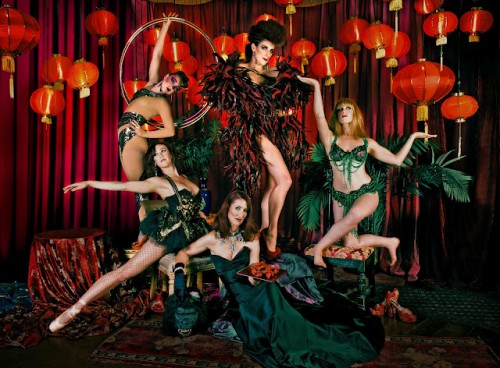
 Finucane and Smith’s Glory Box has one of those great titles that sits in front of a rather poorly-conceived production. I might have thought a more accurate description would be ‘Finucane and Smith’s Lucky Dip’, but that probably wouldn’t have drawn the crowds, would it?
I am unsure of the value of such performances as Finucane and Smith’s Glory Box. It seems to me I have just sat at the window of a room and looked in while a few people play dress ups and do silly little routines for no reason other than their own amusement. Apart from a couple of engaging performances, this really didn’t strike me as being a professional production at all. In fact, I wouldn’t even credit most of these performances as a worthwhile party trick without…
The rest of this post is published on Australian Stage.
- Canberra Critics Circle review
- Michelle Potter may have more insight into this than I!
- The Canberra Dilettante also posted on this one.
- Theatre People review (as staged at fortyfivedownstairs)
- Herald Sun review (as staged at fortyfivedownstairs)
Tags: Anna Lumb, antlers, balloons, burlesque, Cabaret, Maude Davey, Moira Finucane, party tricks, The Street Theatre
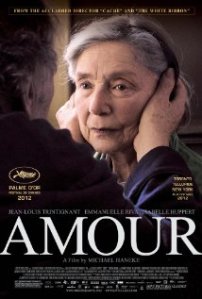 Amour probably won’t rate too highly on many people’s radars. It’s a little slow, the plot is a little controversial, but only if you have some knowledge of it, and it has no real pizazz to draw attention to itself. It doesn’t even draw you in terribly well, but nonetheless, I admire it deeply, and think it deserves more attention than it is likely to get.
As a film, it is strongest in what I think is one of the most important aspects of all films; it takes the transcendent, the metaphysical, the magic of life, and plonks it down into the stuff of life, the grit and grime of reality where it rubs up against a higher meaning, a sense of purpose.
We meet the protagonists as they attend a recital at a theatre on the Champs Elysée. The elderly couple speak to the pianist afterwards, and they are clearly on familiar terms. From here, they return home to what seems a humble but comfortable existence. The following day, the wife suffers a stroke, which paralyses her on her right side, and their world is slowly changed. In fact, the gradual decline of her condition sometimes lulls the audience into a false sense of security as the couple adapt and change to accommodate alterations. The change, however, doesn’t cease.
If ever there was a good reason to make a slow film, this is it. The gradation of the woman’s deteriorating condition is carefully crafted to draw your attention away from the inevitable. The couple simply carry on with life and take control of whatever they can take control of.
I really wish more films were like this. There is no reason to divorce the transcendent from the prosaic, and here where they coexist they say something that few other mediums could put so eloquently. If the opportunity arises, see this film.
Tags: Emmanuelle Riva, France, French, Jean-Louis Trintignant, Love, Michael Haneke, Paris, prosaic, transcendent
 Sometimes a film starts out poorly, but improves out of sight by the end of the exposition. Such a film is Sightseers, which begins with an elderly woman making a miserable groaning sound for several minutes, while her daughter tries to get her attention. None too quickly the horrible old woman is removed from the scenario as her misfit of a daughter and her equally awkward boyfriend pack a caravan and head off.
I must admit one thing that drew me to this film was the idea of Brits taking a caravanning holiday. I have always been curious to know the whys and wherefores of using a caravan to explore such a tiny island, and if there’s anyone out there with the same idea, I can tell you I have gained no insight into the phenomenon from watching this film.
What I did gain was a fantastically funny and gory 95 minutes. It was a little like a Tarantino film without all the corny one liners that really don’t work. And unlike a Tarantino film, it had characters. Real characters, with feelings and depth and backstories that you could only guess at. In some ways it was a bit like Shakespeare without the superfluous repetition, which of course brings us to the blood faster.
No, Sightseers is definitely not for children (not even my children!). It has one of the most hideous scenes of human mutilation I’ve ever seen in a film; and even this one has that wonderful capacity to combine gore and humour in the one image.
Don’t bother with Sightseers if you’re a little squeamish, but if you like a bit of blood with your humour, this is the film you’ve been waiting for.
Tags: Alice Lowe, Ben Wheatley, Canberra International Film Festival 2012, CIFF, Sara Stewart, Seamus O'Neill, Sightseers, Steve Oram
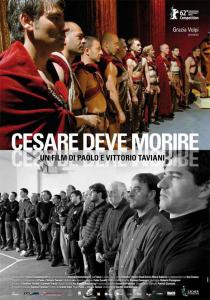 Well my first venture out into the 2012 Canberra International Film Festival was a little disappointing. Cesare Deve Morire (Caesar Must Die) was interesting, but I think it fails to stand as a cohesive whole, stumbling rather awkwardly from scene to scene.
The film follows a group of inmates from Rebibbia prison in Rome staging Shakespeare’s Julius Caesar. The inmates are introduced by their names, date of birth, sentence and crime before the play is cast, and we follow them through auditions, rehearsals and their performance.
Though it has its moments, and the performance itself appears compelling, I just didn’t find that connection that good films bring about with their characters. The film is slow, which can be tolerable, but a slow film shouldn’t lack detail. I really didn’t feel I got to know these characters, and when the credits rolled, I just felt it was about time.
I’m hoping for a better result from tomorrow’s CIFF films.
Tags: Caesar Must Die, Canberra International Film Festival 2012, CIFF, Cosimo Rega, Giovani Arcuri, Julius Caesar, Paolo and Vittorio Taviani, Rebibbia, Rome, Salvatore Striano, William Shakespeare
 This post is coming all the way from Singapore, where I’m holidaying! And it has been a feast for the senses. While food is high on my list of reasons for visiting this amazing little island, I have heard good things about theatrical activities here for some time. When I checked my dates, however, I found very little to whet my appetite. What I did eventually find was an interesting piece produced by a Peranakan community organisation to explore how a traditional theatrical style works in modern Singapore.
First, I might digress a little to put some cultural context around this. Singapore’s Peranakan community is a Chinese cultural group within Singapore’s amazing cosmopolitan microcosm. They constitute a sizeable
proportion of the population, and are otherwise known as the Straits Chinese, as they descend from Chinese migrants to the Straits Colonies of Indonesia, Singapore and Malaysia during the colonial era.
I would also like to make the point before expressing my opinion on this play that there is much that I will have missed or failed to understand because I am not familiar with the particular theatrical tradition this play
flows from. This is also the first time I have been to theatre anywhere in Asia, and I may be influenced by irrelevant Australian expectations. Much of the audience talked about the play as it was being performed, which I would have expected to draw the odd tsk tsk from an Australian audience, but it seemed natural here, and after a little time it didn’t even bother me. It may be a Singaporean tradition (my theatre history reminds me that in the period in which the English dominated Singaporean social life, talking in British theatres was likewise acceptable; perhaps this didn’t change in Singapore?). It is also worth noting that as I do not understand any
Mandarin, Malay, or Patois Peranakan, I was dependent on the subtitles through much of the play.
The play itself is probably not a masterpiece. Written by local Peranakan teacher, Victor Goh Liang Chuan, it is an attempt to modernise a long-standing Peranakan theatrical tradition that the student of British Theatre might recognise as having much in common with the Well Made Play. A core element of this tradition, however, is humour, and even this ignorant Aussie found much to laugh at in this production.
The story is readily relatable. Madam Tay has raised two sons and a daughter since the death of her husband, and in adulthood feuds break out. The eldest son isn’t the sharpest tool in the shed, the next son is clever but
disloyal, and the daughter, though a university graduate, is waiting for the right job to find her while she freeloads off her mum. With two daughters in law to contend with and the area’s busiest busybody for a best friend, it is only a matter of time before the stress of life puts Madam Tay into hospital.
I’m sure I’ve seen something like this on the SBS.
The plot is predictable, and the characters very thinly drawn, but the performers do a great job with what little they have to work with. There is something very genuine and heart warming in this production, and it may just
flow from the oddity of having the audience chatter through the whole play. I felt at the end that I’d just spent a couple of hours amongst a true community. And I’d tolerate the silliness of the whole thing to be a part of
it again.
Tags: Alvin Teo, Ameline Goh, Asia, Audrey Tan, Christina Wee, Frederick Soh, Jessie Cheang, Lee Yong Ming, Malaysia, Mandarin, Peranakan, Shirley Tay, Singapore, Theatre, Tony Quek, Victor Goh Liang Chuan
 Theatre 3 has seen some fine productions over the years, but few of the calibre of of Rep’s current production of Neil Simon‘s Lost in Yonkers, the preview for which I saw tonight.
Lost in Yonkers is apparently a well-known play, which simply reveals my ignorance, because I’d never heard of it until I heard about Rep’s production. It’s the story of two brothers left with their cantankerous grandmother when their recently-widowered father has to go on the road to repay the debts incurred in the course of losing his wife to cancer. The Second World War being underway, and the Great Depression just barely relegated to memory, opportunities are few, but the loyalty of this barely functional family forms a great basis for Simon’s exploration of human relationships.
And the cast delivers Simon’s characters with aplomb. Lachlan Ruffy has received more than a few compliments for his theatrical activities, and this production demonstrates how well-deserved they are. His performance of Jay strikes a careful balance between the impetuousness of childhood and the control of a maturing adolescent. He is complemented wonderfully by Pippin Carroll, who plays the younger brother Arty with a comparable balance of naivety and wisdom beyond his years.
Bridgette Black’s Bella brought a lot of energy to the stage throughout the show, and with just the right amount of pathos to be able to carry off her more intense monologues as the plot reached its crescendo, without losing anything from the character’s comic qualities.
It is the illusion of ease with which the play is delivered that really stamps this as a production of the highest calibre. There is no point at which the actors appear to be labouring, which of course indicates that they’re working harder than most do. This production has that wonderful quality that marks all the best productions; a simple, forthright telling of a story, with nothing to draw our attention to the artifice of the theatrical process. It puts the audience at ease and creates exactly the right environment for the suspension of disbelief.
One of the noteworthy elements that goes into producing this effect with this production is the use of the New York accent. One of the most difficult American accents for Australians to emulate, this cast have pulled it off admirably. Even Paul Jackson, who may be thought to have had a head start on the accent, must have worked hard to get his gangster right. Despite a few slips of pronunciation from one or two members of the cast, the greatest achievement here is the uniformity of the accent across the cast, which is, when using foreign accents on stage, more important that accurate emulation from any individual actor. And when it comes to the use of foreign accents on the Canberra stage, I’ve rarely been convinced; this may be only the second or third Canberra cast who have caused me to forget that they’re a bunch of Australians bunging on an accent.
Lost in Yonkers is a solid production; one of the very best I’ve seen on the Canberra stage in my (almost) fifteen years in this town. Brilliant performances, superb direction, a great set, clever lighting and Neil Simon’s excellent script make for a laudable production. The rule here is, see this show, or forfeit the right to speak with any authority on the quality of theatre production in Canberra. That is all.
- Lost in Yonkers by That Guy who Watches Canberra Theatre
- Comedy with a serious side review by Helen Musa, City News
Tags: Amber Spooner, Andrew Kay, Angela Punch-McGregor, Ashlyn Maloney, Bridgette Black, Colin Milner, Daniel Maloney, Dot Russell, Elaine Noon, Greg Bateman, Helen Vaughan-Roberts, Irene Ussenko, John Gieroszynski, Jonathan Pearson, Lachlan Ruffy, Megan Skillicorn, Michael F Coady, Mike Maloney, Monica Bird, Naoné Carrel, Paul Jackson, Pippin Carroll, Ryan Tyler
 A spritely script and punchy performances made for an engaging opening night for Chris Aronsten’s The Lunch Hour.
This funny play centres on the strained relationship between a group of co-workers in a ticketing agency’s call centre and their boss Martin, a hapless victim of middle management. In the first act we see the staff doing everything they can to frustrate Martin by avoiding actually answering calls while procrastinating about their covert collective effort at writing a play lampooning their longsuffering boss for…
The rest of this post is published on Australian Stage.
Tags: Angela Bauer, Ash Bee, Bali Padda, Branden Christine, Briallen Clarke, Charli Dugdale, Chris Aronsten, Daryl Wallis, Diego Retamales, Gerry Sont, Kate Gaul, Kirby Burgess, Liz Arday, Lizzie Gibney, Luiz Pampolha, Shaun Rennie, Siren Theatre Company, Sonny Vrebac

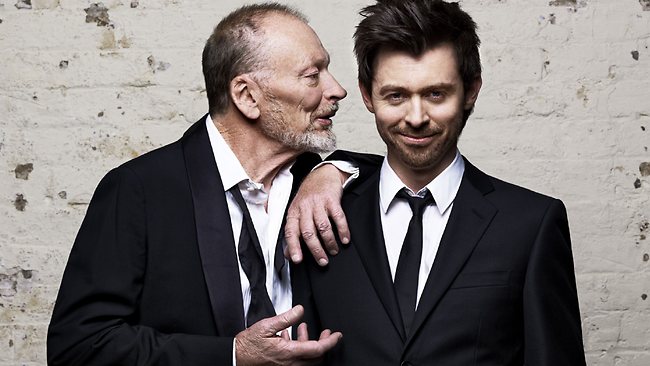 A post-industrial landscape meets a little Brit kitsch in Bell Shakespeare’s latest work to grace the stage of Canberra’s Playhouse. Opening with the dissonance of early Brit Rock and the destruction of a massive Union Jack (a very pleasing sight), Bell’s Henry IV is young, pithy and full of the muck, mire and joy of life.







 Foyer Talk