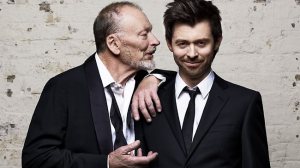
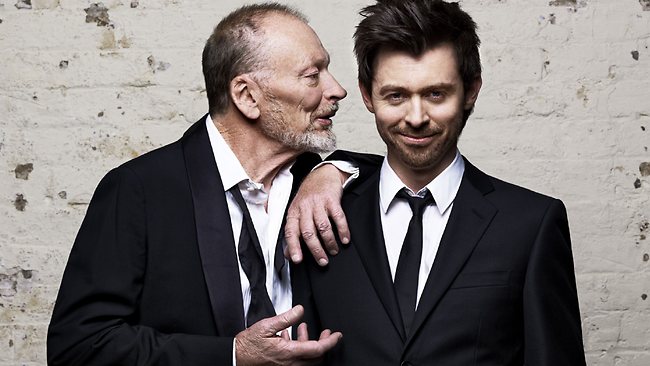
 An enthusiastic audience welcomed Bruce Hoogendoorn’s latest play to the Courtyard Theatre tonight. A simple but effective comedy, The Reluctant Shopper kept its audience engaged and the laughs rolling freely.
Faced with the grim news that consumers aren’t spending, the local business council engages the services of Barry to blackmail one of the city’s more wealthy citizens, Sam, to spend his ill-gotten but sizable nest egg in their members’ businesses. In the course of this task, Barry manages to set Sam up with shopaholic Lisa, and the two find they have complementary interests: Lisa likes spending money, and Sam has a lot of money…
The rest of this post is published on Australian Stage.
Tags: Brendan Kelly, Bruce Hoogendoorn, Elaine Noon, Kimberley Balaga, Rob de Fries
 Mary Shelley’s Frankenstein is not conventionally what we might refer to as a timeless work of literature. It is clearly a product of its time, fashioned from the particular obsessions of its age and demonstrating the changing view of science that characterised the early nineteenth century. It is true that the themes of Frankenstein have made it relevant through the generations, but Nick Dear’s script is a sublime theatrical blueprint that draws the focus to those themes that truly resonate in our age.
Lee Jones tackles the role of Frankenstein’s creation with an amazing energy. He approaches a long exposition with no dialogue beautifully and shows the growth and development of a man born as an adult reasonably well. There are perhaps some timing issues with this as the ebb and flow of his development seems somewhat curtailed…
The rest of this post is published on Australian Stage.
- That Guy Who Watches Canberra Theatre was mildly impressed
- Frank McKone was keen to tell us how old he is while praising Dear
- and Ron Cerabona explores the context
Tags: Andrew Henry, Arts, Brian Meegan, Frankenstein, gothic, Heather Stratfold, Katie Fitchett, Lee Jones, Literature, Mark Kilmurray, Mary Shelley, Mary Shelley Frankenstein, Michael Rebetzke, Michael Ross, Nicholas Higgins, Nick Dear, Olivia Stambouliah, Simone Romaniuk
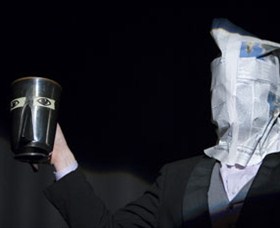
 Those who enjoy a good lecture will be decidedly disappointed by this seminar on classic Shakespearean plots. Those who detest a good lecture, however, should be tickled pink by the Professor’s quirky wit and humour, and his delightful playfulness with improvised puppets.
The Professor introduces himself as he enters the auditorium. One audient at a time. That is, until he realises just how many audients there are…
The rest of this post is published on Australian Stage.
Tags: Black Hole Theatre, Compagnie Chemins de Terre, pork roast, puppets, Stéphane Georis, The Australian, William Shakespeare
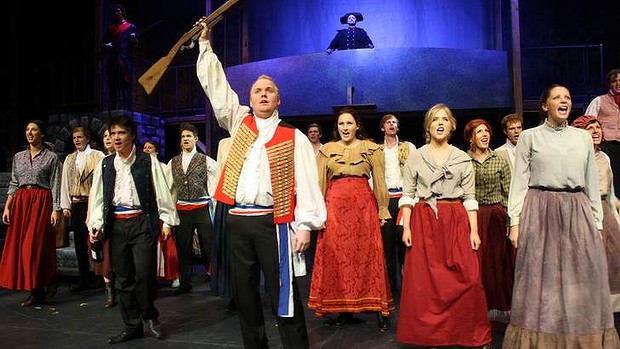
 Just quietly, I think Canberra Philharmonic have outdone themselves with their latest rendering of a classic musical. I mean, it’s nothing terribly innovative, the staging is much what you’d expect for any other rendition of Les Misérables, and the set, while pleasant, goes through a few clunky moments. But the performances drawn out of these ‘amateur’ performers is nothing short of spectacular.
Dave Smith’s Valjean is a perfect match for Adrian Flor’s Javert, and the two milk Schönberg and Boulbil’s book for every hyper-sentimental note it’s worth. Their energy and focus, while admirable, is upstaged by other principals, particularly Kelly Roberts’ Fantine, Mat Chardon O’Dea’s Marius, Laura Dawson’s Cosette and Vanessa de Jager’s Eponine. Their energy filled Erindale’s cavernous auditorium, and they must be finding the run absolutely gruelling. The rest of the cast are pretty impressive too, on the whole.
I found the performance on the whole moving, and the staging, while predicable, was solid. The orchestra, though it needed to be hidden under a fully extended stage, was in fine form.
The whole evening hangs together beautifully, as evidenced by the full standing ovation with which this late-run audience honoured the splendid cast and crew. This is a great night out, and you’ve got one more week in which to get along and see it.
- Bill Stephens’ review on Canberra Critics Circle
- Alanna Maclean’s review from the Crimes
Tags: Adrian Flor, Amos Walker, Andrew Spence, Éponine, Boulbil, Casey Tucker, Casey White, Clare Pinkerton, Cosette, Dave Smith, Evan Kirby, Fantine, Grant Pegg, Greg Hood, Greg Sollis, Ian Croker, James Court, Javert, Jim McMullen, Kaitlyn Nihill, Kate Gordon, Kate Tricks, Kelly Roberts, Lachlan Ruffy, Laura Dawson, Les Misérables, Mathew Chardon O'Dea, Matthew Tallarida, Miranda Cookman, Peter Karmel, Peter Rodda, Richard Block, Schönberg, Valjean, Vanessa De Jager, Will Collett, Will Huang, Zach Dowse
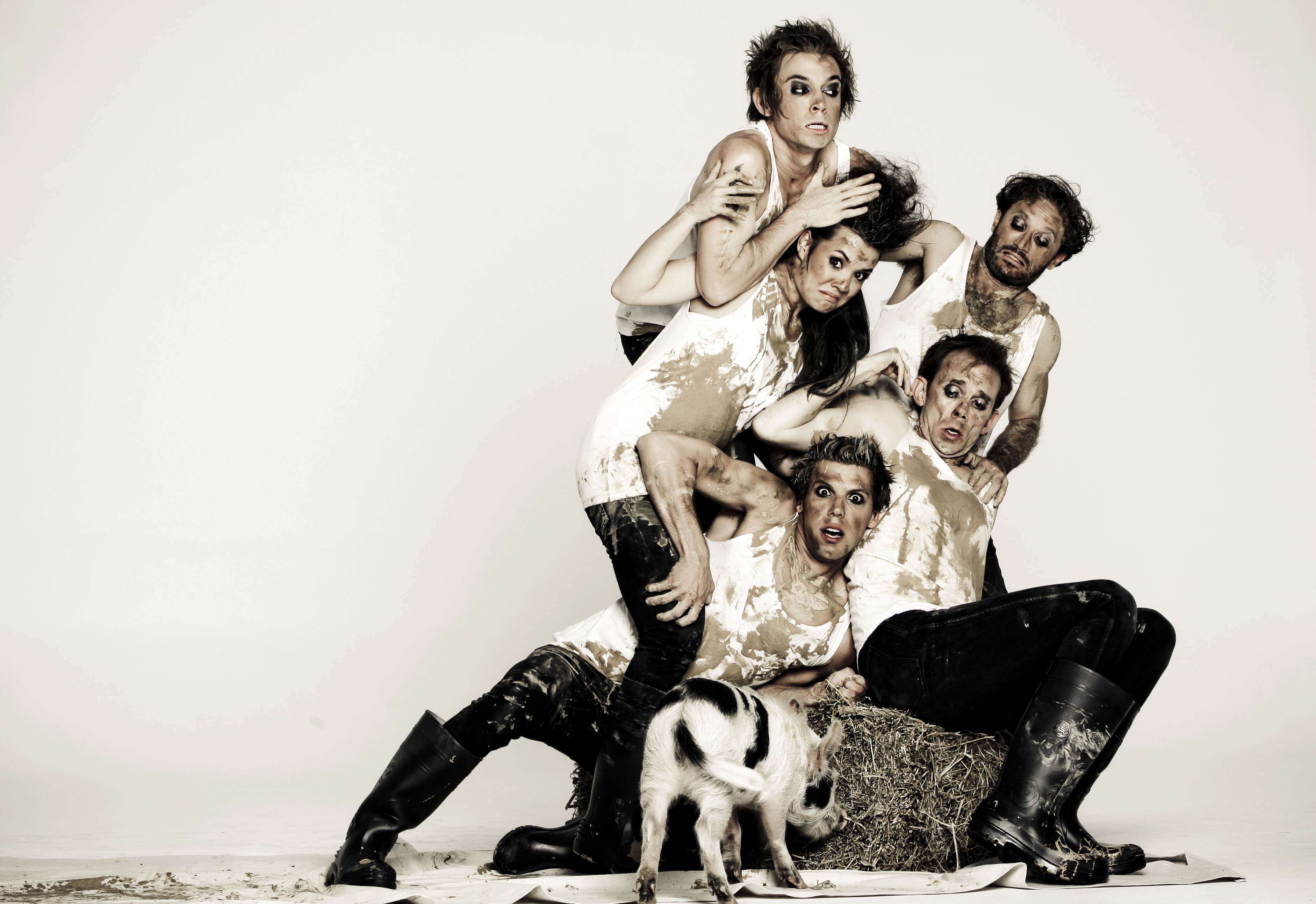
 Playing far too short a season at the Queanbeyan Performing Arts Centre, Shake & Stir’s Animal Farm is a remarkable piece of theatre. Adapting George Orwell’s Animal Farm is something that would intimidate most playwrights, but the three cast members who pulled this amazing work together have handled the challenge with amazing dexterity, delivering a performance that is intensely theatrical, deeply engaging and absolutely essential.
For those who, like me, deftly avoided reading Animal Farm in high school, the basic premise is that the animals on an English farm stage an uprising, overthrow the farmer, and establish a system of governance to allow the farm to continue to produce food for the benefit of the animals, rather than their former master. In this new order, the leaders slowly increase in greed and the other animals find themselves no better off.
Originally written in the context of twentieth century fears…
The rest of this post is published on Australian Stage.
Tags: Animal Farm, Bryan Roberts, George Orwell, Guy Webster, Jason Glenwright, Josh McIntosh, Michael Futcher, Nelle Lee, Nick Skubij, Performing arts, Ross Balbuziente, Shake & Stir, The Q, Tim Dashwood
 A post-industrial landscape meets a little Brit kitsch in Bell Shakespeare’s latest work to grace the stage of Canberra’s Playhouse. Opening with the dissonance of early Brit Rock and the destruction of a massive Union Jack (a very pleasing sight), Bell’s Henry IV is young, pithy and full of the muck, mire and joy of life.
Not one of Shakespeare’s better-known plays, Henry IV, which was written in two parts but is here presented by Bell in one, tells the story of King Henry IV’s efforts to restabilise his kingdom and rein in his recalcitrant son and heir. Led astray by the inimitable Falstaff, Prince Hal confides…
The rest of this post is published on Australian Stage.
- Ron Cerabona’s view, as published in the Canberra Times and the Age
- John McCallum drools a little over JB, less so over Matthew Moore, published in The Australian
- Frank McKone articulates his disappointment with the production, over on Canberra Critics Circle
- The Barefoot Review by Deborah Hawke
Tags: Arky Michael, Bell Shakespeare, Ben Wood, Canberra, David Whitney, Falstaff, Felix Jozeps, Henry IV, Henry V, Jason Klarwein, John Bell, Kelly Ryall, King Henry, Matilda Ridgeway, Matt Scott, Matthew Moore, Nathan Lovejoy, Prince Hal, Scott Witt, Sean O'Shea, Stephen Curtis, Terry Bader, Tony Llewellyn-Jones, Wendy Strehlow, William Shakespeare, Yalin Ozucelik
Whoa! Just when you think it’s safe to go to the theatre!
One thing needs to be said right up front: The Bird Man’s Wife is not a bedtime story. The Bird Man, for one thing, is not the pilot my mum sang to me about who had the penchant for flying upside down. And I think we can safely assume his wife is no Amelia Earhart, either!
Rachel Hogan’s psychodrama starts very slowly, but it heats up much like an Alfred Hitchcock film. The birds, however, are not the aggressors in this tangled web of psychoses. Drawn a little too deeply into a patient’s troubled and convoluted past, Doctor Walton (Adam Salter) finds himself embroiled in a web of deceit. His concern for his patient’s welfare drags him deeper into the futility, with tragic consequences.
The play explores a most interesting period in the history of psychotherapy, and questions the validity of many of our assumptions about mental health. Those with a stronger understanding of Freud may find themselves with something to argue about, but even for the ignoramus (yes, I fit this category, as, I suspect, did Freud himself) the theme is engaging and pertinent.
The exceptional cast of four is led by Alexandra Howard as Daphne, the bird man’s wife herself. The role is demanding and intense, and she carries it well. She is well accompanied by Phillip Meddows, whose dramatic intensity was fine, even if the pair needed a little more coaching in combat.
There is little I can say without divulging too much of the plot, but I found the play to be very engaging and well worth the excursion to Canberra’s far side… which is now even more deserving of that name for having hosted this play.
The Bird Man’s Wife closed in Belconnen tonight, but is said to be opening in Sydney in 2013. I haven’t been able to find the details, but if you like Lexx Productions’ page on Facethingy I’m sure you’ll hear about it in good time.
Tags: Adam Salter, Alexandra Howard, Alfred Hitchcock, Amelia Earhart, Belconnen, Bird, Canberra, Jess Waterhouse, Phillip Meddows, Rachel Hogan, The Bird Man's Wife
 Everyman Theatre has opened a fine production of a modern classic at the Courtyard.
The story of a group of impoverished friends struggling to make their name in New York under the shadow of HIV/AIDS, Rent is among the longest-running Broadway musicals, having been performed at the Nederlander Theatre from 1996 to 2008. Its historical significance (both social and theatrical) is great, and it is starting to show its age, with a few obscure lines now highlighting the changes that have come about in western society’s responses to HIV/AIDS and homosexuality in the last decade. It remains, however, a very poignant story, highly developed in character and plot; qualities that are extremely rare in musical theatre.
It can’t be denied that Rent is a big show. Nothing about it is intimate; its themes are as lofty as its music is histrionic. And its characters, while well-developed, are nonetheless representatives of archetypes more than they are individual personae. So to squeeze this vast musical into the Courtyard at the Canberra Theatre Centre is a curious choice. Perhaps it is the bite…
The rest of this post is published on Australian Stage.
Tags: Adrian Flor, AIDS, Alexander O'Sullivan, Amy Fitzpatrick, Chris Neil, Christine Pawlicki, Christopher Pappas, Dave Collins, Duncan Driver, Eliza Shephard, Everyman Theatre, James McPherson, Jarrad West, Jason Henderson, Joanna Licuanan, Jordan Kelly, Julia Jenkins, Kate Graham, Lachlan Ruffy, Laura Dawson, Louiza Blomfield, Marion West, Mathew Chardon O'Dea, Max Gambale, Musical theatre, Nathan Fernandez, Nathan Patrech, Nederlander Theatre, New York, Nick Griffin, Nick Valois, Nikki Fitzgerald, Nyasha Nyakuengama, Rent, Ronnie Flor, Sarah Pritchard, Sophie Stanton, Taimus Werner-Gibbons, Vanessa De Jager, Will Huang
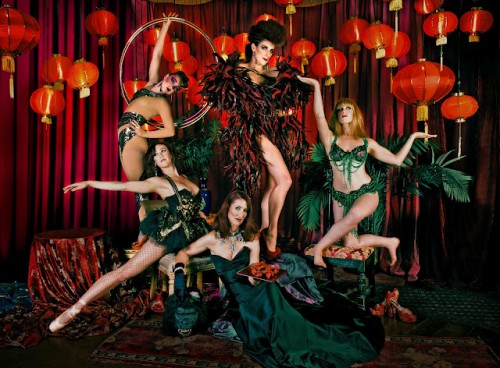
 Finucane and Smith’s Glory Box has one of those great titles that sits in front of a rather poorly-conceived production. I might have thought a more accurate description would be ‘Finucane and Smith’s Lucky Dip’, but that probably wouldn’t have drawn the crowds, would it?
I am unsure of the value of such performances as Finucane and Smith’s Glory Box. It seems to me I have just sat at the window of a room and looked in while a few people play dress ups and do silly little routines for no reason other than their own amusement. Apart from a couple of engaging performances, this really didn’t strike me as being a professional production at all. In fact, I wouldn’t even credit most of these performances as a worthwhile party trick without…
The rest of this post is published on Australian Stage.
- Canberra Critics Circle review
- Michelle Potter may have more insight into this than I!
- The Canberra Dilettante also posted on this one.
- Theatre People review (as staged at fortyfivedownstairs)
- Herald Sun review (as staged at fortyfivedownstairs)
Tags: Anna Lumb, antlers, balloons, burlesque, Cabaret, Maude Davey, Moira Finucane, party tricks, The Street Theatre
 Theatre 3 has seen some fine productions over the years, but few of the calibre of of Rep’s current production of Neil Simon‘s Lost in Yonkers, the preview for which I saw tonight.
Lost in Yonkers is apparently a well-known play, which simply reveals my ignorance, because I’d never heard of it until I heard about Rep’s production. It’s the story of two brothers left with their cantankerous grandmother when their recently-widowered father has to go on the road to repay the debts incurred in the course of losing his wife to cancer. The Second World War being underway, and the Great Depression just barely relegated to memory, opportunities are few, but the loyalty of this barely functional family forms a great basis for Simon’s exploration of human relationships.
And the cast delivers Simon’s characters with aplomb. Lachlan Ruffy has received more than a few compliments for his theatrical activities, and this production demonstrates how well-deserved they are. His performance of Jay strikes a careful balance between the impetuousness of childhood and the control of a maturing adolescent. He is complemented wonderfully by Pippin Carroll, who plays the younger brother Arty with a comparable balance of naivety and wisdom beyond his years.
Bridgette Black’s Bella brought a lot of energy to the stage throughout the show, and with just the right amount of pathos to be able to carry off her more intense monologues as the plot reached its crescendo, without losing anything from the character’s comic qualities.
It is the illusion of ease with which the play is delivered that really stamps this as a production of the highest calibre. There is no point at which the actors appear to be labouring, which of course indicates that they’re working harder than most do. This production has that wonderful quality that marks all the best productions; a simple, forthright telling of a story, with nothing to draw our attention to the artifice of the theatrical process. It puts the audience at ease and creates exactly the right environment for the suspension of disbelief.
One of the noteworthy elements that goes into producing this effect with this production is the use of the New York accent. One of the most difficult American accents for Australians to emulate, this cast have pulled it off admirably. Even Paul Jackson, who may be thought to have had a head start on the accent, must have worked hard to get his gangster right. Despite a few slips of pronunciation from one or two members of the cast, the greatest achievement here is the uniformity of the accent across the cast, which is, when using foreign accents on stage, more important that accurate emulation from any individual actor. And when it comes to the use of foreign accents on the Canberra stage, I’ve rarely been convinced; this may be only the second or third Canberra cast who have caused me to forget that they’re a bunch of Australians bunging on an accent.
Lost in Yonkers is a solid production; one of the very best I’ve seen on the Canberra stage in my (almost) fifteen years in this town. Brilliant performances, superb direction, a great set, clever lighting and Neil Simon’s excellent script make for a laudable production. The rule here is, see this show, or forfeit the right to speak with any authority on the quality of theatre production in Canberra. That is all.
- Lost in Yonkers by That Guy who Watches Canberra Theatre
- Comedy with a serious side review by Helen Musa, City News
Tags: Amber Spooner, Andrew Kay, Angela Punch-McGregor, Ashlyn Maloney, Bridgette Black, Colin Milner, Daniel Maloney, Dot Russell, Elaine Noon, Greg Bateman, Helen Vaughan-Roberts, Irene Ussenko, John Gieroszynski, Jonathan Pearson, Lachlan Ruffy, Megan Skillicorn, Michael F Coady, Mike Maloney, Monica Bird, Naoné Carrel, Paul Jackson, Pippin Carroll, Ryan Tyler
Week 2 of the Short+Sweet Top 20 began in a very different fashion from the usual festival, with Joe Woodward sitting in a bath wearing a pair of angel’s wings and philosophising about the great question. It was a great start to a great evening of theatre, and I’ll admit I did get a little sentimental.
Short+Sweet really lends itself to great moments. The performance quality varies and the scripts are incredibly diverse, but even when the plays don’t live up to what you might hope for, there is often something that emerges statue-like from the stack. It puts me in mind of Patrick White’s metaphor of a squirming mass of eels from The Ham Funeral (if you haven’t read it, do yourself a favour).
Some moments are hilarious, and others are poignant, but in my mind they end up in a montage that makes me feel like I’ve witnessed a single, epic masterpiece. It’s those transcendent moments that make the trivial meaningful.
Ruth Pieloor’s caricature of the prime minister in For the Love of Their Country might have been the performance of the festival. Often I use the word caricature to denigrate sub-par performances, but Pieloor’s observance, emulation and emphasis of Julia Gillard’s mannerisms and very unique vocal qualities was identifiable, amusing and wonderfully distinct. It was caricature of the highest order, which is very difficult to achieve in live theatre.
I was similarly impressed by one of my former classmates from the ANU, Sam Hannan-Morrow, in The Brett I Haven’t Met. Simon Tolhurst could have directed his script in a very different way, with more direct action (as I understand it had been done in The Logues), but it would have lost the raw engagement with the audience that Hannon-Morrow was able to deliver.
There were a few moments, though, when I just wanted to get up and fix things. I loved Remy Coll and Sam Floyd’s concept for Insecurity Guard, and despite a couple of points where the dialogue didn’t quite carry the action, it has a pretty good script, but it really needed a director who wasn’t on stage. These two vey talented performers managed very well, but they needed that extra punch of clarity that an observing director provides.
There is no question that the final moment of the festival, the performance of Genevieve Kenneally’s Ah! was an inspired choice for that particular slot. The energy of Kiki Skountzos, Riley Bell and Elizabeth McRae was precisely what was needed at the end of such a varied night, but the highlight in my book was Smart Jimmy Slow Bob. Greg Gould’s great script was brilliantly delivered by a spectacular cast (Bradley Freeman as the unconscious boy was particularly impressive, I didn’t detect a breath!).
Everyone involved in this festival deserves a pat on the back, not just those I’ve tapped out some words about. Short+Sweet is a unique event in the annual calendar, and I hope it’s a permanent one. What impresses me is where the different people involved in the festival come from. Theatre folk whose paths don’t cross find themselves in the same dressing room for four nights in a row, and that can only be good for our theatre community. And of course with opportunities for those who prefer pure theatre to musical theatre dwindling, it is a particularly important event.
I have two scripts finished (at least to first draft stage) for the 2013 festival, and I hope the wonderful people who made this festival such a great success are around next year.
- Short + Sweet, courtyard studio from That Guy Who Watches Canberra Theatre
- Short & Sweet Canberra Final from the Canberra Dilettante
Tags: Bradley Freeman, Bruce Hoogendoorn, Canberra, Elizabeth McRae, Genevieve Kenneally, Greg Gould, Joe Woodward, Julia Gillard, Kiki Skountzos, Musical theatre, Patrick White, Remy Coll, Ruth Pieloor, Sam Floyd, Sam Hannan-Morrow, Simon Tolhurst, Theatre
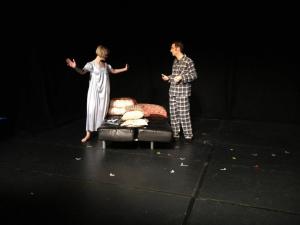
Connie challenges Charlie in ‘The Fence’
Last night I had one of those moments. You know, when something you’ve been working on for a while has come to fruition and is about to end. Theatrical folk do tend to go a little over-the-top experiencing these moments, but it is genuinely sad when you see a cast perform a show you’ve been working on for the last time.
So it was with The Fence and The Commuter in this year’s Short+Sweet. I didn’t realise until just before the lights went up on The Fence for the last time that it was the last time I’d see it. And then I realised it would be the last time I’d see them too (even if they get into the final next Saturday, I can’t be there because of a family commitment). For me they were the culmination of five or so pretty intense weeks of casting, rehearsing, preparing, and of course lots of laughing.
The cast I worked with on The Fence was just great. They were extremely committed to the show, so when the Murphy’s Law of Theatre (that if anybody can get sick s/he will) took effect, it was great to see the cast rally around, make changes to the schedule as necessary and finally plough right on through. The actor in question, Tony Marziano, was a trooper and a director couldn’t have asked for more in terms of commitment and effort, and the result was great. Katarina Thane gave a lot to the role of Connie, and I was so pleased to see the vision I had of this kind of suburban Lady Macbeth realised. And it was great to be able to catch up with an old uni friend, Arne Sjostedt, who played the neighbour, John, with great humour.
I hope it did justice to the writer’s vision. It was difficult to have to ask Coralie Daniels, the playwright, if we could cut the script when we found we were quite significantly over the ten minute time limit. The cuts we finally made did make a significant difference to the play’s reference points, but they gave us a stronger ending, and of course brought us within cooee of the time limit. My last play in Short+Sweet, Mr Fixit, was found to be significantly over the time limit, and the cuts were quite brutal. Not so with The Commuter, which I carefully restricted to seven pages (though it still comes close).
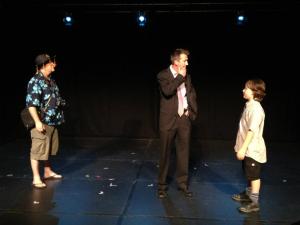
The Commuter deals with a strange kid and an American tourist.
I will never get tired of seeing characters that started as a vague image in the dark recesses of my mind come to life on stage. Arne was in this one too, bringing my American tourist to life, and young Henry Maley made a great precocious eight-year-old, with Gabriel Strachan as his aggressively protective mother. But of course it all came down to Simon Clarke’s portrayal of the commuter himself, and I was very pleased that he didn’t turn out to be either too ocker, or in any way a bleeding heart. This character could be portrayed in many ways, and I was really pleased with how closely Simon aligned the character to my vision.
The calibre of plays being performed in this week’s Short+Sweet really is impeccable. I was a little surprised, to be honest, having read Gerry Greenland’s script for Driving the Holden, with how well it translated to the stage. Sometimes you just don’t see the characters in reading the play, and Lis Shelley’s direction has served Dan Holliday and Nick Foong’s efforts well in bringing this story to life. It’s a very strong start to the festival. On opening night, it was disappointing to see the cast of A Short History of Weather drop a line in the middle of their otherwise impeccable performance, and I was so pleased to see the play again last night without the cicadas. They deserve an encouragement award for powering on, especially since the result last night was so effective.
But I think the play to fear in week one is definitely Spit for Tat. The sight gag of lovers spitting water all over each other is funny enough, but performers Scott Rutar and Caroline Simone O’Brien have backed it up with stellar performances that demonstrate some fantastic character development. Despite the somewhat fanciful nature of the script, they’re completely believable in every moment, and deliver what for my money is the standout performance of week one.
Short+Sweet has been a lot of fun, and I’m so glad I managed to participate this year. The Commuter will be available on my scripts page in a day or two, but it’s better to see it than read it, and unless the judges choose it for the Gala Final, tonight’s your last chance!
- The Fast and the Fabulous by Arne Sjostedt, Canberra Times
- Short+Sweet on HerCanberra
- Short+Sweet Brisbane 2012 (chilver.net.au)
Tags: A Short History of Weather, Alex Broun, Alex Dremann, Arne Sjostedt, Arts, Canberra, Coralie Daniels, Dan Holliday, Gabriel Simone Strachan, Gerry Greenland, Henry Maley, Jonathan Yukich, Katarina Thane, Kristin Louise, Lis Shelley, Nick Foong, Ryan Pemberton, Samuel Moynihan, Scott Rutar, Short+Sweet, Simon Clarke, The Commuter, The Fence, Theatre, Tony Marziano, Trevar Alan Chilver
 Tuggeranong Arts Centre‘s Women’s Theatre Forum is creating some great opportunities, and it’s encouraging to see regular performances in Tuggeranong’s magnificent theatre. My opinion is that in terms of space, acoustics and relationship between stage and auditorium, this remains the single best theatre space in Canberra, and it’s unfortunate it’s been such a struggle to see it used more. The set for Wyrd Sisters is one of the best I’ve seen in this space, so I was very pleased to see the auditorium so near to full for tonight’s performance.
They were a very responsive audience too. The sisters of the title did a great job with Stephen Briggs’ very clunky script, and attracted plenty of laughs with the one-liners scattered through it. Briggs really hasn’t given any of Pratchett’s characters much to work with, and a few moments fell flat on the back of his spartan and somewhat filmic dialogue and scenography.
The play has a huge and diverse cast of characters, and director Kerrie Roberts did very well at casting performers with complementing multiple characters, which can often be a confusing task. Overall it’s an impressive cast, although comic timing may not have been everyone’s forte.
As a play for the Women’s Theatre Forum, I am not sure it quite gives adequate focus to the witches, or to Duchess Felmet. The action and plot really centre on the ineffectual Duke and his fool, played by Tony Cheshire and Jonathan Sharp, both of whom I’ve had the pleasure of directing in other productions. Despite the strength apparent here, I would certainly have enjoyed seeing greater depth and greater attention for Janine O’Dwyer’s lovable Nanny Ogg, Elaine Noon’s forthright Granny Weatherwax, and Tracy Thomas’s young and idealistic Magrat.
Nonetheless, Wyrd Sisters is a funny and enjoyable show with an enthusiastic cast intent on engaging with their audience. You’ve got two more performances if you want to see it.
Tags: AJ Biega, Andrew Jackson, Ashley Davis, Bevan Noble, Caitlin Davis, Cerri Murphy, Chris Donohue, Christine Pawlicki, Dene Burton, Elaine Noon, Janine O'Dwyer, Jenna Arnold, Jonathan Sharp, Judith Peterson, Katherine Byron, Kerrie Roberts, Khiani Klaus, Liam Wilson, Michael Miller, Nina Stevenson, novel to stage, Pablo Latona, Peter Butz, Ralphie Kabo, Robbie Matthews, Stephen Briggs, Terry Pratchett, Thompson Quan Wing, Tony Cheshire, Tracy Thomas, Wyrd Sisters
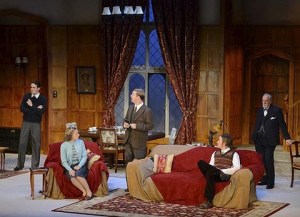 Taking over (quite ironically) from Ngapartji Ngapartji on the Playhouse stage, Agatha Christie’s The Mousetrap is a tightly-directed period piece as formulaic as it is popular. Come this November, it will have been playing on the West End for 60 years, and already boasts in excess of 24,000 performances.
This quintessential murder mystery funnels a number of Europeans into one room, kills one of them off, and eventually reveals who done it. The complications to Christie’s basic formula in this instance include a couple setting up shop as a guest house; a range of guests, each with their own oddities; a blizzard cutting them off from the outside world; and a potentially intriguing story about a tragedy from almost two decades earlier that took place on a farm neighbouring the guest house. These additions constitute one of Christie’s better contributions to the murder mystery genre, and make The Mousetrap a memorable play.
In this production, a talented cast delivers admirably on Christie’s characteristically verbose script. Christy Sullivan, in the role of Mollie Ralston, holds the play together, and Travis Cotton’s Christopher Wren breathes a little life into the production, but on the whole the performances seem altogether too mechanical, lacking a depth…
The rest of this post is published on Australian Stage.
Tags: Agatha Christie, Christie, Christopher Wren, Christy Sullivan, Crime fiction, Gary Young, Gus Murray, Jacinta John, Justin Smith, Linda Bewick, Linda Cropper, Louise Withers, Matt Cox, Michael Coppel, Mousetrap, Nicholas Hope, Robert Alexander, Suzy Strout, Travis Cotton, West End theatre
 The Butterfly Effect is often used to describe the confluence of seemingly unrelated and remote causes to social, political or psychological effects that are otherwise beyond comprehension. On seeing Ngapartji Ngapartji tonight, my first thought is whether writer Scott Rankin was aiming to use Maralinga and its aftermath as irrefutable evidence of the Butterfly Effect beyond the realm of physics.
In this epic work, Trevor Jamieson tells the story of the Maralinga nuclear weapons tests from the perspective of the Anangu people of the Western Desert. Through narration, song, mime and film, Jamieson and the rest of the cast pull together loose threads of culture, language and political history into a compelling piece of theatre, but what is truly remarkable is how, from the Anangu perspective, the confluence of…
The rest of this post is published on Australian Stage.
Related articles
Tags: Anangu, Anungu, language, Maralinga, Nguru, Pilu Nguru, Pitjanjatjara, Scott Rankin, Trevor Jamieson
So I was scrolling through Facethingy for something interesting this morning, and lo and behold, I was successful. That doesn’t happen often!
I came across a link to a new blog about theatre in Canberra. Again, anonymous, and seemingly a little critical of Canberra’s slightly longer-standing anonymous critic, Max, who’s had a six-month head start and has ruffled a few feathers. This blogger, who goes by the title That Guy Who Watches Canberra Theatre is rather more modest and wants to increase conversation about theatre in Canberra, which I appreciate rather more than Max‘s claim that whatever s/he thinks is Gospel. Well, I congratulate That Guy on that, and wish him all the best. I also look forward to offering the odd pingback where we happen to post about the same show.
My one little hesitation is that I’m not fond of the anonymous critic idea generally. It has some merit, since it allows the critic to be completely candid about people s/he might otherwise just pay lip service to, but it also encourages that most useless form of criticism, the attack. Max has been known to tear artists down under the rather bemusing motto of being “objective, honest and accurate” (objectivity is of course impossible in a critic, who by definition must take a position; and an accuracy of opinion is hardly something to distinguish any individual critic from any other (for all anyone knows every critic’s expression of his/her opinion has always been accurate); though I value the honesty). Max is rarely as aggressive as the worst of the critics at the Crimes (a significant achievement!). So while I can understand why a critic might want to remain anonymous, and don’t really object, I just don’t see enough value in anonymity. If opinions are personal, they should be owned by a person and not paraded about as gospel.
I’m aware I’m sitting in a glass house here; I haven’t always focused on what I like, which was my intention for this blog when I started it four years ago. But nonetheless, I stand behind my opinions and own them. My real name is all over this blog and everything that links to it, and anyone can click through or search for my Facebook or Twitter accounts to hurl abuse right back at me. There are photos of my face so that if you don’t know me and you object to something I write you can approach me the next time you see me in a theatre foyer and punch it. Even my phone number is here, freely available for you! Anyone can post a dissenting point of view in response to my posts, and know who they’re having a conversation with. When I review for Australian Stage, I need to be more forthcoming, and I don’t get the privilege of simply not writing about shows I really don’t like. On my blog, though, I can just speak my mind about what I do like and save my vitriol for Andrew Lloyd Webber, who truly deserves it for his criminal aversion to character and plot.
At times, I’ve found myself and people I’ve worked with desperately discouraged by the Crimes’ most viscous and disreputable reviewers, and though their reviews aren’t anonymous, I fear the same level of vitriol could develop as a result of Max and That Guy‘s anonymity. It doesn’t really help, and this kind of critic potentially leads great artists to quit and exit the field based on one irrelevant person’s opinion before they’ve created their greatest work or found what they’re really good at. I prefer the philosophy of pointing out what I value and hoping the artist does more of that. I certainly hope that no artist I’ve been critical of sees my opinion as being more important than anyone else’s.
The two posts currently up on That Guy‘s blog are reasonably balanced and positive, so I guess time will tell whether the anonymity will be a blessing or a curse. I just hope it doesn’t become a haven for discouraging the wonderful artists who make up Canberra’s theatre community. Overall, it’s just great to have another blog about Canberra theatre around, and I’m looking forward to a greater diversity of opinions being expressed (especially because That Guy‘s no great fan of Andrew Lloyd Webber). Have a look at his review of Free Rain’s Cats here.
Tags: Andrew Lloyd Webber, Australia, Canberra, Cats, criticism, Facebook, Free Rain Theatre, Max, That Guy, Theatre, theatre criticism, Twitter
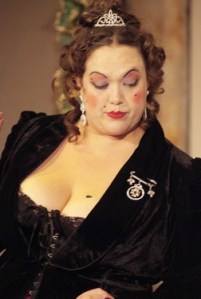 What a shame not to have made it to opening night for this fun little gem! The Wednesday night audience I joined was rather small and far too subdued for such a funny play so energetically brought to life by Centrepiece Theatre, but it was a lot of fun anyway.
I think this may be the third production of Moliere‘s work that I’ve seen from Centrepiece. The Miser, staged in 2005, remains one of my fondest memories of a night of comic theatre, and I think there was another in between. It has been some years, though, and too long to wait for another instalment.
This largely-forgotten and very old play rests on the even older plotline of marriages arranged by parents that don’t meet the expectations of the betrothed, but its genius plot twist is that the central character, Argan, is the imaginary invalid of the title, a wealthy hypochondriac trying to marry his daughter to a doctor in order to save money on medical bills. It was Moliere’s last play, and though he was playing the lead role in its premiere, he collapsed during the fourth performance and died shortly afterwards. Some say this is irony, but it seems Moliere’s malady was apparently not adequately imaginary!
The cast deserves a medal for their magnificent performances. Erin Pugh would upstage the entire cast, were her over-the-top mannerisms not generous to a fault. Her ability to be so very expressive (and excessive) while still drawing attention to other performers is remarkable, and I am not trying to dismiss the high calibre of performance delivered by all members of the cast, but this production definitely belongs to Pugh!
I am not intimately acquainted with the script or story of The Imaginary Invalid, but it struck me that, in comparison to the performances of the rest of the cast, Tony Turner’s Argon was rather subdued. Perhaps this is part of the text or a directorial choice, but it seemed to me a rather significant gulf. Not an entirely inappropriate one, though; just slightly unbalanced and maybe a little awkward.
The cast worked tirelessly to raise the energy levels, but it was a tough ask with such a small audience in such a large auditorium, and the performances fell short of their potential not through a lack of quality material in the script or technical difficulties or a lack of talent, but simply because the energy levels of the performers really need, in a production like this, to be matched by the energy levels of the audience. It really brings to the fore the difficulty of finding an appropriate venue in the capital. For this production, The Q was just too large. The Courtyard at Canberra Theatre Centre would probably have been better, but that’s awfully picky. It would be better yet if Canberrans would simply turn off The Voice (that steaming pile of… nevermind), get off their lazy arses, and go see some performers with both talent and an eye for a good material. But we all know that’s not going to happen, which is why I think we need more smaller venues. We have nothing really to match Sydney’s Belvoir or Stables theatres, and that’s a shame, as these theatres have just the right sort of atmosphere for our ‘crowds’.
But I digress. This production is all about a little bit of silliness, and it is admirably carried by a spectacular cast whose generosity in engaging the audience is faultless.
Tags: Argon, Belvoir, Benjamin Russell, Cameron Samuell, Cameron Thomas, Canberra Theatre Centre, Cate Clelland, Courtyard, Emma Sekuless, Erin Pugh, Imaginary Invalid, Jim Adamik, John Lombard, Jordan Best, Kiki Skountzos, Miser, Molière, Riley Bell, Tegan Ricketts, The Q, The Stables, Tony Turner
 Playing at The Street Theatre this week is Monkey Baa’s latest incarnation of one of Australia’s best-named plays, The Bugalugs Bum Thief. No, it’s not quite Shakespeare, but it’s closer than one might assume.
Its central character, Skeeter Anderson, just one young member of Bugalugs’ coastal community, wakes up one morning to find his bum is missing, which proves inconvenient for him. He soon finds that just about everyone in town has had their bum stolen, including his friend Mick Misery, for whom it is not so inconvenient, as it means his mum can’t smack him. The advantages of life without a bum, however, do not prove to outweigh the disadvantages, and Skeeter sets out to identify the bum thief and locate everyone’s bums.
The entire town is brought to life through the generous energy of just three performers who present mums, dads, teachers, police and sailors as well as their main role as a child. It may not be universally accepted as a compliment, but Gideon Cordover, Carl Batchelor and Mark Dessaix make excellent children, which is particularly helpful when…
The rest of this post is published on Australian Stage.
Tags: Australia, Bugalugs Bum Thief, Carl Batchelor, Eva Di Cesare, Gideon Cordover, John Saunders, Mark Dessaix, Mark Thompson, Performing arts, Sandra Eldridge, Theatre, Tim McGarry, Tim Winton, Toby Knyvett
 I’m a sucker for an immigration story, and Joanna Weinberg’s latest offering, The Piano Diaries, starts with one, so I was engaged from the get go with both her story, and her intoxicating voice.
I know I commented on a recent post that I might not be a particular fan of cabaret, but this was marvellous. While The Piano Diaries doesn’t have a plot in the conventional sense, Weinberg’s autobiographical stories are wonderfully full of the froth and bubble of life, flowing from the joys of a child’s fascination with her parents’ happiness to the darkness of witnessing racial vilification. These stories, fragments of a life story, provide a backdrop for the seemingly-effortless grace with which Joanna engages her audience.
London-born Weinberg grew up in South Africa (yet another reason for my interest; stories of South Africa fascinate me) and much of the material for this show is inspired by her childhood and youth in South Africa, with much of the remainder relating to her migration experience in coming to Australia. The Winds of Fear explores this, with its humble reference to the South African migrant as the “privileged of the refugees”. The unique perspective of South African Australians on this topic is refreshing, and Weinberg’s stories really speak to the immense value of a diverse society.
Weinberg took joy in complimenting Tuggeranong, even likening its Town Centre to Florence, repeatedly! No compliment was received with anything less than a hearty laugh by Tuggeranongians, who apparently take much less delight in the simple beauties of a well laid-out urban entity. It is Weinberg’s simple delight in the varied experiences of her life that make this show so charming, though. It is wonderful to just hear stories gleaned from life experience that then translate so beautifully into song, and the articulation between story-telling and song is what makes this show really special.
If nothing else, I’m finally sold on cabaret.
Tags: Africa, Australia, Florence, Joanna Weinberg, London, migration, piano, South Africa, story, Tuggeranong
The trouble with satire is that it can so easily come across as melodrama. Satire is incredibly dependent on nuances in timing and expression, and unfortunately, Queanbeyan Players’ production of Iolanthe falls all too often on the melodramatic side of the divide.
Iolanthe, oddly enough, is not really about Iolanthe, but about her son, Strephon, and his love, Phyllis. A fairy, banished 24 years ago for marrying a mortal, Iolanthe is restored to the fairy community, and introduces to them her son, who it turns out is half fairy and half mortal (the lower half being the mortal bit). He is planning to marry Phyllis, a ward under the guardianship of the Lord Chancellor, who expects her to marry a member of the House of Lords…
The rest of this post is published on Australian Stage.
Tags: Anna Greenwood, Chris McNee, Christina Philipp, Elisha Holley, Elora Ledger, Fairy, Gerard Ninnes, Gilbert, Gilbert & Sullivan, Iolanthe, Janetta McRae, Jennifer Groom, Lord Chancellor, Madeleine Rowland, Queanbeyan Players, Sullivan
 An enthusiastic audience welcomed Bruce Hoogendoorn’s latest play to the Courtyard Theatre tonight. A simple but effective comedy, The Reluctant Shopper kept its audience engaged and the laughs rolling freely.


 Foyer Talk