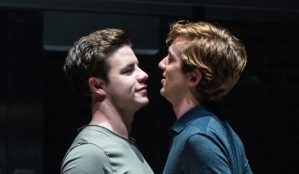
 Though somewhat confused, Teddy Ferrara is an engaging piece with some intriguing characters and an excellent cast.
Set on a university campus that sees more than it’s fair share of suicide, it explores the lives of a range of gay and not-so-gay characters and how they intersect around stigma and social activism. It’s absolutely engaging, deals with important issues that must be addressed, but it doesn’t quite manage to hold together as well as I wanted it to.
I fear it may be too politically-minded to be of any practical good. It covers, I think, too much ground, and delves into so many political issues that its narrative is mired and somewhat unclear. It wants to be at once a story while also being a missive, and in trying to be both, it succeeds at being neither. The missive’s premise, it seems, is articulated by a minor character, rather than, as should be the case on stage, demonstrated by the central plot. The very title itself obfuscates the drama by implying that the central plot is that of Teddy Ferrara, which it is not, by any means. Far prettier characters (I’m not just talking about the actors portraying them, but also these characters’ charisma) steal the show, with Teddy ending up little more than a plot device. Or perhaps that’s not true: the stories they tell are also compelling.
And this is the play’s biggest flaw. The playwright, Christopher Shinn, has developed several compelling stories, all of them worth telling:
- Gabe’s somewhat pragmatic romance with Drew, interrupted by personal traumas and mild betrayals, would make a brilliant variation on the usual romantic play where the central characters, instead of falling madly in love, fall gently into a mixture of like and lust.
- Jay’s interest in Gabe could be more than a mere subplot to that story.
- Teddy Ferrara could also warrant a play that was actually about him, exploring the multiple personas of those who live online to escape the trauma of actual human interaction.
- The ostensibly platonic relationship between Gabe and Tim would be an interesting drama.
- The university president, with his hilarious working relationship with the provost, and their interactions with student representative groups could make a brilliant comedy.
As it stands, none of these narratives really take centre stage.
Despite the mild confusion of the competing sub-plots, Gabe, portrayed annoyingly (which is entirely appropriate) by Luke Newberry, was front and centre as a character. He is a wet handkerchief. Ostensibly altruistic and kind, but born with the benefits of good looks, and white male privilege, and displaying them in the worst possible way. His membership of the LGBTIQ minority is really the only reason he comes across with any sense of altruism at all. He is a poor choice for the university’s diversity panel, and of course endears himself to the establishment.
He is supported by the noteworthy performances of Ryan McParland, who is brilliantly awkward and absolutely endearing as the Teddy of the title, Nathan Wiley as his closeted questioning friend Tim, and Oliver Johnstone, whose irksome portrayal of the principled and very controlling boyfriend is not in any way endearing but nonetheless very recognisable and absolutely believable.
So I am left a little flat. The play was engaging and the performances brilliant. But at the risk of being as annoyingly principled as Drew, I must remind myself that although a politician may articulate, a playwright must demonstrate. It is something I always try to remember when writing, though I, too, fail.
Tags: Abubakar Salim, Anjli Mohindra, Carolyn Downing, Christopher Imbrosciano, Christopher Shinn, Dominic Cooke, Donmar, Donmar Warehouse, Griffyn Gilligan, Hildegard Bechtler, Kadiff Kirwan, London, Luke Newberry, Matthew Marsh, Nancy Crane, Nathan Wiley, Nick Harris, Oliver Johnstone, Pamela Nomvete, Ryan McParland, Seven Dials
 Gobsmacked.
Many of you know I’m not big on variety shows, acrobatics or sight gags. Circus is all well and good, but I’d rather see a film usually. Well this is not much more than a circus, but it is so much more than a circus! La Soiree line up consummate professionals to impress and engage.
Take Captain Frodo, for instance. He’s billed as the son of a famous Norse magician, and brilliantly portrays a super nerdy and uber skinny buffoon. He doesn’t rest on his ability to pass through a tennis racket and a slightly smaller tennis racket, oh no! He plays the buffoon with the utmost professionalism, getting himself tangled up in a microphone cord, tripping over a stool and falling off the stage. It is this aspect of his routine, of course, that endears him so well to the audience, bringing a great round of applause when he returns in the second half. It is also why I was so taken with this show.
It’s just not about the amazing feats of acrobatics or the spectacle, no matter how impressive they are: it’s about the way they engage.
The English Gents perform some brilliant acrobatic work, but there would be nothing terribly interesting beyond the skill involved if they weren’t puffing a pipe or reading a newspaper while doing so.
And for those of you who usually like the circus, well you’re easily impressed, so there’s no need to bother with La Soiree, but if you do decide to come, be prepared to have the bar raised!
Tags: Asher Treleaven, Bret Pfister, Captain Frodo, Denis Lock, Hamish McCann, La Soiree, London, Mario Queen of the Circus, Melanie Chy, Miss Frisky, Mooky, Southbank, The English Gents
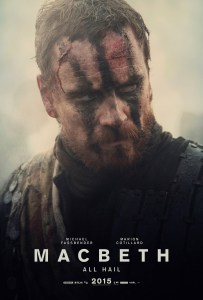 I fear I may be less impressed by this film than I should be.
The fact is, I think it’s very true to Shakespeare’s intentions. Had the muse of fire that we know as the cinema been invented during his lifetime, I expect this is very much how he would have imagined his play. A very Scottish Thane, rather than a slightly Gaelified English Lord, is met in battle, defeating King Duncan’s enemy in a bloodbath. He meets witches on the heath as it snows, and his wife is met in a rustic wooden cottage in a tiny village. When the king arrives, he stays in a tent. There is no hint here of English imperialism; Shakespeare’s English fable is as it should be: foreign.
In this aspect, the film distinguishes itself. It avoids the unfortunate assumptions of English and American producers which lead to a hybrid English/Scottish aesthetic, and presents The Scottish Play as if it were actually Scottish.
The performances also: spectacular! Fassbender is the quintessential Macbeth: astute, hirsute and when needed, a brute. He mixes genuine humanity with resolute barbarity. Marion Cottilard, too, is as conniving and “full of direst cruelty” as she ought to be, until her husband’s unerring barbarity tips her over the edge.
But still, I find myself craving a little more imagination. This is the Macbeth I read in high school and at university. I teach this Macbeth. It is the standard Macbeth. The Macbeth with factory fittings, or you might say, it is a Macbeth in original, mint condition. I don’t dislike it, but it’s hardly worth noticing.
At least with Geoffrey Wright’s film I thought it was disappointing. This is worse. Macbeth is protrayed absolutely perfectly, as is medieval Scotland, and I don’t care. I should care: Justin Kurzel, the film’s Australian director, should have given me a reason to care! I paid £14, an absurd sum, to be made to care, and yet, I don’t care. This is a perfect film for teaching Macbeth, unfortunately, and will probably be with us for many years to come as a result. I’m not unhappy about that. I just don’t care.
Tags: David Thewlis, Jack Reynor, Justin Kurzel, Marion Cottilard, Michael Fassbender, Paddy Considine
This post contains minor spoilers. Not enough to ruin the film, but more than I would usually give, so proceed at your own risk!
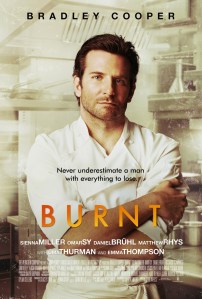 Burnt is one of those great little films that really gets around your prediction instinct. The plot, in a way, is really quite predictable, but it disguises itself exceptionally well.
Essentially, the film is based on the formula for an action film. It utilises the late twentieth century chronotope of the gruff and superficially unpersonable hero, but casts him as a chef with a questionable history of drug use and alcoholism, determined to prove his value, in this instance, by attaining a third Michelin Star.
Bradley Cooper, of course is the perfect man for the job. Cooper embodies the masculine stereotype, but both his manner and his filmography allow him the leeway to delve into more unexpected waters, particularly as a sensitive and relatively accepting human being.
He is supported in this endeavour by much more nuanced casting. As a heroine, Helene (Sienna Miller) makes a shrewish entrance and, though following a similar trajectory to Shakespeare’s Kate, develops in a much more textured manner to matching Cooper’s Adam. Daniel Bruhl completes a love triangle, with his character Tony engaging with Adam’s obnoxious quest out of an unrequited love. His depiction of this character is exciting in being so understated. Neither his appearance, nor his portrayal of Tony rely on gay stereotypes, and it is refreshing to see such a subtle portrayal of a queer character, especially when the character’s orientation is a key element of the plot.
Burnt may not be a brilliant film, it may not boast spectacular dialogue or a unique plot arc, but it does surprise with some beautifully drawn characters and the perfect ending.
Tags: Bradley Cooper, Daniel Bruhl, Emma Thompson, John Macdonald, John Wells, Matthew Rhys, Michael Kalesniko, Omar Sy, Raphael Acloque, Riccardo Scamarcio, Sam Keeley, Sienna Miller, Steven Knight
 Some days just come together, don’t they? I wasn’t thinking of doing anything terribly interesting today, but my housemate suggested trying for last minute tickets for The Winter’s Tale. I was going to say no thanks, but I struggle to say no to Shakespeare at the best of times, and I thought it was a good idea to get off my great lumbering arse. As she was queuing, though, she changed her mind and asked if I’d like to see Husbands & Sons instead. I’d not heard of the show, and knew nothing about it. So of course I said yes. And right glad I am that I did, too!
Husbands & Sons creates a deeply engrossing story by interweaving three of D.H.Lawrence’s plays. The Widowing of Mrs Holroyd, A Collier’s Friday Night, and The Daughter-in-Law sit splendidly side-by-side, woven together delicately by Ben Power. I’m not sure I’d have bothered to make the effort if my housemate hadn’t suggested it. Three plays simultaneously just sounds like asking for trouble! But the skillful manner in which these three have been brought together is quite remarkable.
The action shifts, often distractingly, between the three spaces that have been created, three collier’s houses in a northern English village, as it were. And while the characters hear each other, they interact little until the latter part of the play. Their stories, while separate, are far from independent, though. Power has carefully brought the themes of the plays together, so that the stories complement and enhance one another.
Bunny Christie’s design is remarkable, in that it appears, at first glance to be predictable. It reflects the Kitchen Sink style D.H.Lawrence’s scripts were ultimately categorised with, until the play begins. Projections cast an industrial shadow over domestic imagery, and the four-sided performance space of the Dorfman Theatre oozes atmospheres domestic and industrial, damp and cold, tense and cosy throughout the lengthy passage of the play’s action.
Lengthy though it may be, this production is far from a labour. We were lucky enough to find ourselves upstairs, at the rear of the auditorium high above the stage. I was able to sit back or forward, and even to stand when the mood took me. This position truly added to the experience, which was engaging enough as it was, thanks also to a brilliant cast that had benefited from impeccable direction by Marianne Elliott.
There are so many things to love about this play, but the highest praise I can offer is that it was one of those theatrical experiences where, walking outside afterwards feels like stepping into a duller, less real reality. This is the reason theatre remains so vital, so visceral, experiences like this. Even the glorious dusk light over the Thames, shining brilliantly on St. Paul’s, seemed dun in comparison to the vibrant humanity of the stories I’d just been through.
Perfect theatre. Simply perfect.
Tags: A Collier's Friday Night, Adrian Sutton, Anne-Marie Duff, Ben Power, Bunny Christie, Cassie Bradley, D H Lawrence, Dorfman Theatre, Flynn Allen, Husbands & Sons, Husbands and Sons, Ian Dickinson, Jeannette Nelson, Joe Armstrong, John Biggins, Johnny Gibbon, Josie Walker, Julia Ford, Kate Waters, Katherine Pearce, Katy Rudd, Lloyd Hutchinson, Louise Brealey, Lucy Carter, Marianne Elliott, Martin Marquez, Matthew Barker, National Theatre, NT, Oliver Finnegan, Penny Dyer, Philip McGinley, Scott Graham, Sue Wallace, Susan Brown, Tal Rosner, Tala Gouveia, The Daughter-in-Law, The Widowing of Mrs Holroyd, Tommy Rodger

Director, Hayward B. Morse, photo by Paddy Gormley
Tonight, my play The Ballad of Hobart Jones was honoured with a reading at Actors and Writers London‘s regular meeting. Actors and Writers London is an organisation that helps actors build their careers while helping writers develop their scripts, and that’s certainly how I have experienced the organisation since I joined in 2014.
When I was contacted about this script, one of the first suggestions that was given to me was to remove the narrator. The feedback I’d had prior to this had been equally for and against narration, and I’d followed a more moderate piece of advice in developing the third draft, which had led me to connect the narrator to the story more closely by making her an elderly version of the play’s heroine. But in order to reduce the length of the play to meet the requirements of Actors and Writers London, I reluctantly produced a fourth draft with no narration. Though I lost some exquisite turns of phrase, I still think this improved the work. I was forced to rethink quite a few scenes and find ways of bringing action to the stage that had previously been merely described (something I always thought was cheating anyway). So the work began before the reading was even cast.

Keith Warren as Hobart Jones. Photo by Paddy Gormley.
I was surprised, while working with Hayward Morse, the director assigned to my play, that he, having read only the fourth draft, sought some narration to clarify the settings and the passage of time. While most of the difficulties in this regard would be readily solved in a feature production by the change of a set or a mere lighting state or a sound effect, in the minimalist context of a rehearsed reading the narration had every reason to exist. So, small snippets of the original voice of the luminary were reinstated, for one night only, as it were, and I was very glad an audience got to hear them. There’s still a question in my mind as to whether or not they’re needed. Various members of the group gave me suggestions both for and against the narration, with more of them in favour of it, but I’m still favouring doing some work to exclude it altogether.
That audience was very receptive. Within a few seconds of the play commencing, I was relieved to hear some titters amongst the crowd. Within a minute, there’d been a chortle, and it wasn’t long before proper belly laughs flowed. This was a relief. I’ve written a drama and found out through skilful direction that it was actually a comedy, which is good; but to write a comedy and find out it’s a drama is no laughing matter, pardon the pun. The laughs came thick and fast through the first act, but slowed too much in the second, so there’s a little work to do there, too.
The comments from the meeting after the performance were all very positive. I was somewhat overwhelmed by how enthusiastic some of the members were, and took down their suggestions for draft five. The most useful of these, I think, were comments on the one female character. From the beginning, this character was always intended to be the real protagonist despite there being a superficial focus on the hero named in the title. The action still allows her to take a back seat, and remain something of a passive participant rather than the protagonist I always intended her to be.

Henry Lawson introduces Sydney to Miss Adelaide Harris. Photo by Paddy Gormley.
Of course, there can be no greater praise than to hear an audience laugh at the moments that were actually intended to be funny, and aww at the moments that are intended to inspire an aww. In addition to the very thoughtful and helpful criticism I had from my peers at AWL, these almost involuntary reactions are extremely encouraging, and give me confidence in the value of what I’ve created.
I’m really very proud of how this script works on stage. It jumps along at a merry pace (as attested to by several members of AWL), and allows the characters to shine. There are only a few adjustments to make, most of which revolve around Ada, the would-be protagonist. So, I set to preparing a fifth rendition of my Ballad. And then all I need is a producer. Anyone interested?
Tags: Actors and Writers London, Adelaide Harris, Alexander Jonas, Andrew Barton 'The Banjo' Paterson, ballad, Banjo Paterson, development, Gerard Manley Hopkins, Hayward B. Morse, Hayward Morse, Henry Lawson, hero, heroine, Hobart Jones, Keith Warren, Laurence Binyon, Lee Peck, Lianne Tucker, Melbourne Romsey, Paddy Gormley, Peter Mair, Protagonist, Rick Alancroft, script development, Sidney Ross, Sir Henry Parkes, The Ballad of Hobart Jones, William Topaz MacGonagall

Cineworld Hammersmith’s decaying facade
Ordinarily, I write about plays and musicals and films. I have been known to write about writing, and about developmental work, and once or twice I have even written about a cinema. As far as I can remember, I’ve only written about cinemas with historic value, but on this occasion, it’s because a cinema has actually distracted me from the film I’ve gone to see by their sheer bald-headed stupidity.
The cinema in question is Cineworld Hammersmith. I’ve been to this cinema on a number of occasions, even though the first time I noticed it, it was shut and in such a state of disrepair that I thought it abandoned. Nonetheless, I have seen three films here, in three of their auditoria. The first two were not terribly remarkable. They lacked carpet, and had something of the feel of a hospital ward, and they have quite small screens. But other than that they were vaguely tolerable, as long as the film was good.
But tonight I was in auditorium 1 for a screening of Spectre. This being the film’s first week, and given the popularity, auditorium 1 was larger than the others I’ve visited. It was also busier. My seat (allocated) was between two other patrons, which was not surprising. What was surprising was that, when attempting to sit in it, I found the distance between the armrests was narrower than the width of my pelvis.
Now, I have sat in many seats. Some have been narrower than others, some higher, some have been more wobbly, some have been more comfortable. I have, in developing countries in South East Asia, found more than once that my ample western posterior was too much for their flimsy plastic chairs. I have also found, quite regularly, on aeroplanes and buses, seats where the distance between the seat back and the back of the seat in front is shorter than the length of my femurs, which is not terribly comfortable, as I am not equipped with joints at any point in my femurs. But never, in almost four decades on this planet (and the last two with a fully-developed pelvis), have I encountered a seat with fixed armrests that are closer together than the distance between the extremities of my pelvis.
I admit I am slightly on the tall side. I exceed the average height of men in the United Kingdom by more than ten centimetres (that’s just shy of four inches in the Old Scale). So my kneecaps are accustomed to being compressed by small seats, and I’ve learnt to sit at funny angles to compensate for stingy designers. The widest part of the human hip structure is known as the intertrochanteric width. The average for most humans is just shy of 30 centimetres. My own intertrochanteric width (I’ve checked, since encountering Cineworld’s seats) is precisely 31.3 centimetres, and the distance between the armrests in auditorium 1 at Hammersmith is, apparently, 31.2 centimetres. I know this because, upon my first attempt to sit in seat B7, I didn’t quite fit. It took me three attempts, the last of which involved substantial downward force, which was not altogether pleasant for the patrons in seats B6 and B8.
How an organisation in a relatively-advanced country like the United Kingdom can fail to recognise the need for armrests to be positioned at a distance that can accommodate above average intertrochanteric widths, I do not understand. It would make sense that a person who gets paid to design seats for humans should be at least slightly familiar with the average, as well as the outlying, intertrochanteric widths of human beings. They should also have some familiarity with the biological composition of human beings. While the femur is attached to the rest of the skeleton in a manner that permits its owner to adopt an angle that compensates for the stinginess of bus and plane seat designers, I can assure you the pelvis is not. My intertrochanteric with is fixed, and though I may be able to squeeze some of my extra flesh through these very stingy seats, it makes for a very uncomfortable film viewing experience.

Daniel Craig in a seat wider than Cineworld’s.
It seems to me that, when making a booking for a seat in auditorium 1 at Hammersmith, Cineworld’s website or staff should warn patrons that the seats in this auditorium are only suitable for people with average or below average pelvis widths, so as to reduce the embarrassment for those of us who are slightly wider than the average human.
So, given the immense distraction these seats provided, I can only say that Spectre is quite an engrossing film, as there were one or two occasions when I almost forgot that Cineworld’s ridiculous attempt to provide a seat was making me uncomfortable. Daniel Craig’s performance was not in any way squishy, and he seemed to have substantially more elbow room in his Aston Martin than I had in my seat. Ben Wishaw was as dreamy as ever, and seemed to have plenty of space in his seat in the gondola, even when he was beset by many tourists. I think the film is worth a look, as long as you can find a seat to sit in that doesn’t make you feel like you’re about to explode with rage at the idiocy of the person who made it. I give this film four out of five well-proportioned seats.
Tags: armrests, bastards, chair, chairs, Cineworld, Daniel Craig, ecorat, Hammersmith, height, hip, hip width, intertrochanteric width, narrow seats, pelvic width, pelvis, seat, seats, size, Spectre, stingy, wide hips
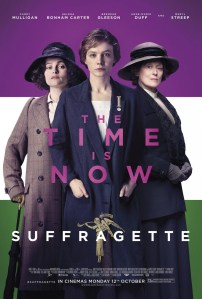 Suffragette is the story of a fictional woman in early twentieth century London, who becomes involved with the Suffragette movement to enfranchise women in the United Kingdom. Maud Watts is an ordinary mother, working in a laundry to help make ends meet. We see the journey she takes as she goes from merely supporting suffrage, to actively and militantly campaigning for it.
This technique of using someone who becomes involved in a movement to illustrate how people interacted through history is one I appreciate. I think it provides a view of history that is easier to relate to, and is possibly more accurate as it doesn’t present history merely through the eyes of leaders.
In this instance, the ploy is largely successful. It is easy to empathise with Maud, especially as her son is taken away from her. But it is this element of the plot that somehow gets lost along the way. One minute she is a mother, and the next she is just a suffragette, and her son is neither seen nor mentioned again.
From a feminist perspective, perhaps there is nothing wrong with this. But the purpose of creating this fictional character as a lens through which to view history is to humanise the story. The tragedy of losing such a precious relationship could not be understated, and its impact on the protagonist should not have been overlooked. It is at this point that the film goes from being brilliant to being somewhat clinical, and having the feeling of a docudrama, rather than a film.
The dialogue, nonetheless, is brilliant throughout, and demonstrates an impeccable skill. Carey Mulligan’s performance as Maud is professional and engaging.
I just wish the writer, Abi Morgan, had stuck more doggedly to her initial approach.
Tags: Abi Morgan, Anne-Marie Duff, Ben Wishaw, Carey Mulligan, enfranchisement, Helena Bonham-Carter, Meryl Streep, Sarah Gavron, suffrage movement, Sufragette, votes for women
 In 1945, one of Noël Coward’s great successes hit the big screen. Brief Encounter centred on the romance between a married man and a married woman, whose love is an impossible dream. Phil Willmot’s Encounter reimagines this story as a romance between Lawrence, a doctor who passes through Vauxhall Station each week, and Arthur, the station master. A chance encounter leads to a developing romance that is hindered by external pressures. However strong their connection, the barriers to their happiness in post war London seem insurmountable.
Both of the main characters are exquisitely developed and spring out from the stage through sparky, intelligent dialogue and magnificent performances from Adam Lilley as Lawrence and Alexander Huetson as Arthur. The supporting roles are somewhat more flat, with four additional characters played by two actors. These four just don’t have the depth of the central characters, and occasionally undermine the pathos of the whole, though they retain some comic value and drive the plot along.
One of the great achievements here is the way in which the tiny set transforms so readily to so many locations. That, and the sense of a filmic style that carries well in Above the Stag‘s tiny space under the overground.
Encounter, it is suggested, is the play Noël Coward wanted to write, but couldn’t: I think it presumptuous to suggest so. Coward never saw his private life, especially his sexuality, as a suitable topic for public conversation. But Willmot’s play, nonetheless, is a perfectly executed reimagining of Brief Encounter. It acknowledges the past and celebrates the present in a subtle but powerful way.
This is a deeply moving piece of theatre, with characters who quickly warm your heart and hold it enthralled until its chilling conclusion.
Tags: Above the Stag, Adam Lilley, Alexander Huetson, Christopher Hines, Noel Coward, Phil Willmot, Vauxhall
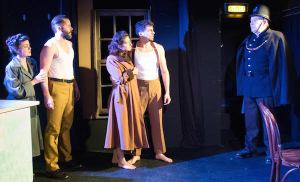 Setting a fictional story in a real history can be a challenge. In doing that myself, I’ve built up intricate scenarios only to realise I’ve overlooked a minor historical fact that makes a big difference to the plot. In Saffron Hill, Penny Culliford triples the challenge for herself, and still delivers a script that engages and elicits the necessary empathy for the characters.
Beginning with the migration of the Italian Musetti family to London in 1872, the play marks the journey of the family in their new country over three different periods in the coming century. Observing the struggles of the migrants in the 1870s, the generation that faced the heartache of being an Italian Briton during the Second World War, and those who continued to hold an Italian identity almost a hundred years after their ancestors migrated, the play takes a broad look at the family’s fortunes.
With the same cast delivering a range of roles over the three periods, a strong bond develops and it is easy to remain engaged with the family across what is essentially three stories. The use of radio news broadcasts to highlight the passing of time creates a great atmosphere and marks the passage of time leading into the next stage of the story.
In all, I found the play engaging and insightful, and I admire the skill involved in bringing the story to life.
Tags: Anthony Comerford, Anthony Shrubsall, Edmund Dehn, Edmund Sutton, Fed Zanni, Fiona McKeon, Maeve Leahy, Nadia Ostacchini, Penny Culliford, Roseanna Frascona, Tricolore Theatre Company

Okay, I’m a bit late. I recall wishing I had the time to go see this on stage a few years ago, and in recent months I again thought it looked like an interesting film. How I underestimated it!
.
The story of a cabby from Broken Hill who finds himself with terminal cancer and an abrupt prognosis, this film resonates with some of the deepest anxieties of humanity. When the Northern Territory legalises euthanasia, he hoofs it in his cab across the desert to end his life on his own terms.
.
This is a brilliant road movie, certainly one of the best I’ve ever seen. It succeeds in portraying some deeply flawed characters with empathy and keeps them at the centre of the story despite the political nature of the theme. This is probably the film’s greatest strength. It could have ended up being something of a polemic, but it remains grounded by its earthy and endearing characters who are never out of focus.
.
I ended up seeing Last Cab to Darwin in an aeroplane flying across Australia, and it turns out that’s the perfect context. I whipped up my window blind afterwards and watched Kangaroo Island pass underneath as the plane made its way out over the Bight, just the right time to whistfully ponder the beauty and ugliness of life. Australia’s outback offers the perfect metaphor for this; majestic in its grandeur and vicous in its relentless trajectory towards death and destruction.
.
Be afraid, it seems to say, but stay on the road. I hope when my journey ends, I don’t have to make a decision like this, but I’m also sure I’d make the same one. I just hope our governments can manage to keep their worthless noses out of my bloody business.
Tags: Darwin, David Field, Emma Hamilton, Jacki Weaver, Jeremy Sims, John Howard, Mark Coles Smith, Michael Caton, Ningali Lawford, Reg Cribb
 Timothy Conigrave’s autobiographical story of his love for John Caleo has turned into one of the finest Australian films ever produced. In fact, I should strike the Australian from that sentence, as it’s really one of the finest films ever produced in the world, but having seen it, I’m rather more proud to be an Australian than I was yesterday, so it’s staying.
Adapted for the stage (and subsequently the screen) by Queanbeyan playwright Tommy Murphy, Holding the Man follows the story of Tim and John from when they meet in high school and Tim pursues John. The story follows their love through homophobia, infidelity (of sorts), moderate success and finally AIDS. The characters are portrayed skilfully by Ryan Corr as Tim, and Craig Stott as John. Despite a strange, forced accent from Corr (he insists on pronouncing every T as if he were dining with the queen and it annoyed me throughout), their performances are truly impeccable.
The film matters in a sociological sense because it is set against the backdrop of the changing Australia of the late seventies through early nineties, which was when the bulk of social attitudes about the rainbow community shifted. And yet, despite the significance of these political shifts, this story is firmly grounded in the experience of the two men at the heart of this tragedy. And therein lies its greatest strength.
If you really hate spoilers, you might want to stop reading now, but really, the ending is clear from the very opening moments of the film, anyway. It is rare, I think, that this tactic works, but this is certainly one of the circumstances in which it serves well for keeping the story on track and focused. One of the benefits of knowing that John dies is that as the film delves into some very dark places the audience doesn’t question whether he will pull through. And because we know he is going to die, we are able to concentrate on the way in which the characters deal with their circumstances. It really is very strategic storytelling, and shows a master of the art was at work.
Despite the darkness of this story, this film is, at its heart, a celebration of love. It truly demonstrates a spectacular skill on the part of Tommy Murphy, to delve into such dark plotlines with such pathos and not lose sight of the heart of the story, which was the love between the two protagonists. Few writers can manage this with such dexterity.
I simply cannot recommend this film highly enough. Get it. Watch it. Share it.
Tags: AIDS, Australia, Australian film, Craig Stott, gay, HIV, HIV/AIDS, Holding the Man, John Caleo, LGBTIQ, Melbourne, Queanbeyan, Ryan Corr, Sydney, Timothy Conigrave, Tommy Murphy
After missing a year, it has been a great feeling being involved in Short+Sweet again this year. The competition, as always, is eclectic.
.
I think one of the highlights this week has been
The Adventures of Captain Midnight, in which Captain Midnight, a widower, describes his experience of moving to a retirement village and finding himself the centre of all the ladies’ attention. Don Smith as Captain Midnight strikes a very dignified presence with an air of David Attenborough examining the sex lives of the elderly.
.
I’ve also been enjoying The Truth About Mum and Dad, yet another great piece by Greg Gould with some snappy one-liners and very relatable adult siblings who enjoy making a scene while learning that their parents may not be quite as prudish as they thought.
.
Harriet Elvin’s Untitled was in good company with these offerings, too. What seems to be an art critic being harangued by a less appreciative gallery visitor turns out to be something far more amusing.
.
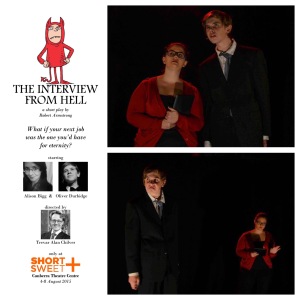
I had the privilege of directing two very talented and committed performers in Robert Armstrong’s zippy little piece, The Interview from Hell. Alison Bigg and Oliver Durbidge took the production very seriously, and made the whole process very enjoyable. I also think the result was spectacular, but I’m biased!
.
But the image that will stay with me after this year’s festival will certainly be that of Alison McGregor’s ‘Sparkles’, whose homage to love and chicken was simply gut-wrenching, especially the third time you see it! This one certainly deserved to take home People’s Choice!
.
If this is the Top 20, there’s no way of predicting what will be in the Wildcards!
Tags: Alison Bigg, Alison McGregor, Canberra Theatre Centre, Don Smith, Greg Gould, Harriet Elvin, Oliver Durbidge, Short+Sweet
I’m not a big fan of sports. I did audient at a game once when I was young, but I found the plot far too predictable and the characters quite superficial. It has always seemed to me that if you’ve seen one game, you’ve seen them all. I am generally in the habit of going straight to the sports pages in a newspaper when I need to clean the windows or if I have to deal with a puppy’s nuggets of joy. Instead of sport, for most of my life I’ve turned my attention to production styles with more drama, intrigue and three dimensional characters, but just this week, I’ve found it very interesting to note the strange audience responses to a mime act by an Aboriginal footsport player, especially given the controversy sparked by his performance.

Lewis Jetta’s enthusiastic mime, a subtle inspiration for so much Bogan ire.
For those living in the rest of the world, or for Australians who live in their own little bubble, what happened was essentially this: last Sunday, during a game of sportsball staged by Australia’s largest sportsball producer, the AFL, a group of Bogans in the auditorium were taunting one of the Aboriginal performers: Adam Goodes of the Adnyamathanha and Narungga peoples in South Australia. Following a plot crescendo during which one of the protagonists, an Aboriginal performer by the name of Lewis Jetta, had apparently sportsed very well, he stopped sportsing for an improvised aside in which he mimed the throwing of a spear. It was a gesture of excitement following a small victory that took its inspiration from the performer’s heritage. The mime, it seems, was very convincing: the Bogans in the auditorium were so terrified of the mimed spear that they booed ever louder, and they’ve been booing all week.
The performance, luckily, was recorded and plastered everywhere, so I have had the opportunity of viewing it on television and the interwebs approximately seven hundred and eighty four thousand, six hundred and fifty times. My considered opinion is that the mime, though solid, was not of Marcel Marceau’s calibre (though his blackface was certainly convincing). Don’t get me wrong: it was a fine mime, but so brief, and with so little development of plot or establishment of environment, that it really doesn’t appear sufficient to warrant such fear. I would have thought a prop spear may well have had such an effect, but the mime? I’m not so sure there was much to be afraid of. But the Bogans were very afraid, and the official spokesperson of Boganhood has been making it known just how frightened they were by it.
Ever since the event, the entire country has been discussing whether the mime was appropriate for this performance space. Apparently, sportsfoot games are usually a very vocal environment: performers and audiences are both encouraged to be very vocal about their feelings, so a mime is quite an unusual piece of performance art in this environment. I suspect a part of the Bogan response is the unfamiliarity of the audience with the subtlety of the protagonist’s choice of mime.
The conflict has been heated. Many Australians feel that miming an aggressive action such as throwing a spear is not appropriate, though apparently punching the air is acceptable, as is dressing in ancient Polynesian armory and screaming threatening words in a language even more frightening than German. Heck, even punching other people is apparently okay! But according to the Bogan Lord, miming the throwing of a spear is never acceptable. A good number of other middle aged white men of European heritage have also expressed their disappointment that an Aboriginal man would do Aboriginal things in Australia, and have railed at the suggestion that their response is racist. They’re even saying that pointing at racism and calling it racism is not in the spirit of the game. No wonder I don’t have an affinity with sport. According to these commentators, the Australian race who have suffered the greatest degree of racial vilification over the last 227½ years just aren’t qualified to identify racism when they see it.
Now, it is clear that Australians are more conservative about violence than most cultures, and we don’t get terribly emotional about sports. British fans of boring sports, for instance, have been known to go to more extreme lengths than Jetta, and rather than miming the throwing of a spear, the British Bogan is more inclined to kill children when he gets bored of watching a game. Brazilians also tend to throw actual things, rather than miming things to throw when they play sportsball. Thank goodness Australian players draw the line at gang rape and only mime violent acts.
As a very astute friend of mine remarked on the Book of Face, in most theatres, an audient behaving in a disruptive manner like the Bogans at Subiaco Oval would be asked to leave by one of the ushers to allow the rest of the audience to enjoy the performance. It seems to me that the failure of the venue to expel the disruptive audients is the most egregious error here. But perhaps Western Australian theatres are just more tolerant of poor behaviour in auditoria. I hear there were even people using a mobile phone during the performance! I certainly hope that custom doesn’t migrate to the eastern states; I can’t think of anything more disrespectful.
Now, I’m no expert on performances in this kind of context: I don’t usually find the plot in footsport games interesting enough to warrant any analysis on my theatre blog. But with so many people speculating about whether booing an individual for expressing their excitement in a manner appropriate for their race is racist, and since quite a few of my friends who I didn’t think were racist have been saying racist or at best just plain ignorant things this week, I felt it might be useful to describe the controversy from a different perspective. And as a dramatist, I can confirm that this is certainly the most interesting thing to happen on a sportsing paddock since the fitba riots in Europe in the 1980s led to the development of crowd control as a field of academic inquiry.

Goodes summoning the sportsing gods, or maybe just walking along with an arm outstretched, I’m not sure.
A mime in a shouty context doesn’t necessarily play well, but neither does it warrant this kind of response. I think begrudging an Aboriginal man his Aboriginality and asking him to act like a Gubba instead is definitely more than just a little bit racist. Getting upset about the miming of a violent act in an environment characterised by actual violence is, I think, equally ridiculous.
If you read nothing else about this sorry affair, give Stan Grant’s remarkable piece a go.
And if you’re not a reader, Waleed Aly debunks the two most profound myths surrounding the ever-so-apty-named Mister Goodes in this video.
Tags: Adam Goodes, Adnyamathanha, AFL, aggression, Alan Jones, Andrew Bolt, Brazil, controversy, everyone's a little bit racist, football, football violence, Lewis Jetta, little bit racist, mime, Narunnga, Perth, racism, riots, spear, sport, sportsball, Stan Grant, Subiaco, violence, Waleed Aly, Western Australia
 The expression on the faces of the three actors after their opening night performance said it all: they’d put their whole heart and soul into it!
And why wouldn’t they? The Compleat Wrks of Wllm Shkspr (Abridged), despite being abridged, is one of the most amusing responses to the Bard’s works ever penned. It has been entertaining both Shakespeare enthusiasts and the partners they drag along to the theatre for almost 30 years, and so far it has failed to age.
Covering all 37 of Shakespeare’s dramatic works in under two hours is no mean feat. Granted, they do cover 16 comedies all at once (because they’re all the same anyway), and they merely name a few rather than delving into them, but still, you can understand them experiencing some fatigue at the end of such a night. Truly, if any actor has earned the right to collapse at the end of a performance, it’s an actor in this hilarious show.
And this cast has certainly done it justice.
Ryan Pemberton introduces James Scott as the bumbling scholar, who in turn calls on Brendan Kelly, drawing him into the debacle. The pace begins rather more slowly than I think this piece calls for, but the three certainly picked it up. Perhaps not quite enough to hold the energy where it needs to be, but that will probably slot into place as the run continues and the cast get a better feel for audience reactions.
A great production that both needs and deserves a high quality audience!
Tags: Brendan Kelly, Complete Works of William Shakespeare (Abridged), James Scott, Reduced Shakespeare Company, Ryan Pemberton, The Compleat Wrks of Wllm Shkspr
 This year, two films with names starting with the word paper have impressed me. I’m not sure what to make of that. I’m not even sure what I should make of the fact that two films with names starting with the word paper have been released this year. Nonetheless, it seems to be a good formula, because both of them are bloody brilliant.
Paper Towns is an American Indie film, and if there’s any negative generalisation you can make about American films, American Indie films are the exception that proves the rule. American films sacrifice plot intrigue for dramatic licence. American Indie films don’t. American films have superficial characters that barely even remind you of humanity. American Indie films don’t. American films make a lot of money at the box office. American Indie films don’t. Okay, that last one wasn’t negative, but you get my drift. Want to understand the American psyche? Spend some time with their Indie offerings and you’ll encounter the sweet, sour, ugly, beautiful soul of America.
Paper Towns delivers a deeply engaging plot centred on the protagonist’s crush on his neighbour, a girl who develops a habit of disappearing. It’s a kind of coming of age story, kind of a road movie, kind of romantic comedy, but, as with all good Indie films, it defies categorisation. Its characters really get under your skin. They’re characters you can really care about, drawn with such a fine verisimilitude that you don’t even notice the archetypes being presented. Antagonists, too, are never left to wallow in the audience’s antipathy, but they come to life as fully developed characters worth as much respect as protagonists, if not as much love. Stories like this are rare.
This is genuine storytelling. I have seen a lot lately that doesn’t quite engage me as I wish it would, but this just held me enthralled from beginning to end.
Tags: Austin Abrams, Cara Delevigne, Florida, Indie film, Jake Schreier, John Green, Justice Smith, Michael H. Weber, Nat Wolff, Scott Neustadter
 I think I need to begin this post with a warning: I may gush a little. This is simply one of the best films I’ve ever seen. Maybe I say that a lot, but it doesn’t make me like it any less. There’s a great deal of skill involved in balancing plot with character development, balancing pathos with humour and balancing light with dark. The creators of this film have done all three brilliantly.
Paper Planes is focused on Dylan, a 12-year-old who lives with his grieving father on a dilapidated farm near the fictional town of Waleup in Western Australia. When a strapping, visionary student teacher introduces him to the world of competitive paper plane-making, he enters that world with enthusiasm and brings a balance of humility and determination with him, which helps to draw his father back to life.
Ed Oxenbould‘s portrayal of Dylan is the linchpin for this brilliant film, and his ability to balance energy and pathos is remarkable for a 13 year old actor. He is supported well by Sam Worthington, whose character is sullen throughout without being entirely flat, which is quite an achievement. And light relief is all in the hands of the brilliant Deborah Mailman, who adds just the right spice to the mix.
The plot is largely predictable, but doesn’t suffer for it. Even the best of the humour is available in the trailer, so if you don’t like character and aren’t interested in their journeys, then maybe you shouldn’t bother with this film (if that’s the case, why would you watch films at all anyway?). The fact is, this is a light-hearted story that really gets to the guts of what life is about.
And more importantly, perhaps, this film is a testament to growing maturity in Australian storytelling. While it is distinctly Australian in character, it refrains from either romanticising or demonising the bush, and there’s barely a skerrick of cheap and nasty ockerism. There’s a hint of romanticism about Sydney (something I’ll never understand, having been liberated from Sydney myself), but what it does best is pitch a national identity that is quietly confident, but nonetheless cautious. I don’t think we’ve done that very much before.
I’m even willing to forgive some very substantial continuity errors, the biggest of which I can’t mention as it would spoil the movie for those who haven’t seen it.
If the opportunity presents itself, don’t miss this one. If you’re the teary type, take tissues. If you like a good laugh, don’t put the popcorn in your lap. But either way, see it.
Tags: Australiana, character, Deborah Mailman, Ed Oxenbould, Ena Imai, gush, Humour, Nicholas Bakopoulos-Cooke, ockerism, Paper Planes, pathos, Perth, plot, Robert Connolly, romanticism, Sam Worthington, Steve Worland, Sydney, Waleup, Western Australia
 In the opening moments of this film, I loved its playfulness and cross-cultural references like the name of its location in San Fransokyo and the Asian touches on the Golden Gate Bridge. The animation grabbed me immediately, and it was easy to engage with the characters. Of course, you’d expect that from these guys. Disney are masters of the dramatic arts and know how to play them to commercial advantage, and they’ve built an empire on engaging audiences across ages and cultures.
The film concerns Hiro, a young robot enthusiast who develops a brilliant new concept for robotics in order to gain a scholarship for his brother’s university. He succeeds, but the death of his brother and the theft of his concept present a need to turn from Hiro to hero before he takes up his place in academia.
The cross-cultural elements are particularly interesting, and on the surface at least, reinforce the values of multiculturalism. But I just felt uneasy as I started to notice cultural stereotypes creeping in. Despite a broad brush being applied in the races of the animated characters, it can be observed with some objectivity that all the notable Asian characters were nerds, all the characters with political, financial or academic power were Anglo-Celtic, and the muscles belonged to the African American. Not racist by any means, and the way in which these characters contributed to the functioning of the symbolically-hybridised San Fransokyo is a respectable image, but really, Disney? Is it necessary to reinforce these stereotypes? Could you not just shake it up a little bit? For the kids? Maybe?
To their credit, there are some strong, understated female role models here. The gender balance is better than the race balance, and the catchphrase “woman up” is one I hope will resonate with my daughters. The film is also very strong in character development. Though one of the characters dies early in the film, his presence remains palpable throughout, thanks to the treatment of the central character, whose grief is brilliantly established and expressed.
This really is an excellent film. It has a unique and engaging story, well-developed characters and beautiful animation. But I just feel that little bit uncomfortable with the way it reinforces stereotypes, so I have some hesitation in praising it too highly.
Tags: animation, Big Hero 6, Daniel Henney, Disney, Hiro, Hiro Hamada, microbots, Ryan Potter, Scott Adsit
 It’s not always that I manage to get lost in a film, and this one took me by surprise!
Halfway through this year, as my daughter’s tenth birthday approached and I was living in the antipodes, I popped (I literally cycled) over to Harrods and found a copy of Michael Bond’s famous novel and a Paddington teddy bear. I then rode with that bear over to Paddington Station and snapped his picture with a Great Western train, and popped them into a parcel for my girl in Melbourne. And to find shortly afterwards that Studio Canal was about to release a major film just meant that I could share this a little more with my daughter.
Well, it hardly needed this kind of personalisation, as it turned out. A simple but playful approach to telling the story makes this film very relatable and engaging. Add some brilliant performances by some remarkable actors and it is truly something special.
Hugh Bonneville is essentially just reprising Lord Crawley in his role as Mr Brown, but Sally Hawkins, who plays his wife, is just brilliant. The children are likewise splendid, but I have come away in awe at Nicole Kidman‘s transformation into Millicent. I was in some doubt about whether it was Kidman or not, her transformation was so thorough.
It’s very rare for me to tear up in any film, so it was a surprise to do so in this one, which is definitely not a tear-jerker by any stretch of the imagination. The film’s setting in the part of London where I spent several happy months living this year, and the truism it finishes on that “anyone in London can fit in”, really sang to me. And although the practicalities of life drag the romance of any place violently down to earth, this film manages to capture much of London’s charm without really whitewashing it. Although, I could be terribly biased!
But whatever way you look at it, this is simply a great story told with vitality and boldness. Rarely does any film manage to tell a story as well as this one does, so it really shouldn’t be missed.
Tags: Ben Wishaw, Downton Abbey, Hamish McColl, Harrods, Hugh Bonneville, Judy Brown, Julie Walters, London, Michael Bond, Nicole Kidman, Paddington, Paddington Bear, Paddington Station, Paul King, Sally Hawkins, Samuel Joslin
 World War Two movies really should be sold by the dozen. I mean how many times can we just keep rehashing this? With the 70th anniversary of the end of the war less than a year away, principally between Hollywood and Europe, it seems, from a cursory search of IMDB, that the rate of production regularly exceeds 40 feature films per year, with no sign of abatement. And despite the severity of the Asia-Pacific Theatre, we are predominantly focused on Europe.
So I didn’t really go to see this film because I thought it would be something remarkable or special or even noteworthy. There’s a new WWII movie for just about every week of the year. I just felt like going to the cinema, and this one was on at the right time.
And really, that’s about how this one should be valued. It’s not a bad film by any means. It has a strong plot, interesting characters, great explosions, confronting gore and just the right amount of novelty (I’ve never seen a tank battle portrayed quite like this before). It has some profound little lines like “Ideals are peaceful, history is violent”, which are included subtly enough for my taste, and in some way justify the bordering-on-extreme degree of violence depicted here.
And that’s really all there is to it. There is no attempt to glean any new insight into humanity from the species’ darkest days. No spark of genius or flash of brilliance. There’s some valour, perhaps, but really, when we’re churning out so many films on this theme, there is absolutely nothing remarkable about this film.
So I don’t know why I’ve made any remarks at all…
Except to comment that maybe, just maybe, it would be good to start issuing licences for people who want to make films about WWII, or some kind of system that gives us an indication of whether this is just regurgitation or whether there’s something new to be said. I certainly think that there is more to be learned from this period in human history, and I’m very keen to see Angelina Jolie’s upcoming foray, but still… filmmakers, please; can we just explore the humanity of war a little more?
Tags: Angelina Jolie, Brad Pitt, Film, Fury, humanity, Logan Lerman, movie, Shia LaBeouf, war, WWII


 Foyer Talk