Every now and then a play comes along that leaves you feeling like you’ve just witnessed something important, but you’re not sure what. Winter’s Discontent is one of them. It is coherent, intelligent, demanding of its audience and at times funny, but I still feel like I missed something. Like there was something substantial, important, that the writer was trying to communicate, and I’m a bit of a goose for missing it…
The rest of this post is published on Australian Stage.
Tags: The Street Theatre, William Zapper
Well, I’ve finally done it. More than twelve years after moving to Canberra, I have finally been to one of Rep’s winter variety shows. I recall that it was originally recommended to me in 1998 as an undergraduate beginning a Theatre Studies major at the ANU, as an excellent example of the music hall tradition, so there’s something bittersweet in having finally attended in the same week that the ANU’s Theatre Studies major met its demise.
The cast certainly delivers. After a slightly flat first half, which could be put down to opening night, the second was quite magical. Ian Croker’s rendition of Minnie the Moocher got the audience engaged, and Christine Forbes followed this with a beautifully theatrical The Girl from 14G, about which she bragged that she was overjoyed to be able to wear her pyjamas on stage!
I felt my personal cringe factor rise when we were informed that the finale was to be a rendition of Peter Allen‘s perfectly horrid canticle I Still Call Australia Home, but it dissipated completely with the cast’s magnificent send-up of the song’s overwrought history.
A variety show stands or falls on the energy of its cast, and this cast certainly works hard for their applause. After a flat start, the energy flowed and made Jazz Garters a fun and entertaining show, well worth a night out.
Tags: Arts, Canberra, Christine Forbes, Ian Croker, Jazz Garters, Peter Allen, Theatre
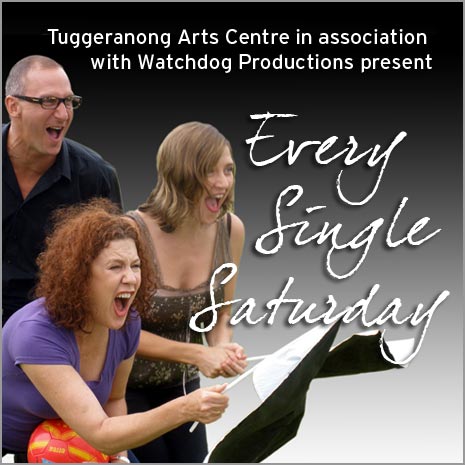
Before going along to see Every Single Saturday I must admit to a little apprehension. It is the same fear I face every time a conversation turns to sport or someone makes a comment vaguely sports-related and then looks at me as if I am expected to make a certain type of comment. That’s right, I’m a member of Australia’s smallest minority group: the Sports-Ignorant. Thankfully, although it really is all about soccer mums and dads, Every Single Saturday makes life easy even for the Sports-Ignorant. There’s even one of us amongst the characters!
The rest of this post is published on Australian Stage.
Tags: Australia, Daniella Lacob, Geoff Sirmai, Joanna Weinberg, Matt Young, Melanie de Ferranti, Paul Geddes, Recreation and Sports, Sara Grenfell
 Love Cupboard can be neatly summarised as the story of an adolescent girl who isolates herself from the rest of her life to live with her boyfriend (hence the love); and to avoid discovery, hides in a cupboard in his lounge room (hence the cupboard). The story is as quaint as its title…
The rest of this post is published on Australian Stage.
Tags: Arts, Cameron Thomas, Cathy Hagarty, Cupboard, David Atfield, Emma Gibson, Hanna Cormick, Peter Butz, Peter Matheson, Relationships, Romance, Scott Cummings, Tim Levy
Henry Lawson’s legacy is not an easy one to identify. It is wrapped up in the mystery of the Australian identity, which is now, as it was in Lawson’s day, straddled across the divides between urban and rural, between civilised and free, and of course between global and local. Max Cullen’s play, Faces in the Street, somehow manages to explore these weighty notions while remaining firmly grounded in the story of Lawson’s life…
The rest of this post is published on Australian Stage.
Tags: Australia, cultural cring, Henry Lawson, Lawson, Max Cullen, New South Wales
Well it’s time for another first… but this is scary!
I have just handed over a show to my assistant director, Seth Robinson, before the last two dress rehearsals! Now, I can’t complain too much. I’ve done this because I’m off to Fiji to attend my nephew’s wedding, but it really is scary to think that this show will go on without me. Even at opening night!
It’s not that I don’t think the cast is ready; they could open tomorrow and be fine, I’m sure, but I’m not ready to let it go! I mean, I’ve slogged away for the last two months with them, and they’re about to step up and perform, and I won’t be there to enjoy it!
Still, that doesn’t mean the rest of Canberra shouldn’t; so if you haven’t booked your tickets yet, call the Tuggeranong Arts Centreand tell them you’re coming!
Tags: Arts, Canberra, Don Wilkinson, Seth Robinson, Tuggeranong Arts Centre
In Richard III, Shakespeare has left us one of the greatest challenges to the willing suspension of disbelief ever created; Richard is a foul and loathsome character, and yet every time I see the play, I am amazed at how much sympathy I have for the detestable excuse for a human being I am presented with. Everyman Theatre has left me in this state yet again.
The rest of this post is published on Australian Stage.
Tags: Adrian Flor, Arts, British, Duncan Driver, Duncan Ley, Helen McFarlane, Ian Croker, James Scott, Jim Adami, Literature, Peter Fock, Richard III, Shakespeare, William Shakespeare, World Literature
While it might be an exaggeration to say that Parkes scooped the 2009 CAT Awards, their achievements were certainly the main highlight of the night. The town of 10,000 may be one of the smaller in the Canberra Area Theatre (CAT) Awards’ broad catchment, but it is certainly punching above its weight in impressing the judges…
For the rest of this article, go to Australian Stage
Tags: 2009 CAT Awards, Arts, CAT Awards, Don Hillam Entertainment, Rhys Holden
I have just handed over the reins of my current project, Take Their Life, to the stage manager, Joyce Gore. I thought I was scared of directing anything of Shakespeare’s before, but now I’m even more scared because I no longer have any control over what happens!
I have learned an awful lot from the experience of directing a sacred cow. Having only directed new, or relatively new, works before, I’ve never had to deal with strongly-established and conflicting interpretations of character before. The principles are the same: you look for various interpretations and pick the one that best suits your needs, but when there is such a wide range of varying interpretations, and when some of those interpretations are so firmly entrenched from centuries of analysis, it can be a tough call to pick the one that best suits our purposes.
All directors say it, but it really has been a pleasure to work with such a talented cast. They’ve amazed me at times with their capacity to take an idea I’ve had about how a character should act or respond, and incorporate that into a holistic expression of a character, which essentially is nothing more than a concept. I have found it quite humbling to watch those characters emerge from vague and shadowy ideas in my head into characters who stand and walk about and interact as if they’re real people.
So next stop is opening night, when we turn Shakespeare’s sacred cow into a profane one. I hope people enjoy it, but really, the best part of the experience of profaning a sacred cow is over, and after nine months in development, I am both breathing a sigh of relief, and beginning to fret about letting it go.
Chookas, cast.
Tags: adaptation, Diane Heather, Hannah Dawson, Jon Sharp, Joyce Gore, Melissa Savage, Performing arts, Pete Stiles, Shakespeare, Stage management, take their life, Theatre, William Shakespeare
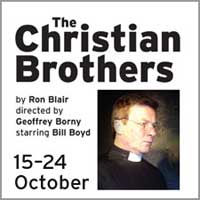
 I am getting a little bored with the whole “let’s say nasty things about the Catholic church” thing that our culture seems to have going on these last few years. Being an older play, Ron Blair’s The Christian Brothers doesn’t suffer from the same simplistic and one-dimensional depiction of Catholicism as its more modern counterparts. It’s refreshing.
This one-man play is about an ageing Catholic school teacher going through something of a crisis of faith in the strangely public context of his classroom. Perhaps the most interesting part of this play is how the classroom itself, while occupied by however many students the audience imagines to be there, can be at once public and private.
Veteran of the Canberra stage, Bill Boyd brings the flawed teacher to life brilliantly, eliciting empathy and laughter as we recognise those flaws that most of our teachers probably also had. This is a great production, and an hour well spent.
Tags: Bill Boyd, Canberra, Catholic Church, Catholicism, Congregation of Christian Brothers, Geoffrey Borny, Ron Blair, Tuggeranong, Tuggeranong Arts Centre
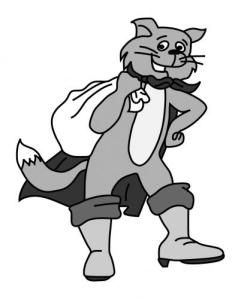 How the magnificent Nina Stevenson manages to harness the enthusiasm of more than 30 youngsters to fill a stage and tell a comprehensible story is beyond me, but with Puss in Boots, she has done this and more, because the show is a delight.
I took my own three youngsters (who have the energy of 30), and they sat enthralled, completely engaged by the show’s larger-than-life characters, especially the evil ones. And who wouldn’t be? There is some fine emerging talent on display, especially in the personages of Rebecca Riggs, who plays the evil sister Rubella, and Adrian Thomas, as her brother Snotty. Even at my age (and with my degree of evilness), I struggle to emit an evil chuckle, but Rubella’s cackle sent shivers down my spine. And their brother TJ, played by the engaging Rory Asquith, was as lovable as his sister was evil.
The principal cast is supported by a young ensemble equally noteworthy for their excellent performances; and the whole show is a magnificent showcase for the talents of these young Canberrans, who I expect will be entertaining us for decades.
Tags: Adrian Thomas, Nina Stevenson, Puss in Boots, Rebecca Riggs, Rory Asquith, Tuggeranong, Tuggeranong Arts Centre
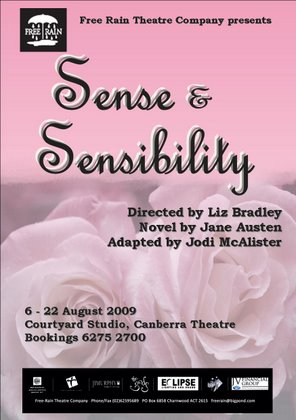
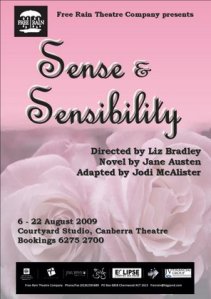 Jane Austen’s novels don’t appeal to me greatly, but the quality of her wit is superb. Although Sense and Sensibilityis not a novel that readily lends itself to a dramatic adaptation, Canberra’s own Jodi McAlister has done a fine job of condensing Austen’s story into two hours of engaging stagework.
One of the most memorable characteristics of Austen’s work is the importance of the subtext, and the many paradoxes that are inherent in such a context. Drama, of course, thrives on paradox and subtext, but the sheer volume of these found in Austen’s work has been the downfall of many dramatisations of her stories. In this production, I think both Jodi McAlister and Liz Bradley are to be commended for their work in focusing the attention and keeping the journey of the characters paramount.
A great performance by the cast was punctuated by three stellar performers in the roles of the three Dashwood sisters. Alex de Totth, Ylaria Rogers and Nicola Grear are most notable in the degree to which they are able to balance the humour of their roles with the truth of their characters’ experiences. This is critical to Austen’s stories, and the success of this production owes much to these three performers.
I have never been a great fan of Austen, but have always enjoyed the quality and intensity of her satire, and am very pleased that this production managed to express it so well.
Tags: Alex de Totth, Canberra, James Scott, Jane Austen, Jodi McAlister, Liz Bradley, Martin Searles, Nicola Grear, Sense & Sensibility, Sense and Sensibility, Ylaria Rogers
I really must come up with a good reason why I don’t like follow spots and smoke. Normally my dislike of them doesn’t matter, but in the case of
Chess, they use them right at the beginning, and they use them well! Why is this a problem? Well, if you don’t like follow spots and you don’t like smoke, but the first thing in the show is a follow spot and smoke, it distracts you from the show. It’s not a problem with a poor show, but unfortunately, The Q’s production of
Chess is not a poor show, so I feel I need to justify my dislike of follow spots and smoke. One day, my prejudice will have a justification, but this is not that day.
Chessis just too good.
Chess is, in many ways, poles apart from Krapp’s Last Tape, which I gushed about the night before, but it shares two important characteristics: it tells a remarkably human story, and allows an audience to engage in some depth with its central characters. That said, I think I missed some elements of that story, due to some distortion of Tim Rice’s lyrics. I am unsure whether this was a problem with enunciation or amplification, but I suspect the latter. Of course, putting such complicated sentence structures into lyrics was probably a bad idea in the first place, but in this instance it was not a fatal one, probably due to the talents of this magnificent cast.
The ensemble gathered for this production must be one of the best I have seen in Canberra, but they were not a patch on the magnificent talents of principals Stephen Pike, Christine Forbes and Lexi Sekuless. Even an old cynic like me felt goosebumps!
Tags: Adrian Flor, Benny Andersson, Bjorn Ulvaeus, Canberra, Chess, Christine Forbes, Derek Walker, Lexi Sekuless, Roy Hukari, Stephen Pike, Tim Rice
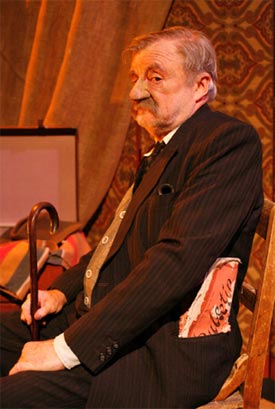
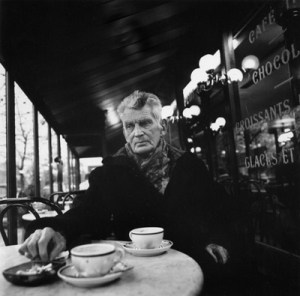 Opening at Tuggeranong Arts Centre, Krapp’s Last Tapeis one of Samuel Beckett’s more well-known plays.
Sitting, as I am, and contemplating what I want to say about Krapp’s Last Tape, I think about commenting on the set, the actor’s performance, the lighting, the direction; but all of that seems to undermine this play. This is a story about a man who made a decision decades ago, and whose existence is not haunted, but shaped by the consequences of that decision. And nothing matters more than that character.
Of course, the design elements have to be properly balanced, or the character won’t be visible. Ian Croker’s set, Jack Lloyd’s lighting, and Len Power’s sound design are as important as Graham Robertson’s performance, but all of these must be properly balanced, and nod gently to the presence of Beckett’s ‘hero’. I think this is the great strength of this production. All of these design elements are indeed balanced perfectly, giving the audience perfect access to the character.
I had read Krapp’s Last Tape many years ago, and enjoyed it at the time. Like any of Beckett’s work, it is difficult to read, but it absolutely sings when a performer embodies it. Graham Robertson is a veteran of the Canberra stage, and as one would expect, he brings Beckett’s miserable Krapp to life. His engrossing performance is punctuated with perfect delivery of Beckett’s dry humour.
I will argue to my dying day that the use of the word ‘absurd’ to describe Beckett’s world view is absurd. He is a logician, and his work epitomises logic. It might baffle a person who tries to read it, but in performance Beckett’s work is simplicity itself. And Krapp is a superb example of Beckett’s magnificent capacity to tell a story. Nothing beats that.
Tags: Beckett, Canberra, Courtney Blanch, Geoffrey Borny, Graham Robertson, Helen Hunter, Ian Croker, Jack Lloyd, Krapp, Krapp's Last Tape, Last Tape, Len Power, Liz Topperwein, Samuel Beckett, Tuggeranong Arts Centre
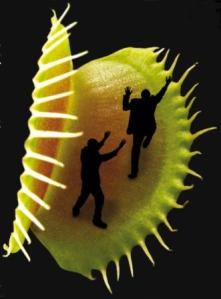
Canberra Repertory opened Deathtrap tonight. A comedy about an ageing playwright ready to kill to get what he wants.
What I found most interesting about Deathtrap was its style. This is a play by an Australian playwright, written in the late 1970s, and very much set in that time and place; but it has all the hallmarks of an excellent British comedy from the 1960s. The madcap humour, dialogue almost entirely dependent on wit, and a very conventional structure, all mark this play as something other than what it is, and were I not aware that it was an Australian play, I would have assumed it wasn’t, despite the references to Sydney’s northern suburbs.
It is a lot of fun: one of those plays that you could well come away from with a sore belly from all the laughing. I didn’t, though. Maybe the timing was a bit off due to opening night nerves, or maybe I just like a little more meat on characters’ bones than Levin provides, but it was good.
Tags: Alison Croggon, Australia, Canberra, Corille Fraser, Deathtrap, Ian Croker, Ira Levin, James O'Connell, Kerrie Roberts, Playwright, Sydney

Opening night of David Williamson’s Let The Sunshine and The Street Theatre was full. Well, you wouldn’t expect any less for one of Williamson’s plays, would you?
I would like to describe this play as an amusing double-autopsy of capitalism and socialism, but that hardly does the play justice. Williamson’s superb play demonstrates the inability of these two-dimensional political ideologies to deliver what they promise their adherents, through characters who, despite being built on one or the other of these ideologies, are forced to grapple with humanity in three dimensions.
I think some of Williamson’s best qualities as a writer are on display in this piece; the intricate crafting of character and plot is astonishing to reflect on. This, like most of his work, is a plot-driven story, but that plot is clearly driven by the characters, and their individuality, their connectedness and their ideologies dominate the plot. Without the cast of distinguished actors assembled by the Ensemble Theatre, the text could be very dense, but it resonates beautifully as a play for today.
Tags: ANdrew McFarlane, David Williamson, Emma Jackson, Ensemble Theatre, generation gap, Justin Stewart Cotta, Kate Raison, Let the Sunshine, Sandra Bates, Theatre, Toni Scanlon, William Zappa
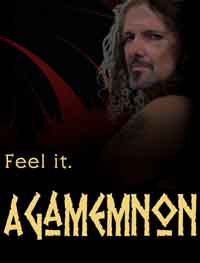
 Anyone who’s ever spoken to me about authors knows that the author I loathe most is Tolkein. I hate Tolkein’s work because I can’t understand how someone who fails entirely to grasp the idea of interworking exposition with climax can sell a single book! These people may also realise that I have a double standard insofar as my hatred of Tolkein for this reason has not caused me to dismiss the playwrights of Ancient Greece. The fact is, the Ancients wrote for a different purpose and a different audience, but Tolkein was just a babbling fool. Aeschylus, of course, was a master playwright, who had a justifiable reason to write an enormous quantity of vaguely interesting, but largely confusing, expository matter and interspersing it between some good dialogue and interesting plot. What I like most about Rachel Hogan’s adaptation of Agamemnon is that she has managed to distil the essence of Aeschylus’ tale into a performance that is widely accessible.
In doing this, the focus is drawn carefully onto Agamemnon’s wife Clytemnestra, particularly her interpretation of Agamemnon’s actions, and her primal response to his slaughter of their child. These characters are portrayed exquisitely by the performers in this production, who balance the intensity of their emotions well with the need to edify the audience, as was the tradition of the Ancients.
The interplay between what we can control and what we can’t control is one of the things we humans find most difficult to get a grip on. For the most part, we get the things we can control confused with the things we can’t; and even when we do know which one is which, we still instinctively try to control the things we can’t, ignoring the things we can. In some ways, Agamemnon’s story is that of a king who spent ten years doing something about what was out of his control, while unwittingly losing his grip on what he could have had. But then again, Agamemnon was never really about Agamemnon.
Although I may have retitled it Clytemnestra, I love what Rachel Hogan has done with Aeschylus’ play, perhaps enough to hail her as the anti-Tolkein. Of course, she may take offence at that (I don’t know how she feels about Tolkein) but it is intended to be the compliment of compliments!
Tags: Aeschylus, Agamemnon, Ancient Greece, Arts, Clytemnestra, Clytennestra, Drama, Jenna Arnold, Kerrie Rob, Literature, Oresteia, Rachel Hogan, Tolkein
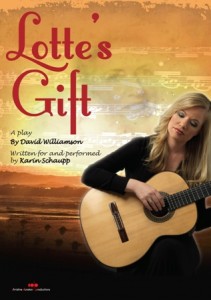 Another uncomfortable trip to the theatre tonight. I am not entirely sure why I didn’t enjoy this play, because on one level, it has all the things I love; a good story, great performances, and a novel approach to storytelling. And yet, it just didn’t engage me.
The play is a one-hander, and it is the true story of the performer’s grandmother, told through a conversation between them where the granddaughter learns her grandmother’s deepest secret. And yes, a single performer with dialogue does mean that old naff idea of the person jumping from one character to another; but no, that’s not why I didn’t like it, because that performer, Karin Schaupp, manages to change character effortlessly, and David Williamson’s ‘dialogue’ moves slowly, allowing the audience to move with her, and engage with the story. At least I think that’s the intention. Having failed to engage, I’m not sure.
This is where Lotte’s Gift left me in two minds. A good story, well told, and expertly written by one of the country’s best playwrights. But it was just too slow.
Tags: David Williamson, Karin Schaupp, Lieselotte Reinke, Trudy von Stein

All Shook Up is a take on Shakespeare’s
Twelfth Night, in case you didn’t know. I knew, and I think I missed half the show trying to figure out which characters corresponded to which
Twelfth Night characters. Why did I do that?
As we have come to expect from
Supa,
All Shook Up is a great show that doesn’t ask a lot of its audience. We joined the blue rinse set for today’s matinee. It’s not normally a good idea to go to a matinee, the audiences are usually a bit flat, and the performers suffer for it. This was probably true today, and yet what struck me was the technical precision displayed by the cast. Under the musical direction of Garrick Smith, the principal cast gave stunning performances of many of Elvis Presley’s most popular songs, supported by an equally impressive ensemble.
It was a great show, although not a patch on Supa’s recent productions of Buddy. It could have something to do with the music, but I think maybe I’m just a little too young to appreciate it the way the rest of the audience, who were mostly twice my age, did. It’s a good show, but for my tastes it needed a little less sugar.
Tags: All Shook Up, Christine Forbes, Emilie Van Os, Garrick Smith, Grant Johnson, Jacqueline Richards, Kat Brand, Pete Ricardo, Ron Dowd, Roy Hukari, Sarah Hull, Will Huang








 Foyer Talk