I’m just home from Las Vegas where I had the opportunity to see The Phantom of the Opera at The Venetian. What I have found fascinating since first hearing about the production is the idea that a theatre could be constructed specifically for one show; it seems at once wasteful and devout. The ancient Greeks invented the notion of an architectural entity devoted to theatre, and three thousand years seems rather a long time to wait for a theatre devoted to one show. Las Vegas, apparently, boasts two, but I only managed to see the Venetian’s Phantom Theatre. It is a spectacular representation of Paris’s Opera Populaire, complete with wax vestiges of Parisian high society in the nineteenth century in the balconies.
The custom build has allowed for some spectacular use of the fly tower to quickly present a myriad of different scenes and aid some very clever blocking. Effects including fireworks and flame throwers as well as a dancing chandelier and a rather clever gondola, not to mention the thickest smoke I’ve ever seen, cover a multitude of sins as the performers omit all pathos to avoid making a technical error. Not that it would matter if their performances were better; the audience simply wouldn’t notice with all the smoke and mirrors around (and, I might add, not all of the smoke is intentional special effect; Nevada’s lax smoking laws mean that cigarette smoke from the neighbouring casino fills the auditorium constantly).
I’ve said in the past that I like museum pieces; and apart from some impressive special effects, there’s little more of value in this show. Any student of theatre should see it, purely to flesh out their understanding of nineteenth century theatrical culture and gain a sense of the theatre’s layout. Of course, if you’re going to Paris you could go see the real thing, and probably get a better show into the bargain. The Venetian’s production, though, is also a fine example of theatrical precision, and execution, but little more. Dead flat characterisation and mechanical and unfeeling theatrical precision from the performers sucks what little life Andrew Lloyd Webber deigned to sprinkle into his book, and leaves you with nothing more than special effects to keep you entertained.
The big theatrical surprise of my trip to the United States is that the express version of Aladdin being performed twice daily (and often more) at Disney’s California Adventure Park shows the same technical precision and impressive technical effects while also portraying the story and characters with reasonable passion. It really puts the Venetian’s production of Phantom to shame. Still, that’s Las Vegas; the bright and shiny things are a very thin veil designed to distract the observer from the soulless decrepitude of the human condition. Andrew Lloyd Webber fits in perfectly.
Tags: Andrew Lloyd Webber, Andrew Ragone, Anthony Crivello, Kristi Holden, Las Vegas, Opera, Paris, Phantom, Phantom of the Opera, The Venetian, Theatre, United States
Erindale was alive tonight with Philo’s opening of 42nd Street. The froth and bubble of Broadway is generous if not really enlightening, and the cast delivered a fine performance of a quaint old musical.
The story is that of a talented girl who dreams of singing on Broadway. Her talent noticed, she lands a role in the chorus line and when she accidentally trips the leading lady, fracturing her ankle, she manages to take her place. Woops, did I give away the ending? No, I think that was the writer…
The rest of this post is published on Australian Stage.
Tags: 42nd Street, Adrian Flor, Al Dubin, Amy Fitzpatrick, Arts, Broadway, Broadway theatre, Canberra Philharmonic Society, David Merrick, Ele Wilcher, Harry Warren, Kate Tricks, Musicals, Performing arts, Philo, Theatre
It is unusual, I think, to hear about a play inspired by a statistic. It is not encouraging, either. Nonetheless, Bruce Hoogendoorn‘s play, The Clever Country, currently playing at The Street Theatre, takes as its theme Australia’s falling science enrolments, and does so—perhaps surprisingly, considering its inspiration—with great humour and an intriguing plotline…
The rest of this post is published on Australian Stage.
Tags: Australia, Brian Kavanagh, Bruce Hoogendoorn, David Villanti, Jaime Isfahani, Michelle Cooper, Performing arts, Theatre
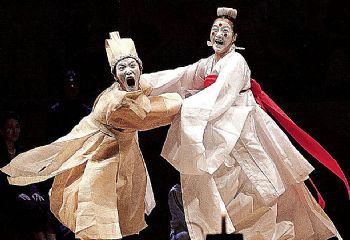
Having secured what I knew to be the last available ticket for Yohangza Theatre Company’s production of Hamlet, I was surprised to find myself sitting next to the South Australian Premier and his wife for the performance. The irony of watching a king’s downfall orchestrated through a theatre production while sitting next to the leader of a state government in a theatre was not lost on me, but I doubt that Mike Rann and his wife felt the same pangs of guilt as Gertrude and Claudius.
Played by Eun-Hee Kim, this Gertrude is perhaps not as guilt-ridden as some I have encountered. But whereas Gertrude is often portrayed with an underlying sense of her own moral corruption, Kim has given her an aloofness, lasting until Hamlet finally reveals his hand following the theatre scene. I prefer this change, as risky as it might be. It holds more weight with Shakespeare’s text, and in this production, in this context, it provides a profound shift in the character that is necessary to add depth for its Australian audience. This is not a criticism of the performers, but a play performed in Korean for a predominantly English-speaking audience can’t skimp on such details.
Hamlet certainly doesn’t. Played by Jung-Yong Jeon, his vacillations are as palpable as that fatal hit, and his descent into madness is beautifully paced; almost undetectable. Claudius could perhaps have emoted rather more; by both dress and demeanour he emerged more western than the rest of the cast. But in all, this cast expended enough energy and elicited enough pathos to warrant a standing ovation from the opening night audience (though the premier, notably, remained seated).
A minimalist set spares no effort, with a centre rostrum raised in the middle of what must be hundreds of kilos of rice, and surrounded by traditional Korean artworks, and Korean percussive instruments. These instruments are put to excellent use by the cast, whose timing and energy is perfectly synthesised. More intriguingly, Korean Shaman rites are used to ensure the story is at home in its Korean context.
This is a remarkably sensitive production of what I think is Shakespeare’s greatest work. It is faithful, if such a word can really be applied to any production of Shakespeare’s work later than the seventeenth century, to the characters, their motivations, fears and desires; as well as their circumstances. And it dispels in my mind any doubt that the stories of Shakespeare are absolutely universal in their application to humanity.
Tags: Claudius, Eun-Hee Kim, Gertrude, Hamlet, Jung-Yong Jeon, Mike Rann, Shakespeare, Theatre, William Shakespeare
Well, I’ve finally done it. More than twelve years after moving to Canberra, I have finally been to one of Rep’s winter variety shows. I recall that it was originally recommended to me in 1998 as an undergraduate beginning a Theatre Studies major at the ANU, as an excellent example of the music hall tradition, so there’s something bittersweet in having finally attended in the same week that the ANU’s Theatre Studies major met its demise.
The cast certainly delivers. After a slightly flat first half, which could be put down to opening night, the second was quite magical. Ian Croker’s rendition of Minnie the Moocher got the audience engaged, and Christine Forbes followed this with a beautifully theatrical The Girl from 14G, about which she bragged that she was overjoyed to be able to wear her pyjamas on stage!
I felt my personal cringe factor rise when we were informed that the finale was to be a rendition of Peter Allen‘s perfectly horrid canticle I Still Call Australia Home, but it dissipated completely with the cast’s magnificent send-up of the song’s overwrought history.
A variety show stands or falls on the energy of its cast, and this cast certainly works hard for their applause. After a flat start, the energy flowed and made Jazz Garters a fun and entertaining show, well worth a night out.
Tags: Arts, Canberra, Christine Forbes, Ian Croker, Jazz Garters, Peter Allen, Theatre
Another great show from the Impro Theatre ACT guys tonight. I have unfortunately missed the shows for quite a while, and I’m very impressed with both the standard of performance and the format used in tonight’s show. The show was non-competitive, and was centred around long-form improvisation. The long form very much suits the ensemble’s style, and the smaller presence of the MC also retains a greater degree of focus.
I was particularly impressed with the ability of this cast to reincorporate earlier plot lines, and tie up loose ends that had been left earlier in the show. I recall a few moments in the middle of uproarious laughter wondering why I was laughing, and realising that the humour was in the simple reincorporation of a theme that had been lost previously. This is one of the golden aspects of improvisation; that the enjoyment of the piece often has more to do with our engagement with the performers than the show itself.
Must get back to Impro more often…
Tags: Arts, Comedy, Impro Theatre ACT, Improvisational, Nick Byrne, Theatre
I have just handed over the reins of my current project, Take Their Life, to the stage manager, Joyce Gore. I thought I was scared of directing anything of Shakespeare’s before, but now I’m even more scared because I no longer have any control over what happens!
I have learned an awful lot from the experience of directing a sacred cow. Having only directed new, or relatively new, works before, I’ve never had to deal with strongly-established and conflicting interpretations of character before. The principles are the same: you look for various interpretations and pick the one that best suits your needs, but when there is such a wide range of varying interpretations, and when some of those interpretations are so firmly entrenched from centuries of analysis, it can be a tough call to pick the one that best suits our purposes.
All directors say it, but it really has been a pleasure to work with such a talented cast. They’ve amazed me at times with their capacity to take an idea I’ve had about how a character should act or respond, and incorporate that into a holistic expression of a character, which essentially is nothing more than a concept. I have found it quite humbling to watch those characters emerge from vague and shadowy ideas in my head into characters who stand and walk about and interact as if they’re real people.
So next stop is opening night, when we turn Shakespeare’s sacred cow into a profane one. I hope people enjoy it, but really, the best part of the experience of profaning a sacred cow is over, and after nine months in development, I am both breathing a sigh of relief, and beginning to fret about letting it go.
Chookas, cast.
Tags: adaptation, Diane Heather, Hannah Dawson, Jon Sharp, Joyce Gore, Melissa Savage, Performing arts, Pete Stiles, Shakespeare, Stage management, take their life, Theatre, William Shakespeare

Opening night of David Williamson’s Let The Sunshine and The Street Theatre was full. Well, you wouldn’t expect any less for one of Williamson’s plays, would you?
I would like to describe this play as an amusing double-autopsy of capitalism and socialism, but that hardly does the play justice. Williamson’s superb play demonstrates the inability of these two-dimensional political ideologies to deliver what they promise their adherents, through characters who, despite being built on one or the other of these ideologies, are forced to grapple with humanity in three dimensions.
I think some of Williamson’s best qualities as a writer are on display in this piece; the intricate crafting of character and plot is astonishing to reflect on. This, like most of his work, is a plot-driven story, but that plot is clearly driven by the characters, and their individuality, their connectedness and their ideologies dominate the plot. Without the cast of distinguished actors assembled by the Ensemble Theatre, the text could be very dense, but it resonates beautifully as a play for today.
Tags: ANdrew McFarlane, David Williamson, Emma Jackson, Ensemble Theatre, generation gap, Justin Stewart Cotta, Kate Raison, Let the Sunshine, Sandra Bates, Theatre, Toni Scanlon, William Zappa
 I love going to Theatre 3. There is magic in the place. I don’t care that the decor is old and tired, I only ever notice it for a moment, because before long you feel the atmosphere of genuine theatre lovers mingling and engaging, like Liberals in the Press Club or bikies in a pub. This was what it was like at Theatre 3 last night, especially straight after the curtain went down on the opening performance of I Hate Hamlet.
The plot revolves around Andrew, a successful television soap actor from Los Angeles, who relocates to New York after having agreed to play Hamlet in a non-profit production in Central Park. Problems arise when he reveals that he hates Hamlet, and mainly agreed to play the role because of his girlfriend’s love for the play. Fortuitously, the ghost of the late, great actor Barrymore, who once occupied Andrew’s gothic apartment and played Hamlet, can return to mentor Andrew through the process of preparing for the most important role of his life.
A couple of the people I spoke to afterwards expressed the same surprise I had; why had I not heard of this play? It was written way back in 1991, and is such an astute and passionate exploration of our attitudes towards Shakespeare that it shocks me to think that it isn’t part of the curriculum of every university’s theatre department. It looks quite deeply into the psyche of the greatest play of all time while still retaining a modern view that is unencumbered by social expectations about how we should view the bard. In short, it is respectful without being reverential. It treats the way society hallows Shakespeare with ridicule, while still holding a deep and profound respect for the man’s humanity, wisdom and power.
When I first started my academic career—after dropping out of high school and bumming around dead end jobs for a few years—one of the first pieces of literature from the English Canon that I encountered was Hamlet. I struggled with it, and came to some kind of understanding of it, rudimentary as it was. Over the years my love for the play has deepened. In the twelve years since first reading it I have seen more than ten stage productions and every film I could clap my eyes on, and I have never been disappointed by modern theatre practitioners’ capacity to glean some new kernel of wisdom from the pages. Just like Tom Stoppard’s Rosencrantz and Guildenstern are Dead, I Hate Hamlet further unpacks Shakespeare’s story, treating it as a living, breathing work of art rather than a museum piece.
Canberra Repertory’s production is simply brilliant, with the considerable talents and experience of Ian Croker in the role of Barrymore admirably matched by my old university classmate Glenn Brown as Andrew. Their swordfight was so much fun that I found found it difficult to resist the urge to get up and join in! The entire cast carries off the production brilliantly, with excellent comic timing (perhaps with a couple of hiccups that I am putting down to opening night), brilliant wit, and impeccable characterisation.
Now all I need is a show I can audition for with a sword fight…
Tags: Hamlet, I Hate Hamlet, Ian Croker, Paul Rudnick, Robert de Fries, Rosencrantz & Guildenstern Are Dead, Shakespeare, Theatre, Tom Stoppard, William Shakespeare
We went last night to the opening of Cosi, which was a great affair, as you would expect. Cosi is the story of a young graduate sent to direct a play with a group of patients at a mental asylum. Funny enough as a situation comedy, but Louis Nowra has deftly wound broad humour around a story about the importance of love over politics.
In this production, the comedy outshines the potentially didactic moralising, just as it should, and as a result, the moral stands on its merits, couched in comfortably broad Australian humour.
Bringing classics to the stage is what Canberra Rep does best, and when you stage something that is as well-known as an enjoyable play as Louis Nowra’s Cosi, you get to pick from the best actors Canberra has to offer. That’s what happened here, and it’s one of the main reasons this show is so enjoyable. This is a spectacular cast, and every nuance of Nowra’s characters is instinctively brought to life. They enjoy the show even more than the audience, I’m sure; and even with a few members of the cast needing to work hard to stifle a laugh now and then, they never missed a beat. Who can blame them? After working so hard to deliver the comedy of Nowra’s lines, to finally have an audience roar into laughter is a rewarding experience.
Canberra Rep’s Cosi is simply one of the best nights out you’ll find.
Tags: Canberra, Carly Jacobs, Così, Cosi, Ian Croker, Jim McMullen, Louis Nowra, Soren Jensen, Theatre
Director Garrick Smith is absolutely right to say that The Wedding Singer is not Shakespeare, but whatever it’s not, it is a lot of fun.
It is possible that opening night nerves got to the cast when I saw it; the first half hour or so was laboured and difficult to relate to, but then one of those great moments in theatre occurred, and the tenor lifted. It is a sign of a strong and talented cast when you see such a strong injection of energy in the middle of the first act. Before long I was tapping away and having a ball.
For those who don’t know, the musical version of The Wedding Singer is substantially different from the film of the same name. In this, it is the musical numbers that drive the emotional essence of the plot, and the most poignant of these are delivered beautifully by the magnificently talented heroine, played by Rebecca Franks, and her equally talented offsider played by Amy Dunham.
The musical is also funnier than the film, as I remember it, and Tim Sekuless’ timing is excellent. In my humble opinion, though, the best moment is when Boy George wannabe, George (played by Jeffrey van de Zandt) bursts into a rendition of an 80s pop song in perfect Hebrew. Gold.
No, it’s definitely not Shakespeare, but it’s a great night out.
Tags: Amy Dunham, Garrick Smith, Jacqueline Richards, Jeffrey van de Zandt, Rebecca Franks, Rose Shorney, The Wedding Singer, Theatre, Tim Sekuless, Wedding Singer, Will Huang
Chekhov bores me. There, I said it. I have spoken the unspeakable; Chekhov bores me. And yet, this play left me at a bit of a loss. How can you have a play that is thoroughly boring populated by characters that are infinitely intriguing? It should be an impossibility. But apparently it’s not.
To be perfectly honest, I thought Free Rain’s production of The Three Sisters to be the most profoundly astute and engaging interpretation of a thoroughly useless play I have ever encountered (and I have encountered many useless plays). Each character was carefully constructed, and portrayed brilliantly by a cast that has clearly engaged with Chekhov’s text on an intimate level.
Don’t take my description of Chekhov’s play as useless to be a negative thing. The play triggered thought, and because nothing seemed to happen, there was time to drift through thought without missing anything particularly important. Nothing was particularly important. At least, not to the mind of a cynical gen-xer like myself. But it would be nice if there were more opportunities to just sit and think.
This play is worth seeing twice, and I’m going back tomorrow. I’m hoping to be able to drift through those sections of the play that I didn’t drift through last time, and vice-versa.
Not the kind of play I would want to see every time I go to the theatre, but this was an opportunity not to be missed, and Free Rain should be commended on a splendid and invariably worthwhile production of something completely useless.
Tags: Anton Chekhov, Art, Catherine Mann, Chekhov, Drama, Literature, Soren Jensen, Theatre, Three Sisters
Now, I’m not in the habit of commenting on shows that I’ve written myself, but I can paste here a transcript of Bill Stephens’ comments on Mrs Holt, which is one of my own shows, which is currently showing at The Street Theatre…
Canberra Dramatics are a local theatre group which is committed to the development of new plays by playwrights from the city of Canberra and the surrounding region.
Their newest production, which is currently running at The Street Theatre until next Saturday 16th August is Mrs. Holt…written by Canberra playwright Trevar Alan Chilver.
I went along to the opening night of Mrs. Holt last Thursday night and discovered a thoughtful, entertaining and engaging play – not so much about aging – which I might have expected given the setting is in a nursing home ward – but more about changing attitudes and expectations between the generations.
I particularly liked the performance given by Gay Evans as an irascible, old patient called – intrigueingly – Zara Holt …who is the subject of the play.
I have not seen Gay perform before, but she is obviously an experienced actress – who has the ability to wring every ounce of comedy – and pathos – from her role to invest it with depth and interest.
Pete Ricardo, as the male nurse Jack Harris, also impressed with a well judged performance…the other actors in the cast Sarah Daphne, Sarah Ritchie and Cerri Davis.
Staged in a simple – effective and appropriate setting, this is probably the best play I have seen so far from Canberra Dramatics.and although it would benefit from eliminating some of the long black-outs between scenes which allow the pace to drop seriously… if you are at all interested in local playwrighting it is well worth your time to get along and see it.
Mrs. Holt runs at the Street Theatre until next Saturday 16th August. You can find out details of performances and performance times by ringing the Street Theatre or visiting their website.
Tags: Canberra, Cerri Davis, Gay Evans, James Scott, Mrs Holt, Pete Ricardo, Playwright, Sarah Foo, Sarah Ritchie, The Street Theatre, Theatre, Trevar Alan Chilver
I was interested to see The Role Model not only because it was written by a fellow Canberran, but also because of the praise it had received from the great Edward Albee. It is usually a mistake to assume that you will enjoy something as much as you expect to when it gets such accolades. Who can live up to such expectations? The Role Model certainly didn’t.
That’s not to say it’s not a worthy production; it is a great story, deftly performed by a cohesive and talented cast. It’s just that the script didn’t deserve the praise I heard. Much of the dialogue is awkward, and it doesn’t help that the lead actor, Raoul Craemer, attempts to portray an elite Australian athlete without attempting an Australian accent. Don’t get me wrong, there were some fine and genuinely funny moments, but this talented cast were let down by often unconvincing dialogue, and a director who allowed them to pronounce every ‘T’ in the script, which lent the already awkward dialogue a foreign and unfamiliar tone, which is not conducive to comedic impact.
Overall, an entertaining show, but this story had the potential to move me to both laughter and tears, and it didn’t do either.
Tags: Bruce Hoogendoorn, Edward Albee, Ellen Caesar, Ian Hart, Jethro Pitcher, John Honey, Kerrie Roberts, Raoul Craemer, Role Model, Theatre
I have long admired the work of Edward Albee. He’s pretty funny, for an American. And Moonlight’s production of The Goat, or Who is Sylvia was by far the most enjoyable thing I have seen on stage in Canberra since Rep did Noises Off last year. Wall to wall laughs were delivered by a talented cast under the direction of Bridget Balodis, who obviously understands timing and has an excellent command of the dramatic fluctuations of Albee’s work.
The play centres on the infidelity of Martin, and its impact on his small family. Jerry Hearn was assigned a difficult task in the role of Martin; to play a dramatic role in a comedy and do it well is an accomplishment in itself. Christa de Jager also toed the line very carefully between the intense drama of her role, and its comic one-liners. Sam Yeo, playing their son Billy, had a difficult time keeping a straight face as he began his hilarious journey, but his energy and timing, like that of the rest of the cast, was superb.
In all, a great night out. It was nice to be back in my old stomping ground of the ANU Drama Lab, but I was very disappointed with the enormous new seating: in order to avoid DVT I had to sit on an angle with my legs in the aisle, and crane my neck around to see the stage. The designers obviously didn’t consider the fact that many Australians are taller than a metre, or maybe they only expected children to be coming…
Tags: Bridget Balodis, Canberra, Christa de Jager, Edward Albee, Goat, Jerry Hearn, Martin Searles, Sam Yeo, Theatre






 Foyer Talk