About Trevar Alan Skillicorn-Chilver
Trevar Alan Skillicorn-Chilver is an authorised celebrant, a playwright, a teacher and quite a few other things!
I’ve never really liked stories about the Vietnam War. They have a tendency to either be so factual that they’re dead boring, or so esoteric that they’re unrelatable to anyone who didn’t live through that time. Patricia Cornelius has deftly sidestepped both potential faults in her heartwarming play, The Berry Man.
The rest of this post is published on Australian Stage.
Tags: Albury, Australia, Butter Factory Theatre, Conflicts and Wars, Darryl Cordell, Greg Stone, Hothouse Theatre, Ivan Donato, Maude Davey, Patricia Cornelius, Susie Dee, Vietnam, Wodonga
A great energy filled Canberra’s southern reaches tonight as local comedians warmed up a more-casual-than-smart audience for Smart Casual. Jokes about bogans (and boganism) predictably abounded, and were well-recieved by their targets. As well as these almost-obligatory barbs there were quite a few gems, particularly from the very sharp-witted Tom Gibson…
The rest of this post is published on Australian Stage.
Tags: Smart Casual, Tom Gibson, Tuggeranong, Tuggeranong Arts Centre
We have a fascination with firsts. Having our first female prime minister has a sense of novelty about it, which would probably be equalled by a first Aboriginal prime minister. Both the reality and the possibility, however, are little more than symbols of a maturing atmosphere of equality; they offer nothing of real substance in themselves. The Girls, I think offers something of greater substance in its diverse vignettes around the theme of womanhood in a postmodern world.
The rest of this post is published on Australian Stage.
Tags: Diana Nixon, Government, Hanna Cormick, Hannah Ley, History, Julia Gillard, Leah Baulch, Peter Butz, Prime minister, The Street Theatre
Some films are a chore to watch, but many of these reward the viewer’s effort with a character that lives on well after the film has finished. Greenberg is such a film. Its central character, who exists in a cloud of mental illness, faces a banal life, overshadowed by his failures and their impact on those around him. Miserable, perhaps, but the character is not merely recognisable; he elicits an empathy that outlasts his film.
This character, Roger Greenberg, superbly portrayed by Ben Stiller (who I had previously thought a mediocre actor) finds himself resident in his brother’s California home while the family is away after a stint in a psych ward in New York. His condition is never identified, and this is critical; he could be any one of us. Likewise the film’s heroine, Florence Marr (played brilliantly by the little-known Greta Gerwig), presents another kind of mental instability, and elicits a similar empathy.
It takes a special kind of writer to come up with an engaging script around the theme of mental illness, but that is precisely what writer Noah Baumbach has managed to achieve in Greenberg. It’s one of those films that survives being slow thanks to strong characters portrayed honestly and without a silly gush of emotion.
Tags: Ben Stiller, Greenberg, Greta Gerwig, Noah Baumbach
Images of an ageing Ghandi flit through my mind occasionally. They’re a cliché for political activism, akin to the image of Martin Luther King Junior’s infamous proclamation, “I have a dream”. These are epic images, and Ghandi’s in particular speaks of a life well-lived, and spent on something worthwhile. For the rest of us, our dreams—whether they’re as big as Ghandi’s or not—have a very tenuous relationship with the realities of our lives, but paradoxically these same dreams are usually the driving force in what an individual manages to achieve.
The rest of this post is published on Australian Stage.
Tags: Dylan Thomas, fortyfivedownstairs, Julian Meyrick, Martin Luther King, Patricia Cornelius, Patrick White Playwrights Award, Rhys Mc
Wil Anderson is, in my humble opinion, Australia’s most serious comedian. He may not admit it, but just about everything he says has a point, and most of those points are both scathingly critical and bitingly relevant. The only comedian that comes close to him is Paul McDermott, but his humour is very gentle by comparison, and almost exclusively aimed at politicians. Interestingly, both have spent formative years in Canberra, but the announcement that Anderson will be refitting the magnificent concept comedy The Gruen Transfer especially for the election makes me think twice about simply labelling him a ‘comedian’. The Gruen concept, which allows Anderson to refrain from making too many comments that aren’t funny, while still getting to a more salient point.
In the ABC’s weekly newsletter, Gruen Nation is touted to dissect the advertising of the parties and “decode what’s going on for the audience and point out the many strategies political parties use to influence voters”. In his rather more forthright style, Anderson himself describes the show as the “national bullshit detector”.
Analysing election campaigns is mostly about detecting disingenuity and calling candidates to account for their policies in the hope that voters may make an informed decision. Unfortunately, the media, which was enshrined in both our country and the Americans’ as a balancing force in government, is not particularly good at this. Probably because they no longer have the time to undertake thorough investigation, their work is driven by media releases, which are innately untrustworthy. These days, dissecting how political parties construct a sales pitch in the context of an election is the best way to analyse their motivations and question their integrity. We may even find that this heightened scrutiny is a game-changer for federal elections.
And if not, it’s still bound to be a great series.
Tags: ABC, Australia, Gruen Nation, Paul McDermott, Russell Howcroft, The Gruen Transfer, Todd Sampson, Wil Anderson
Every now and then a play comes along that leaves you feeling like you’ve just witnessed something important, but you’re not sure what. Winter’s Discontent is one of them. It is coherent, intelligent, demanding of its audience and at times funny, but I still feel like I missed something. Like there was something substantial, important, that the writer was trying to communicate, and I’m a bit of a goose for missing it…
The rest of this post is published on Australian Stage.
Tags: The Street Theatre, William Zapper
Well, I’ve finally done it. More than twelve years after moving to Canberra, I have finally been to one of Rep’s winter variety shows. I recall that it was originally recommended to me in 1998 as an undergraduate beginning a Theatre Studies major at the ANU, as an excellent example of the music hall tradition, so there’s something bittersweet in having finally attended in the same week that the ANU’s Theatre Studies major met its demise.
The cast certainly delivers. After a slightly flat first half, which could be put down to opening night, the second was quite magical. Ian Croker’s rendition of Minnie the Moocher got the audience engaged, and Christine Forbes followed this with a beautifully theatrical The Girl from 14G, about which she bragged that she was overjoyed to be able to wear her pyjamas on stage!
I felt my personal cringe factor rise when we were informed that the finale was to be a rendition of Peter Allen‘s perfectly horrid canticle I Still Call Australia Home, but it dissipated completely with the cast’s magnificent send-up of the song’s overwrought history.
A variety show stands or falls on the energy of its cast, and this cast certainly works hard for their applause. After a flat start, the energy flowed and made Jazz Garters a fun and entertaining show, well worth a night out.
Tags: Arts, Canberra, Christine Forbes, Ian Croker, Jazz Garters, Peter Allen, Theatre
Harry Brown begins with one of the most guesome scenes of urban violence imaginable. The purpose of this scene, almost unrelated to the rest of the film, is perhaps to numb us a little for what is to follow. The violence of Harry Brown is, perhaps, of the same calibre as Quentin Tarantino‘s films, but Daniel Barber’s use of violence is otherwise entirely incomparable. It is targeted, purposeful and meaningful to the same extent that Tarantino’s is aimless and vague.
Michael Caine is at his best in this film. In case you were wondering, no, he’s not funny; he strikes with absolute perfection that degree of pathos that could so easily turn into melodrama, without even a hint of going too far. He is supported by an impeccable script and visionary cinematography.
I have long been a devotee of those films that can take the most grotesque aspects of the human condition and appeal, even in that context, to our capacity for hope. Trainspotting was one of the first I encountered, and remains one of the best examples of the transcendental in film. Harry Brown certainly stands well beside it.
And in case you read my previous post about seeing Robin Hoodat Perth’s Picadilly cinema, you may be interested to know that Leederville’s art deco Luna cinema was the perfect venue for a film of this calibre!
Tags: Daniel Barber, Harry Brown, London, Luna Cinema, Michael Caine, Movies, pathos, Quentin Tarantino, Robin Hood, slums, Trainspotting, violence
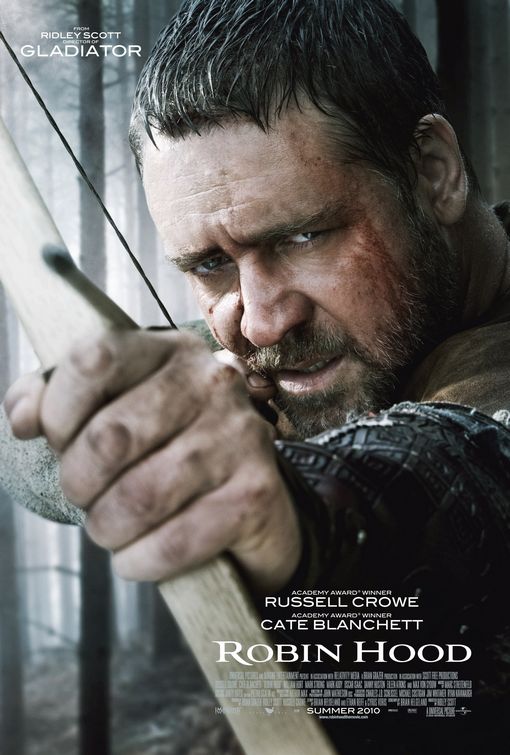
Robin Hood is a bit of a marathon, and if you have a comfortable seat and a few hours to spare, it’s a vaguely worthwhile pastime. Unlike other renditions of the myth, this film draws its impetus from political machinations, and lets go of the story’s usual plebian roots. Surprisingly, this is actually a good decision, as it provides not only a novel context for the story, but also broader relevance.
Russell Crowe plays his typical alpha male with a softer side, only this time with a funny accent. This novelty is complemented by extremely modern dialogue; making the film in many ways a counterpoint to films of Shakespeare’s plays that place sixteenth century dialogue in a modern setting. This is the opposite; playing twenty-first century dialogue in a twelfth century setting, with the added irony of a post-colonial actor playing the Old Country’s chief hero. My strange little mind would like to have heard Crowe’s cultivated Australian accent placed into the context to see what other meanings could be derived, but of course that wouldn’t do so well at the box office, would it?
And the box office is what this film is made for. It is formulaic, rudimentary and appeals to the same values as every other film about underdogs made in the last couple of decades. It does absolutely nothing to distinguish itself from that genre, and sits somewhere in the middle of Ridley Scott‘s very palatable aesthetic.
Of more note than this film is the venue I saw it in. Perth’s Picadilly Cinema is a quaint venue, reminiscent of Canberra’s Electric Shadows. That’s all well and good, but this film needs chairs with a higher back and a clearer view of the screen. I came out with a sore neck and tired knees. Every city, especially Australia’s western mecca deserves a Dendy or a Limelight.
A good film, but a bit meh.
Tags: Australia, Dendy, Electric Shadows, Picadilly Cinema, Ridley Scott, Robin Hood, Russell Crowe, Shakespeare
Animal Kingdom poses that age-old question about how many blood spatters are too many. I suspect that the creators were attempting to use blood spatters as a visual motif, as most of the spatters were of a similar consistency, evenly spread across a contrasting surface, but ultimately they just echoed the naff nature of the film generally.
There was a lot of potential here. After a slow start, the film did engage, and it did manage to take me to that serendipitous point at which you have to know what happens next, and the screening environment just melts away. A magnificent cast with a wealth of experience is admirably lead by newcomer James Frecheville. His treatment of the morose character he landed is remarkably compelling, and I think the cast is this film’s saving grace.
But overall, this is a truly disappointing film; not because it represents nothing of value, but because it really had a lot of potential that it didn’t live up to. An engaging story and some of Australia’s best actors are let down by a slow treatment in the editing suite and mundane cinematography. This one’s definitely worthy of a remake, perhaps even with the same cast, but it needs a more compelling treatment by the creative team.
Tags: Arts, Australia, Ben Mendelsohn, cultural cringe, David Michod, Guy Pearce, Jacki Weaver, James Frecheville, Joel Edgerton, Movies, Robert Pattinson
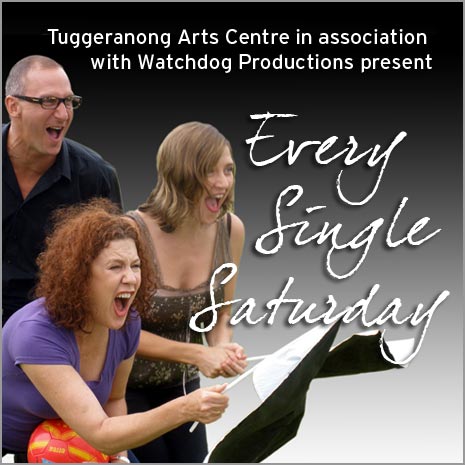
Before going along to see Every Single Saturday I must admit to a little apprehension. It is the same fear I face every time a conversation turns to sport or someone makes a comment vaguely sports-related and then looks at me as if I am expected to make a certain type of comment. That’s right, I’m a member of Australia’s smallest minority group: the Sports-Ignorant. Thankfully, although it really is all about soccer mums and dads, Every Single Saturday makes life easy even for the Sports-Ignorant. There’s even one of us amongst the characters!
The rest of this post is published on Australian Stage.
Tags: Australia, Daniella Lacob, Geoff Sirmai, Joanna Weinberg, Matt Young, Melanie de Ferranti, Paul Geddes, Recreation and Sports, Sara Grenfell
I was one of the privileged hundreds to get free tickets to Limelight Cinemas‘ preview of I Love You Too, with writer Peter Helliar in attendance. After some inane and worthless chatter from morning radio hosts Scotty and Nige, who ‘interviewed’ the rather more intelligent Peter Helliar, this unfortunate train-wreck of a film was underway. Perhaps ‘train-wreck’ is a little harsh; I think this film is more like a series of minor derailments, causing some mayhem on the commute to great Australian cinema.
The plot, although a little cliche, is nonetheless engaging, following the story of Jim, a commitment-phobic man in his early thirties who is threatened with losing his girlfriend. It suffers, however, from that age-old scourge of the comedian-writer; being interspersed with one-liners, which may be hilarious at the time, but seriously interrupt the progression of the plot. It is a problem that may have been resolved, had the writer been an unknown, but perhaps there wasn’t a dramaturge available who could confront Peter Helliar with the awful truth that some of these one-liners should have been ditched to protect the integrity of the narrative arc.
Admirable performances from Brendan Cowell, Yvonne Strahovski, Peter Dinklage and even Peter Helliar himself (who struggled to keep a straight face at times) couldn’t save the compromised script.
Australian film went through a period of producing only one genre of film. It was a cross between comedy and drama that worked very well for the period we were in, but our industry has matured, and our films are now more complex, influenced by a wider range of international cinema, and reflecting a more diverse Australia. I Love You Too does none of this. It harks back to a naive and self-centred Australia from sometime in the 1990s. It has some redeeming qualities, most notably its engaging plot, but it just doesn’t come together as a unified work, and is sorely disappointing.
Tags: Australia, Brendan Cowell, cultural cringe, I Love You Too, Peter Dinklage, Peter Helliar, Yvonne Strahovski
 Love Cupboard can be neatly summarised as the story of an adolescent girl who isolates herself from the rest of her life to live with her boyfriend (hence the love); and to avoid discovery, hides in a cupboard in his lounge room (hence the cupboard). The story is as quaint as its title…
The rest of this post is published on Australian Stage.
Tags: Arts, Cameron Thomas, Cathy Hagarty, Cupboard, David Atfield, Emma Gibson, Hanna Cormick, Peter Butz, Peter Matheson, Relationships, Romance, Scott Cummings, Tim Levy
Henry Lawson’s legacy is not an easy one to identify. It is wrapped up in the mystery of the Australian identity, which is now, as it was in Lawson’s day, straddled across the divides between urban and rural, between civilised and free, and of course between global and local. Max Cullen’s play, Faces in the Street, somehow manages to explore these weighty notions while remaining firmly grounded in the story of Lawson’s life…
The rest of this post is published on Australian Stage.
Tags: Australia, cultural cring, Henry Lawson, Lawson, Max Cullen, New South Wales
Well it’s time for another first… but this is scary!
I have just handed over a show to my assistant director, Seth Robinson, before the last two dress rehearsals! Now, I can’t complain too much. I’ve done this because I’m off to Fiji to attend my nephew’s wedding, but it really is scary to think that this show will go on without me. Even at opening night!
It’s not that I don’t think the cast is ready; they could open tomorrow and be fine, I’m sure, but I’m not ready to let it go! I mean, I’ve slogged away for the last two months with them, and they’re about to step up and perform, and I won’t be there to enjoy it!
Still, that doesn’t mean the rest of Canberra shouldn’t; so if you haven’t booked your tickets yet, call the Tuggeranong Arts Centreand tell them you’re coming!
Tags: Arts, Canberra, Don Wilkinson, Seth Robinson, Tuggeranong Arts Centre
There is an understated richness in every aspect of Toy Symphony. From the rigid, unforgiving box set, to the delicate simplicity of its marvellous performers, to Michael Gow’s unassuming dialogue, the play is replete with this marvellous juxtaposition of natural simplicity with deep pathos…
The rest of this post is published on Australian Stage.
Tags: Barbara Lowing, Chris Pitman, Danial Mulvihill, Ed Wightman, Geordie Brookman, Lizzy Falkland, Michael Gow
Another great show from the Impro Theatre ACT guys tonight. I have unfortunately missed the shows for quite a while, and I’m very impressed with both the standard of performance and the format used in tonight’s show. The show was non-competitive, and was centred around long-form improvisation. The long form very much suits the ensemble’s style, and the smaller presence of the MC also retains a greater degree of focus.
I was particularly impressed with the ability of this cast to reincorporate earlier plot lines, and tie up loose ends that had been left earlier in the show. I recall a few moments in the middle of uproarious laughter wondering why I was laughing, and realising that the humour was in the simple reincorporation of a theme that had been lost previously. This is one of the golden aspects of improvisation; that the enjoyment of the piece often has more to do with our engagement with the performers than the show itself.
Must get back to Impro more often…
Tags: Arts, Comedy, Impro Theatre ACT, Improvisational, Nick Byrne, Theatre
In Richard III, Shakespeare has left us one of the greatest challenges to the willing suspension of disbelief ever created; Richard is a foul and loathsome character, and yet every time I see the play, I am amazed at how much sympathy I have for the detestable excuse for a human being I am presented with. Everyman Theatre has left me in this state yet again.
The rest of this post is published on Australian Stage.
Tags: Adrian Flor, Arts, British, Duncan Driver, Duncan Ley, Helen McFarlane, Ian Croker, James Scott, Jim Adami, Literature, Peter Fock, Richard III, Shakespeare, William Shakespeare, World Literature














 Foyer Talk