About Trevar Alan Skillicorn-Chilver
Trevar Alan Skillicorn-Chilver is an authorised celebrant, a playwright, a teacher and quite a few other things!
Week 2 of the Short+Sweet Top 20 began in a very different fashion from the usual festival, with Joe Woodward sitting in a bath wearing a pair of angel’s wings and philosophising about the great question. It was a great start to a great evening of theatre, and I’ll admit I did get a little sentimental.
Short+Sweet really lends itself to great moments. The performance quality varies and the scripts are incredibly diverse, but even when the plays don’t live up to what you might hope for, there is often something that emerges statue-like from the stack. It puts me in mind of Patrick White’s metaphor of a squirming mass of eels from The Ham Funeral (if you haven’t read it, do yourself a favour).
Some moments are hilarious, and others are poignant, but in my mind they end up in a montage that makes me feel like I’ve witnessed a single, epic masterpiece. It’s those transcendent moments that make the trivial meaningful.
Ruth Pieloor’s caricature of the prime minister in For the Love of Their Country might have been the performance of the festival. Often I use the word caricature to denigrate sub-par performances, but Pieloor’s observance, emulation and emphasis of Julia Gillard’s mannerisms and very unique vocal qualities was identifiable, amusing and wonderfully distinct. It was caricature of the highest order, which is very difficult to achieve in live theatre.
I was similarly impressed by one of my former classmates from the ANU, Sam Hannan-Morrow, in The Brett I Haven’t Met. Simon Tolhurst could have directed his script in a very different way, with more direct action (as I understand it had been done in The Logues), but it would have lost the raw engagement with the audience that Hannon-Morrow was able to deliver.
There were a few moments, though, when I just wanted to get up and fix things. I loved Remy Coll and Sam Floyd’s concept for Insecurity Guard, and despite a couple of points where the dialogue didn’t quite carry the action, it has a pretty good script, but it really needed a director who wasn’t on stage. These two vey talented performers managed very well, but they needed that extra punch of clarity that an observing director provides.
There is no question that the final moment of the festival, the performance of Genevieve Kenneally’s Ah! was an inspired choice for that particular slot. The energy of Kiki Skountzos, Riley Bell and Elizabeth McRae was precisely what was needed at the end of such a varied night, but the highlight in my book was Smart Jimmy Slow Bob. Greg Gould’s great script was brilliantly delivered by a spectacular cast (Bradley Freeman as the unconscious boy was particularly impressive, I didn’t detect a breath!).
Everyone involved in this festival deserves a pat on the back, not just those I’ve tapped out some words about. Short+Sweet is a unique event in the annual calendar, and I hope it’s a permanent one. What impresses me is where the different people involved in the festival come from. Theatre folk whose paths don’t cross find themselves in the same dressing room for four nights in a row, and that can only be good for our theatre community. And of course with opportunities for those who prefer pure theatre to musical theatre dwindling, it is a particularly important event.
I have two scripts finished (at least to first draft stage) for the 2013 festival, and I hope the wonderful people who made this festival such a great success are around next year.
- Short + Sweet, courtyard studio from That Guy Who Watches Canberra Theatre
- Short & Sweet Canberra Final from the Canberra Dilettante
Tags: Bradley Freeman, Bruce Hoogendoorn, Canberra, Elizabeth McRae, Genevieve Kenneally, Greg Gould, Joe Woodward, Julia Gillard, Kiki Skountzos, Musical theatre, Patrick White, Remy Coll, Ruth Pieloor, Sam Floyd, Sam Hannan-Morrow, Simon Tolhurst, Theatre
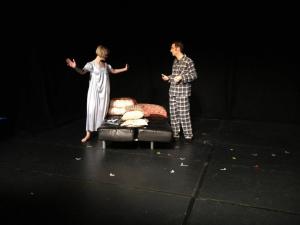
Connie challenges Charlie in ‘The Fence’
Last night I had one of those moments. You know, when something you’ve been working on for a while has come to fruition and is about to end. Theatrical folk do tend to go a little over-the-top experiencing these moments, but it is genuinely sad when you see a cast perform a show you’ve been working on for the last time.
So it was with The Fence and The Commuter in this year’s Short+Sweet. I didn’t realise until just before the lights went up on The Fence for the last time that it was the last time I’d see it. And then I realised it would be the last time I’d see them too (even if they get into the final next Saturday, I can’t be there because of a family commitment). For me they were the culmination of five or so pretty intense weeks of casting, rehearsing, preparing, and of course lots of laughing.
The cast I worked with on The Fence was just great. They were extremely committed to the show, so when the Murphy’s Law of Theatre (that if anybody can get sick s/he will) took effect, it was great to see the cast rally around, make changes to the schedule as necessary and finally plough right on through. The actor in question, Tony Marziano, was a trooper and a director couldn’t have asked for more in terms of commitment and effort, and the result was great. Katarina Thane gave a lot to the role of Connie, and I was so pleased to see the vision I had of this kind of suburban Lady Macbeth realised. And it was great to be able to catch up with an old uni friend, Arne Sjostedt, who played the neighbour, John, with great humour.
I hope it did justice to the writer’s vision. It was difficult to have to ask Coralie Daniels, the playwright, if we could cut the script when we found we were quite significantly over the ten minute time limit. The cuts we finally made did make a significant difference to the play’s reference points, but they gave us a stronger ending, and of course brought us within cooee of the time limit. My last play in Short+Sweet, Mr Fixit, was found to be significantly over the time limit, and the cuts were quite brutal. Not so with The Commuter, which I carefully restricted to seven pages (though it still comes close).
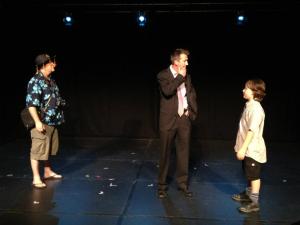
The Commuter deals with a strange kid and an American tourist.
I will never get tired of seeing characters that started as a vague image in the dark recesses of my mind come to life on stage. Arne was in this one too, bringing my American tourist to life, and young Henry Maley made a great precocious eight-year-old, with Gabriel Strachan as his aggressively protective mother. But of course it all came down to Simon Clarke’s portrayal of the commuter himself, and I was very pleased that he didn’t turn out to be either too ocker, or in any way a bleeding heart. This character could be portrayed in many ways, and I was really pleased with how closely Simon aligned the character to my vision.
The calibre of plays being performed in this week’s Short+Sweet really is impeccable. I was a little surprised, to be honest, having read Gerry Greenland’s script for Driving the Holden, with how well it translated to the stage. Sometimes you just don’t see the characters in reading the play, and Lis Shelley’s direction has served Dan Holliday and Nick Foong’s efforts well in bringing this story to life. It’s a very strong start to the festival. On opening night, it was disappointing to see the cast of A Short History of Weather drop a line in the middle of their otherwise impeccable performance, and I was so pleased to see the play again last night without the cicadas. They deserve an encouragement award for powering on, especially since the result last night was so effective.
But I think the play to fear in week one is definitely Spit for Tat. The sight gag of lovers spitting water all over each other is funny enough, but performers Scott Rutar and Caroline Simone O’Brien have backed it up with stellar performances that demonstrate some fantastic character development. Despite the somewhat fanciful nature of the script, they’re completely believable in every moment, and deliver what for my money is the standout performance of week one.
Short+Sweet has been a lot of fun, and I’m so glad I managed to participate this year. The Commuter will be available on my scripts page in a day or two, but it’s better to see it than read it, and unless the judges choose it for the Gala Final, tonight’s your last chance!
- The Fast and the Fabulous by Arne Sjostedt, Canberra Times
- Short+Sweet on HerCanberra
- Short+Sweet Brisbane 2012 (chilver.net.au)
Tags: A Short History of Weather, Alex Broun, Alex Dremann, Arne Sjostedt, Arts, Canberra, Coralie Daniels, Dan Holliday, Gabriel Simone Strachan, Gerry Greenland, Henry Maley, Jonathan Yukich, Katarina Thane, Kristin Louise, Lis Shelley, Nick Foong, Ryan Pemberton, Samuel Moynihan, Scott Rutar, Short+Sweet, Simon Clarke, The Commuter, The Fence, Theatre, Tony Marziano, Trevar Alan Chilver
 Tuggeranong Arts Centre‘s Women’s Theatre Forum is creating some great opportunities, and it’s encouraging to see regular performances in Tuggeranong’s magnificent theatre. My opinion is that in terms of space, acoustics and relationship between stage and auditorium, this remains the single best theatre space in Canberra, and it’s unfortunate it’s been such a struggle to see it used more. The set for Wyrd Sisters is one of the best I’ve seen in this space, so I was very pleased to see the auditorium so near to full for tonight’s performance.
They were a very responsive audience too. The sisters of the title did a great job with Stephen Briggs’ very clunky script, and attracted plenty of laughs with the one-liners scattered through it. Briggs really hasn’t given any of Pratchett’s characters much to work with, and a few moments fell flat on the back of his spartan and somewhat filmic dialogue and scenography.
The play has a huge and diverse cast of characters, and director Kerrie Roberts did very well at casting performers with complementing multiple characters, which can often be a confusing task. Overall it’s an impressive cast, although comic timing may not have been everyone’s forte.
As a play for the Women’s Theatre Forum, I am not sure it quite gives adequate focus to the witches, or to Duchess Felmet. The action and plot really centre on the ineffectual Duke and his fool, played by Tony Cheshire and Jonathan Sharp, both of whom I’ve had the pleasure of directing in other productions. Despite the strength apparent here, I would certainly have enjoyed seeing greater depth and greater attention for Janine O’Dwyer’s lovable Nanny Ogg, Elaine Noon’s forthright Granny Weatherwax, and Tracy Thomas’s young and idealistic Magrat.
Nonetheless, Wyrd Sisters is a funny and enjoyable show with an enthusiastic cast intent on engaging with their audience. You’ve got two more performances if you want to see it.
Tags: AJ Biega, Andrew Jackson, Ashley Davis, Bevan Noble, Caitlin Davis, Cerri Murphy, Chris Donohue, Christine Pawlicki, Dene Burton, Elaine Noon, Janine O'Dwyer, Jenna Arnold, Jonathan Sharp, Judith Peterson, Katherine Byron, Kerrie Roberts, Khiani Klaus, Liam Wilson, Michael Miller, Nina Stevenson, novel to stage, Pablo Latona, Peter Butz, Ralphie Kabo, Robbie Matthews, Stephen Briggs, Terry Pratchett, Thompson Quan Wing, Tony Cheshire, Tracy Thomas, Wyrd Sisters
Hearing that my play The Commuter had been chosen for the Wildcards in the Brisbane Short+Sweet Festival, I made some changes to a work trip and tacked on a weekend in Brisbane. So you can imagine my disappointment when I sat down in the theatre with the program, and couldn’t find my play listed!
I learned later that the cast had pulled the plug at the last minute, and there was nothing the organisers could do. So as disappointing as it was, all that was left for it was to enjoy the wild card entries that had made it. Not a particularly difficult task.
I was impressed with the calibre of these ten minute performances, most of which I’d have thought would have been worthy of the top 20.
Copstitutes told the story of twins who had inherited their mother’s brothel only for their first client to drop dead, turning them into instant private detectives. The performances were impeccable, and the energy admirable, right up until that two-thirds-through point when the action seemed to get lost. It seemed to me that maybe someone had fluffed a line and the cast list their mojo.
But for me the pick of the Wildcards was Tagalong Theatre Company’s It Came From the Couch, in which the cast’s incredible energy and focus told of impeccable direction from Dee Dee Shi and a tightly wound script from Chris Kestrel.
The one that took the position mine lost was particularly good, too. In On The Shelf an enthusiastic carrot and disillusioned celeriac meet a young cauliflower who has just arrived on the supermarket shelf and eagerly anticipates a nice cheese sauce. This one boasted a great script and some very generous performances from Brea Robertson, Bek Groves and Chris Charteris.
It was interesting to be around the theatre before the Gala Final too. The number of people who arrived and greeted each other like old friends really demonstrated one of the best aspects of Short+Sweet; the way it develops a community around it and brings the whole experience to life.
So despite my disappointment, it was a great show, and I’m glad I got to see it. I’m more keen than ever to see how The Commuter goes in Canberra this week, and today I’ve got a first draft of another script ready to submit for Short+Sweet 2013.
Short+Sweet Canberra opens on Wednesday 22 August at the Canberra Theatre Centre, and The Commuter is in the first week of the Top 20.
Tags: Brisbane, Canberra, Canberra Theatre Centre, Short+Sweet, The Commuter, Theatre
 Opening to an enthusiastic crowd, it was difficult not to marvel at the novelty of The Omega Quest. All manner of lighting tricks, cultural references, and visual gags are brought together beautifully by some very talented puppeteers in this very modern incarnation of a three hundred year old storytelling tradition.
Borrowing its style from the seventeenth century Japanese Banraku tradition, and its story from the twentieth century American space epic tradition, The Omega Quest is novel, but it’s more than a novelty…
The rest of this post is published on Australian Stage.
- Review of The Omega Quest on Caleb’s Finklings
- And another from Puppetry News Blog.
Tags: action, Alex Nguyen, Alice Pollard, Banraku, Benji Groenewegan, Cam Faull, Chris Peard, Deiter Barry, Francis McMahon, Holly May, Jayden Lyons, Jodi Thiele, Josh Karlik, Meg Scerri, Mel Loomhen, Miyuku Wantanabe, puppets, Revolt, Romance, Romesh De Silva, Ryan Hodge, Sorjeri Tane, space, Steve Hodge, Tegan Rose, Tim Mager, Tim Sketcher
 We’ve seen plenty of films centred on the victories of the Civil Rights Movement. Most are quite interesting but the bulk of them seem to float in the ether of the social and political significance of their subject matter, and don’t make a particularly smooth landing in the grit and grime of reality. That criticism can’t be levelled at The Sapphires.
Inspired by the true story of the writer’s mother, who toured Vietnam during the American War, The Sapphires portrays three sisters and a cousin, young Aboriginal women who in 1968 are discovered by a drunk Irishman who can barely hold down a job but has a great passion for Soul music and recognises a talent. Auditioning for an American military talent scout, they are recruited and find themselves on their way to a war zone.
The story veers close to the heavy themes of racial discrimination, the Stolen Generation, and the moral predicament of the Western powers in Vietnam, but deftly avoids wallowing in them, instead focusing on the narrative of a family. It is remarkably how carefully balanced this story is, since it could so easily drop into a tirade on the heavy themes it skirts, but instead focuses on the triumph of hope and perseverance.
The Sapphires is distinctly the product of the early twenty-first century. It looks back at this period as a critical juncture in world history, a point when the usual shift in cultural values across the western world took on seismic significance and fundamentally altered the way we see things. And unlike most films that try to do this, it doesn’t preach, it doesn’t overstate the political and cultural significance of its subject matter. It just tells the story of five young people experiencing change at the crossroads of world culture. This is cinema at its best.
Tags: Australia, Chris O'Dowd, Civil Rights Movement, Deborah Mailman, Eka Darville, Jessica Mauboy, Keith Thompson, Miranda Tapsell, Shari Sebbens, The Sapphires, Tony Briggs, Tory Kittles, Vietnam, Vietnam War, Wayne Blair

There seems to have been a slew of films about journeys or pilgrimages from American film makers lately. Either that or I’ve just started noticing them. At any rate, I haven’t seen any as good as The Way.
The film, written by Emilio Estevez (who I had no idea could actually write), is the story of a man who finds himself walking El Camino de Santiago following the death of his son on the pilgrimage, and whereas most of these pilgrimage films I’ve been seeing are either a little light on character or a little too heavy, The Way has just the right balance, and drives forward beautifully, even surviving some very obvious product placement.
It could be a tearjerker if you’re that way inclined, but unlike others that could fit that bill, it doesn’t go out of its way to try to generate a deeper pathos than is necessary, and this is so very refreshing, especially from the Americans. This is the kind of story I want to be able to write.
Of course, the problem with pilgrimage films is that they give me itchy feet, but I always seem to be wanting to go somewhere, so I don’t suppose that matters much. Anyone want to join me in Spain in a decade or two?
- The Way (growingyoungereachday.wordpress.com)
- Sheen, Estevez write moving memoir (goerie.com)
Tags: Emilio Estevez, Film, Martin Sheen, Pilgrimage, Spain, United States, Way of St. James
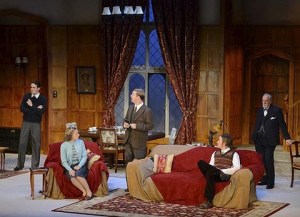 Taking over (quite ironically) from Ngapartji Ngapartji on the Playhouse stage, Agatha Christie’s The Mousetrap is a tightly-directed period piece as formulaic as it is popular. Come this November, it will have been playing on the West End for 60 years, and already boasts in excess of 24,000 performances.
This quintessential murder mystery funnels a number of Europeans into one room, kills one of them off, and eventually reveals who done it. The complications to Christie’s basic formula in this instance include a couple setting up shop as a guest house; a range of guests, each with their own oddities; a blizzard cutting them off from the outside world; and a potentially intriguing story about a tragedy from almost two decades earlier that took place on a farm neighbouring the guest house. These additions constitute one of Christie’s better contributions to the murder mystery genre, and make The Mousetrap a memorable play.
In this production, a talented cast delivers admirably on Christie’s characteristically verbose script. Christy Sullivan, in the role of Mollie Ralston, holds the play together, and Travis Cotton’s Christopher Wren breathes a little life into the production, but on the whole the performances seem altogether too mechanical, lacking a depth…
The rest of this post is published on Australian Stage.
Tags: Agatha Christie, Christie, Christopher Wren, Christy Sullivan, Crime fiction, Gary Young, Gus Murray, Jacinta John, Justin Smith, Linda Bewick, Linda Cropper, Louise Withers, Matt Cox, Michael Coppel, Mousetrap, Nicholas Hope, Robert Alexander, Suzy Strout, Travis Cotton, West End theatre
 The Butterfly Effect is often used to describe the confluence of seemingly unrelated and remote causes to social, political or psychological effects that are otherwise beyond comprehension. On seeing Ngapartji Ngapartji tonight, my first thought is whether writer Scott Rankin was aiming to use Maralinga and its aftermath as irrefutable evidence of the Butterfly Effect beyond the realm of physics.
In this epic work, Trevor Jamieson tells the story of the Maralinga nuclear weapons tests from the perspective of the Anangu people of the Western Desert. Through narration, song, mime and film, Jamieson and the rest of the cast pull together loose threads of culture, language and political history into a compelling piece of theatre, but what is truly remarkable is how, from the Anangu perspective, the confluence of…
The rest of this post is published on Australian Stage.
Related articles
Tags: Anangu, Anungu, language, Maralinga, Nguru, Pilu Nguru, Pitjanjatjara, Scott Rankin, Trevor Jamieson
So I was scrolling through Facethingy for something interesting this morning, and lo and behold, I was successful. That doesn’t happen often!
I came across a link to a new blog about theatre in Canberra. Again, anonymous, and seemingly a little critical of Canberra’s slightly longer-standing anonymous critic, Max, who’s had a six-month head start and has ruffled a few feathers. This blogger, who goes by the title That Guy Who Watches Canberra Theatre is rather more modest and wants to increase conversation about theatre in Canberra, which I appreciate rather more than Max‘s claim that whatever s/he thinks is Gospel. Well, I congratulate That Guy on that, and wish him all the best. I also look forward to offering the odd pingback where we happen to post about the same show.
My one little hesitation is that I’m not fond of the anonymous critic idea generally. It has some merit, since it allows the critic to be completely candid about people s/he might otherwise just pay lip service to, but it also encourages that most useless form of criticism, the attack. Max has been known to tear artists down under the rather bemusing motto of being “objective, honest and accurate” (objectivity is of course impossible in a critic, who by definition must take a position; and an accuracy of opinion is hardly something to distinguish any individual critic from any other (for all anyone knows every critic’s expression of his/her opinion has always been accurate); though I value the honesty). Max is rarely as aggressive as the worst of the critics at the Crimes (a significant achievement!). So while I can understand why a critic might want to remain anonymous, and don’t really object, I just don’t see enough value in anonymity. If opinions are personal, they should be owned by a person and not paraded about as gospel.
I’m aware I’m sitting in a glass house here; I haven’t always focused on what I like, which was my intention for this blog when I started it four years ago. But nonetheless, I stand behind my opinions and own them. My real name is all over this blog and everything that links to it, and anyone can click through or search for my Facebook or Twitter accounts to hurl abuse right back at me. There are photos of my face so that if you don’t know me and you object to something I write you can approach me the next time you see me in a theatre foyer and punch it. Even my phone number is here, freely available for you! Anyone can post a dissenting point of view in response to my posts, and know who they’re having a conversation with. When I review for Australian Stage, I need to be more forthcoming, and I don’t get the privilege of simply not writing about shows I really don’t like. On my blog, though, I can just speak my mind about what I do like and save my vitriol for Andrew Lloyd Webber, who truly deserves it for his criminal aversion to character and plot.
At times, I’ve found myself and people I’ve worked with desperately discouraged by the Crimes’ most viscous and disreputable reviewers, and though their reviews aren’t anonymous, I fear the same level of vitriol could develop as a result of Max and That Guy‘s anonymity. It doesn’t really help, and this kind of critic potentially leads great artists to quit and exit the field based on one irrelevant person’s opinion before they’ve created their greatest work or found what they’re really good at. I prefer the philosophy of pointing out what I value and hoping the artist does more of that. I certainly hope that no artist I’ve been critical of sees my opinion as being more important than anyone else’s.
The two posts currently up on That Guy‘s blog are reasonably balanced and positive, so I guess time will tell whether the anonymity will be a blessing or a curse. I just hope it doesn’t become a haven for discouraging the wonderful artists who make up Canberra’s theatre community. Overall, it’s just great to have another blog about Canberra theatre around, and I’m looking forward to a greater diversity of opinions being expressed (especially because That Guy‘s no great fan of Andrew Lloyd Webber). Have a look at his review of Free Rain’s Cats here.
Tags: Andrew Lloyd Webber, Australia, Canberra, Cats, criticism, Facebook, Free Rain Theatre, Max, That Guy, Theatre, theatre criticism, Twitter
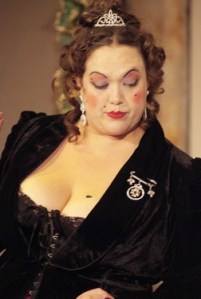 What a shame not to have made it to opening night for this fun little gem! The Wednesday night audience I joined was rather small and far too subdued for such a funny play so energetically brought to life by Centrepiece Theatre, but it was a lot of fun anyway.
I think this may be the third production of Moliere‘s work that I’ve seen from Centrepiece. The Miser, staged in 2005, remains one of my fondest memories of a night of comic theatre, and I think there was another in between. It has been some years, though, and too long to wait for another instalment.
This largely-forgotten and very old play rests on the even older plotline of marriages arranged by parents that don’t meet the expectations of the betrothed, but its genius plot twist is that the central character, Argan, is the imaginary invalid of the title, a wealthy hypochondriac trying to marry his daughter to a doctor in order to save money on medical bills. It was Moliere’s last play, and though he was playing the lead role in its premiere, he collapsed during the fourth performance and died shortly afterwards. Some say this is irony, but it seems Moliere’s malady was apparently not adequately imaginary!
The cast deserves a medal for their magnificent performances. Erin Pugh would upstage the entire cast, were her over-the-top mannerisms not generous to a fault. Her ability to be so very expressive (and excessive) while still drawing attention to other performers is remarkable, and I am not trying to dismiss the high calibre of performance delivered by all members of the cast, but this production definitely belongs to Pugh!
I am not intimately acquainted with the script or story of The Imaginary Invalid, but it struck me that, in comparison to the performances of the rest of the cast, Tony Turner’s Argon was rather subdued. Perhaps this is part of the text or a directorial choice, but it seemed to me a rather significant gulf. Not an entirely inappropriate one, though; just slightly unbalanced and maybe a little awkward.
The cast worked tirelessly to raise the energy levels, but it was a tough ask with such a small audience in such a large auditorium, and the performances fell short of their potential not through a lack of quality material in the script or technical difficulties or a lack of talent, but simply because the energy levels of the performers really need, in a production like this, to be matched by the energy levels of the audience. It really brings to the fore the difficulty of finding an appropriate venue in the capital. For this production, The Q was just too large. The Courtyard at Canberra Theatre Centre would probably have been better, but that’s awfully picky. It would be better yet if Canberrans would simply turn off The Voice (that steaming pile of… nevermind), get off their lazy arses, and go see some performers with both talent and an eye for a good material. But we all know that’s not going to happen, which is why I think we need more smaller venues. We have nothing really to match Sydney’s Belvoir or Stables theatres, and that’s a shame, as these theatres have just the right sort of atmosphere for our ‘crowds’.
But I digress. This production is all about a little bit of silliness, and it is admirably carried by a spectacular cast whose generosity in engaging the audience is faultless.
Tags: Argon, Belvoir, Benjamin Russell, Cameron Samuell, Cameron Thomas, Canberra Theatre Centre, Cate Clelland, Courtyard, Emma Sekuless, Erin Pugh, Imaginary Invalid, Jim Adamik, John Lombard, Jordan Best, Kiki Skountzos, Miser, Molière, Riley Bell, Tegan Ricketts, The Q, The Stables, Tony Turner
 Playing at The Street Theatre this week is Monkey Baa’s latest incarnation of one of Australia’s best-named plays, The Bugalugs Bum Thief. No, it’s not quite Shakespeare, but it’s closer than one might assume.
Its central character, Skeeter Anderson, just one young member of Bugalugs’ coastal community, wakes up one morning to find his bum is missing, which proves inconvenient for him. He soon finds that just about everyone in town has had their bum stolen, including his friend Mick Misery, for whom it is not so inconvenient, as it means his mum can’t smack him. The advantages of life without a bum, however, do not prove to outweigh the disadvantages, and Skeeter sets out to identify the bum thief and locate everyone’s bums.
The entire town is brought to life through the generous energy of just three performers who present mums, dads, teachers, police and sailors as well as their main role as a child. It may not be universally accepted as a compliment, but Gideon Cordover, Carl Batchelor and Mark Dessaix make excellent children, which is particularly helpful when…
The rest of this post is published on Australian Stage.
Tags: Australia, Bugalugs Bum Thief, Carl Batchelor, Eva Di Cesare, Gideon Cordover, John Saunders, Mark Dessaix, Mark Thompson, Performing arts, Sandra Eldridge, Theatre, Tim McGarry, Tim Winton, Toby Knyvett
The few people who read this blog may have noticed some changes. I recently moved it from Blogger to WordPress (which was a great move, by the way), and I’ve overhauled its categories and tags. That’s all pretty superficial though. The real change has been longer and more gradual, and represents an evolution in what this blog really is.
I started this blog four years ago following a series of conversations with Canberra theatre folk who were particularly disappointed with the quality of theatre criticism in Canberra. My intention was to do what most Canberra critics didn’t do: write nice things about good theatre. Of course there were a few critics at the Crimes and other media outlets who tried to be constructive, but most just berated performers, writers and directors and like many others I found myself on the receiving end of their overwhelming efforts at comprehensive discouragement. I wanted to be an encouraging voice.
So much for my good intentions.
I have tried to be positive in this context, and there have been plenty of times when I just haven’t written about a production because I found it actually lived down to the critics’ expectations[1]. But things change. I started writing for Australian Stage, and unlike a blog post where I can just be myself and say what I liked, in that context I have to be more objective. I also started writing about films, which I love just as much as theatre; and sometimes television can be just as cathartic a dramatic experience, so I started writing the odd post about television. And when my day job started flying me interstate every month or so, I started writing about shows outside Canberra.
And in the course of all these changes I also discovered that writing blog posts about what I liked had a really positive impact on my own writing. I knew more instinctively how to build characters and structure narratives because when I wrote about other people’s shows, I reinforced the positive responses in my mind. The very act of writing a blog has become something like a journal of my post-tertiary education.
And that’s why I don’t care that so few people read it.
But since my blog has become such a cathartic procedure in my development as a playwright, I’m starting to think I should be more deliberate about that. Although I’ve put up a page offering samples of my script, I haven’t written about the process of submitting those scripts to competitions in the hope that someone somewhere with the power to do something about it will do what needs to be done to get the damn thing staged. I should. And from now on, I will.
And that leads me to the request I started writing this post for. If you’ve read this far into my blathering about nothing much really you may have realised that ‘Foyer Talk’ is not a name that sums up what this blog has evolved into. I wasn’t even happy with it when I named it four years ago. I see blogs all over with much cleverer names, and someone called Trevar should definitely have a clever name for his blog.
So, I’m asking you; can you think of a better name for my blog? It needs something that captures the blog it’s evolved into. I’ve thought of “Caterpillar Dreaming”, but that’s über naff and not very clever at all. I also thought of “e-merging playwright” but that’s even naffer than the other, so I’m useless at this. It sometimes takes me months to name a play, so I’m in no hurry with this process, but I would love your help.
And if you happen to come up with the cleverest and not-at-all-naff name, I might just reward you by taking you to the theatre with me[2]. Or punish you by taking you to the theatre with me, if that’s the way you want to look at it. Either way, you’ll get something for nothing.
[1] NB there are other reasons why I might not write about a show, including my rule that I don’t write if I can’t do it within a few days of seeing the show, so don’t assume that if you’ve seen me at your show and I didn’t write about it that I didn’t like it! Or, if you know it was bad, maybe you can assume that!
[2] As long as you live in Canberra. If not, you’ll have to come visit me in Canberra. Unless you happen to live in an interstate capital where I visit occasionally. Or Singapore, where I’m going in October. Terms and conditions apply. I don’t know what they are, but I will figure that out when we come to it. Just suggest a name or two!
Tags: blog, Canberra, name change, Theatre
 I’m a sucker for an immigration story, and Joanna Weinberg’s latest offering, The Piano Diaries, starts with one, so I was engaged from the get go with both her story, and her intoxicating voice.
I know I commented on a recent post that I might not be a particular fan of cabaret, but this was marvellous. While The Piano Diaries doesn’t have a plot in the conventional sense, Weinberg’s autobiographical stories are wonderfully full of the froth and bubble of life, flowing from the joys of a child’s fascination with her parents’ happiness to the darkness of witnessing racial vilification. These stories, fragments of a life story, provide a backdrop for the seemingly-effortless grace with which Joanna engages her audience.
London-born Weinberg grew up in South Africa (yet another reason for my interest; stories of South Africa fascinate me) and much of the material for this show is inspired by her childhood and youth in South Africa, with much of the remainder relating to her migration experience in coming to Australia. The Winds of Fear explores this, with its humble reference to the South African migrant as the “privileged of the refugees”. The unique perspective of South African Australians on this topic is refreshing, and Weinberg’s stories really speak to the immense value of a diverse society.
Weinberg took joy in complimenting Tuggeranong, even likening its Town Centre to Florence, repeatedly! No compliment was received with anything less than a hearty laugh by Tuggeranongians, who apparently take much less delight in the simple beauties of a well laid-out urban entity. It is Weinberg’s simple delight in the varied experiences of her life that make this show so charming, though. It is wonderful to just hear stories gleaned from life experience that then translate so beautifully into song, and the articulation between story-telling and song is what makes this show really special.
If nothing else, I’m finally sold on cabaret.
Tags: Africa, Australia, Florence, Joanna Weinberg, London, migration, piano, South Africa, story, Tuggeranong
 A friend’s intention to go see the National Theatre Live screening of Frankenstein this afternoon prompted me to tag along, and am I ever glad I didn’t miss this masterpiece! I’ve been a fan of this story since reading Mary Shelley‘s novel while at uni (this was extra-curricular and yes, I’m that big a nerd!). I have also been impressed by a film adaptation, namely Kenneth Branagh‘s 1994 one, which really brought the novel to life, but I cannot say that either of these seemed more pertinent to my own experience of the world than this play.
Nick Dear‘s script is a fascinating piece of material. A long portion of the beginning of the play proceeds with very few words, and as a playwright I know how difficult it is to craft a play without words. It is, in this instance, essential that this portion of the play not be crowded with words, not only for the sake of the story, but also to draw the focus to Frankenstein’s creation, rather than Frankenstein. It establishes a connection with this character that grounds the rest of the story, and really does take it to a different place from where Mary Shelley positioned her reader.
And it is this positioning that really establishes Nick Dear’s play as a twenty-first century product. The play insists that the audient be confronted by the ethics of creation and the assumption of scientific logic as the supreme voice of reason. And yet, it does this in the absence of a divine. Humankind, refreshingly, is not repositioned as god (as seems to be the fashion), but instead as a more humble, responsible denizen of the world, such as would not have been considered in the early 19th century. Several critical moments of realisation for Victor Frankenstein, played superbly by Benedict Cumberbatch in the version I saw, underpin this reading, and it is the sign of a talented playwright that the character can be so fully formed, and yet still embody such lofty notions without a little compromise.
But all that is very philosophical for a Sunday afternoon. The real joy is seeing these themes explored with such unassuming grace. The set seems to remodel itself with ease (which of course indicates that there is nothing at all easy about it), and the music likewise supports these amazing performers to create magic. The NT Live recording of course doesn’t quite emulate what must be an amazing effect created by what must be thousands of incandescent globes above the stage and auditorium.
What’s really impressive, though, is that a stage production is able to be translated to screen as well as this. Apart from a few moments when the editing left me feeling that a cut had been rushed, and what even the most pedestrian of actors (which these performers certainly are not) would have treated as a pause or silence was instead cut abruptly to the next bit of action, the translation of a stage production into, essentially, a film that can be screened anywhere around the world, is remarkable. I am astounded by the way it has worked, and although I had some hesitation about jumping on the NT Live bandwagon, if this is an indication of what they’re doing, I’m a convert.
Tags: Benedict Cumberbatch, Frankenstein, Jonny Lee Miller, Kenneth Branagh, Mary Shelley, Mary Shelley Frankenstein, National Theatre Live, Nick Dear, Theatre
 Seems to me one of the most common accusations levelled at some films is that they’re predictable. And of course they are. Most films are made to be sold, and sold within a particular genre. Salmon Fishing in the Yemen deftly avoids such categorisation, and is one of the best character-driven films I’ve ever seen.
Of course the problem faced by film makers who choose material like this is how to sell it. Having seen clips for it, I mostly dismissed it, and only made the effort to see it when I had just seen a whole bunch of films and wanted another. It was not my first choice, but of all the films I’ve seen this week (and I’ve seen a lot more than usual this week), this was the best.
The story is centred on a couple of public servants who find themselves at the centre of an exercise in international relations. Emily Blunt plays a consummate professional who has mastered the art of eternal optimism. And Ewan McGregor plays an infinitely more staid and predictable realist. These two find themselves pursuing the whimsical dream of a Yemeni Sheikh, played engagingly by Amr Waked, to introduce the sport of Salmon fishing to his dry homeland.
The story charts an unpredictable course through the ups and downs of the project, but along the way the central characters, even the Sheikh to some extent, become intensely human as they navigate life. It sounds corny, I suppose, but this really is an intensely human story, with all the pathos you could wish for, and none of the schmaltz. How screenwright Simon Beaufort and novelist Paul Torday managed this, I don’t know, but I take my hat off to them. I wish I could be relied upon to write like that.
Salmon Fishing in the Yemen has become one of my favourite films, just like that.
Tags: Amr Waked, character-driven, Drama, Emily Blunt, Ewan McGregor, Kristin Scott-Thomas, Paul Torday, Salmon, Salmon Fishing in the Yemen, Sheikh, unpredictable, Yemen
 The thriller has not been a genre that has appealed to me greatly, but over the last few years a few of them have started to change that. Wolf Creek was one of the first, and The Ghost Writer was probably the most recent to impress me. Swerve can now be added to that list.
Starting with an exchange of drugs and money that doesn’t go entirely to plan, mild-mannered Colin (David Lyons) gets mixed up in a web of deceit, corruption and tangled motivations that don’t just keep you on the edge of your seat, but also keep your mind on its toes trying to remember who knows what, who owes what to whom, and where stuff is. In fact, this web of complications is almost too tangled, but I think the film survives thanks largely to two brilliant central characters expertly portrayed by Emma Booth and David Lyons, neither of whom I’ve ever encountered before.
Several action scenes involving car chases and accidents exemplify the elegant simplicity in this film’s cinematography, and that’s no mean feat. Perhaps its thanks to cinematographer David Foreman‘s background in television, but the action is brilliantly pared back to ensure that the focus remains on the characters and their objectives, contrary to what a lot of film makers tend to do. This is absolutely essential for a thriller, otherwise all you get is stunts and acrobatics, which I find far less satisfying than the thrill of seeing characters I care about in danger. As a result, the film as a whole stands up against its complicated plot and the occasional continuity error.
The sense of fear is palpable, and the film maintains an ethereal atmosphere without losing its grounding. This one is worth watching over and over again.
Tags: Broken Hill, Craig Lahiff, David Foreman, David Lyons, Emma Booth, Ghost Writer, Indian-Pacific, outback, South Australia, Wolf Creek
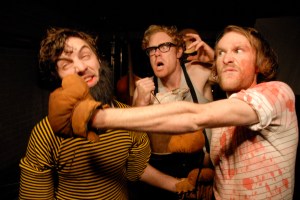
This, believe it or not, was my first experience of cabaret. Well, at least my first experience of cabaret with the name ‘cabaret’ plastered all over the place. I’ve experienced cabaret before, it seems; I just wasn’t quite sure it was cabaret. This cabaret performance, however, was deemed to be cabaret by the people who run the Cabaret Festival in the capital city of the Festival State. Being quite unaware of what technically constitutes cabaret, I think these are the people to trust. And the experiment was worthwhile.
The Suitcase Royale, creators of The Ballad of Backbone Joe, are a tidy little Rag’n’Bone trio from Melbourne who’ve played at a range of festivals and events around Australia, the UK, US, Ireland and Germany. For a taste of their sound, have a listen to this. Their music is right up my street, and given the nature of cabaret, that’s the best feature. I could have forgone the story of Backbone Joe, who I never really came to care about (or possibly even understand), and I would have enjoyed listening to a little more of the music these guys created with such incredible vim! I would have enjoyed just as much some more of their humour, which was impeccably timed.
But seriously, I don’t see myself becoming a big fan of cabaret. Anyone who’s read more than one post on this blog knows that for me the holy grail of theatre lies somewhere between plot and character, so cabaret is always going to leave me a little cold. Nonetheless, the convivial nature of the form redeems it. In musical theatre, I often feel that when character and plot are too thin, a production just seems disingenuous; I don’t care about the story, I don’t care about the characters, and I have no reason to care about the performers unless I know them personally. Cabaret doesn’t suffer the same problem, because the performer connects with the audience regardless of the depth of connection I feel with the plot or character.
I’ll be watching out for more of The Suitcase Royale; mainly for their great music, but also because if this is cabaret, I like cabaret.
Tags: Adelaide Cabaret Festival, Adelaide Festival Centre, Cabaret, Melbourne, Musical theatre, The Space Theatre, The Suitcase Royale, Theatre

I love when comedies turn into dramas without me even noticing. I felt the slightest pang of disappointment a few minutes into Le Chef, at the fact that it was looking like a romp, and I was thinking the characters wouldn’t develop a great deal. I was wrong. Before I knew it I was completely engaged with these two chefs, who seemed at first to be one-dimensional. And although the laughs just kept on coming, the two central characters raised the experience well above a romp into the realm of pure drama.
Le Chef begins with its central character, accomplished chef Jacky Bonnot (Michael Youn), moving from one job to the next because he can’t tolerate his customer’s choices. His partner, expecting their first child, finally impresses upon him the importance of having stability for the sake of the child, and he takes a job as a painter. His talents, though, are soon recognised by Alexandre Lagarde (Jean Renot), one of the finest celebrity chefs in France, and he leaves another job to take an unpaid internship.
Le Chef is not the best French film I’ve ever seen, but that’s a tough challenge. It lacks some energy at times, but overall, it is hilarious and fully engaging. I wish more films could strike that wonderful balance between what is funny and true characterisation.
Tags: Alexandre Lagarde, Chef, France, Hopscotch, Jean Renot, Le Chef, Michaël Youn
The trouble with satire is that it can so easily come across as melodrama. Satire is incredibly dependent on nuances in timing and expression, and unfortunately, Queanbeyan Players’ production of Iolanthe falls all too often on the melodramatic side of the divide.
Iolanthe, oddly enough, is not really about Iolanthe, but about her son, Strephon, and his love, Phyllis. A fairy, banished 24 years ago for marrying a mortal, Iolanthe is restored to the fairy community, and introduces to them her son, who it turns out is half fairy and half mortal (the lower half being the mortal bit). He is planning to marry Phyllis, a ward under the guardianship of the Lord Chancellor, who expects her to marry a member of the House of Lords…
The rest of this post is published on Australian Stage.
Tags: Anna Greenwood, Chris McNee, Christina Philipp, Elisha Holley, Elora Ledger, Fairy, Gerard Ninnes, Gilbert, Gilbert & Sullivan, Iolanthe, Janetta McRae, Jennifer Groom, Lord Chancellor, Madeleine Rowland, Queanbeyan Players, Sullivan


 Foyer Talk