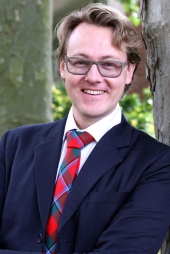
About Trevar Alan Skillicorn-Chilver
Trevar Alan Skillicorn-Chilver is an authorised celebrant, a playwright, a teacher and quite a few other things!
There is an awful lot of speculation out there about the bonds between twins. Whether it’s about finishing each others’ sentences or remotely sensing trouble in each other’s lives, twins arouse a lot of speculation about whether certain behaviours are innate or acquired. Such speculations, I suspect, were part of the inspiration for Blood Brothers, now playing at The Q in Queanbeyan…
The rest of this post is published on Australian Stage.
Tags: Christine Forbes, Pete Ricardo, Queanbeyan, Roy Hukari, Sarah Golding, Stephen Pike, The Q, Willy Russell
After a long period without seeing any theatre, I felt like I made something of a comeback tonight! Between holidays, a family crisis and a minor battle with pneumonia, it’s been something of an epic struggle. I’m glad to be back, though. I’ve started rehearsing to play Horatio and Voltemand in Gertrude’s Hamlet which takes to the stage at Tuggeranong Arts Centre in August.
Tonight, I was blown away by The Q’s production of Blood Brothers. My review will appear on Australian Stage soon, and I’ll post a link, but in the meantime, book your tickets!
Tags: updates
I’m just home from Las Vegas where I had the opportunity to see The Phantom of the Opera at The Venetian. What I have found fascinating since first hearing about the production is the idea that a theatre could be constructed specifically for one show; it seems at once wasteful and devout. The ancient Greeks invented the notion of an architectural entity devoted to theatre, and three thousand years seems rather a long time to wait for a theatre devoted to one show. Las Vegas, apparently, boasts two, but I only managed to see the Venetian’s Phantom Theatre. It is a spectacular representation of Paris’s Opera Populaire, complete with wax vestiges of Parisian high society in the nineteenth century in the balconies.
The custom build has allowed for some spectacular use of the fly tower to quickly present a myriad of different scenes and aid some very clever blocking. Effects including fireworks and flame throwers as well as a dancing chandelier and a rather clever gondola, not to mention the thickest smoke I’ve ever seen, cover a multitude of sins as the performers omit all pathos to avoid making a technical error. Not that it would matter if their performances were better; the audience simply wouldn’t notice with all the smoke and mirrors around (and, I might add, not all of the smoke is intentional special effect; Nevada’s lax smoking laws mean that cigarette smoke from the neighbouring casino fills the auditorium constantly).
I’ve said in the past that I like museum pieces; and apart from some impressive special effects, there’s little more of value in this show. Any student of theatre should see it, purely to flesh out their understanding of nineteenth century theatrical culture and gain a sense of the theatre’s layout. Of course, if you’re going to Paris you could go see the real thing, and probably get a better show into the bargain. The Venetian’s production, though, is also a fine example of theatrical precision, and execution, but little more. Dead flat characterisation and mechanical and unfeeling theatrical precision from the performers sucks what little life Andrew Lloyd Webber deigned to sprinkle into his book, and leaves you with nothing more than special effects to keep you entertained.
The big theatrical surprise of my trip to the United States is that the express version of Aladdin being performed twice daily (and often more) at Disney’s California Adventure Park shows the same technical precision and impressive technical effects while also portraying the story and characters with reasonable passion. It really puts the Venetian’s production of Phantom to shame. Still, that’s Las Vegas; the bright and shiny things are a very thin veil designed to distract the observer from the soulless decrepitude of the human condition. Andrew Lloyd Webber fits in perfectly.
Tags: Andrew Lloyd Webber, Andrew Ragone, Anthony Crivello, Kristi Holden, Las Vegas, Opera, Paris, Phantom, Phantom of the Opera, The Venetian, Theatre, United States
Erindale was alive tonight with Philo’s opening of 42nd Street. The froth and bubble of Broadway is generous if not really enlightening, and the cast delivered a fine performance of a quaint old musical.
The story is that of a talented girl who dreams of singing on Broadway. Her talent noticed, she lands a role in the chorus line and when she accidentally trips the leading lady, fracturing her ankle, she manages to take her place. Woops, did I give away the ending? No, I think that was the writer…
The rest of this post is published on Australian Stage.
Tags: 42nd Street, Adrian Flor, Al Dubin, Amy Fitzpatrick, Arts, Broadway, Broadway theatre, Canberra Philharmonic Society, David Merrick, Ele Wilcher, Harry Warren, Kate Tricks, Musicals, Performing arts, Philo, Theatre
Ten pound Poms let out of the nursing home may enjoy a trip down memory lane with Paris Hat’s production of Look Back in Anger, but there is much more to this play for those of us who didn’t live through post-war England. This is an opportunity to experience a first-rate performance of a play that was pivotal in the development of modern theatre…
The rest of this post is published on Australian Stage.
Tags: Andrew Jackson, Arts, Australia, Benjamin Williams, Cara Irvine, Chris Zuber, England, Fiona Atkin, Ian Croker, John Osborne, Look Back in Anger, Owen Horton, Paris Hat Productions, Paul Jackson, Sophie Benassi
SPOILER ALERT: this post contains references to the ending of the film.
A true story about a chap who literally gets stuck between a rock and a hard place for 127 hours sounds like a pretty boring premise for a film, doesn’t it? But, perhaps because the film was directed by one of the UK’s best directors, and perhaps because the survivor of this ordeal was far more practical and down-to-earth than your average American, this is a brilliant story.
Its protagonist,
Aron Ralston, could well have been turned into a sickly sweet caricature, but Boyle’s deft use of his hallucinations, memory, premonitions, or whatever you want to call them, are handled in a way that firmly grounds him in the reality of his circumstance. The film doesn’t try to pretend that Aron never gave up hope, and it is his constant prevarications between hopelessness and persistence at the only option available to him that makes him both real and truly inspirational.
There have been some ridiculous stories about people finding the blood and gore too much. My suspicion is that these folk must have been completely shielded from any exposure to blood in their entire existence to be so extremely squeamish. There is nothing particularly extreme about the depiction of the removal of Aron’s forearm, you might just need a strong armrest to grab hold of at a few critical moments. Limelight Cinemas’ hardware held up fine!
Tags: "Between a Rock & a Hard Place", 127 Hours, Aron Ralston, Boyle, Danny Boyle, Film, James Franco, Utah
Free Rain really are gracing the stage of The Q at the moment with their production of Oklahoma! The classic musical has certainly been in good hands under the direction of Anne Somes and musical direction of Leisa Keen, and the energy on opening night was simply infectious.
Despite being a musical, and a light one at that, there is some genuine depth to these characters. Jenna Roberts’ portrayal of the heroine is particularly noteworthy, but they all sit in the shadow of Tony Falla, Amy Dunham and Mathew Chardon O’Dea who shine in the love triangle. Despite being given very little to work with by the writers, they have developed an engaging story that really moves along.
I was particularly impressed with the cast’s American accents. Perhaps for the first time in Canberra, a local cast has successfully emulated a single American accent, rather than the more common practice of each cast member using an accent from a different part of the United States. It may not have been a perfect Oklahoma accent, but even the cast of the 1955 film didn’t manage that!
There is something unfortunate in the fact that, when they wrote Oklahoma, Rodgers and Hammerstein didn’t see the value in the pioneering story that underlies the central love story. It leaves the love story a little hollow, and turns references to Oklahoma’s journey to statehood into quaint oddities. I think that with more focus on this aspect, the story would resonate much more deeply, and the central love story would be enhanced by a heightened sense of purpose and destiny.
In all, this production of Oklahoma!is certainly one of the better musical productions of recent years.
Tags: Amy Dunham, Anne Somes, Hammerstein, Jenna Roberts, Mathew Chardon O'Dea, Oklahoma, Rodgers, Rodgers and Hammerstein, Tony Falla
I may again have to eat my words. I’ve often lamented that the advent of remade films in the last decade signifies the death of creativity. Doing something ‘again’ is for the theatre; films can simply be played again, so there’s no point, and you should put your energy into making new ones. Well, now Joel and Ethan Coen have done it, and it is yet another remake of a film that I think is entirely worthy of the treatment. What’s worse is that having enjoyed this film so much, I may now have to watch a few Westerns to find out whether this really is one.
True Grit was first made in 1969. It is the story of a fourteen year old girl who seeks to revenge for her father’s murder and goes looking for a man of ‘true grit’ to undertake the fearsome task. She finds the same in Sheriff ‘Rooster’ Cogburn, a disreputable man with a drinking problem and a dislike for the one other person who cares about seeing the murderer hang. And so begins a journey into the Arkansas wilderness, and the wilderness of human emotions.
Firmly ensconced within the Coens’ aesthetic oeuvre, this film is something really special. Despite being weighed down by overly loquacious and rather pretentious dialogue (which I think may be the norm for Westerns), the story hums along with engaging characters and a beautiful vision of Winter in the old west. Rather than soaking in a puddle of sentimentality, though, it explores the complexity of human emotions in the wake of life-changing events. In this, it diverges from what I had thought Westerns were all about. I understood them to be simplified and over-emotional excuses for a bit of gun-slinging; True Grit is nothing of the sort. I may just have to watch a few to see if I need to rethink my assumptions!
An ageing Matt Damon is an excellent foil for an old Jeff Bridges, but neither hold a candle to Hailee Steinfeld who gives a commanding performance as the ineffable Mattie Ross seeking vengeance for her father’s death. The casting and execution of this role was surely critical to the success of this film, and Steinfeld really carries both the plot and the substance of the story.
Now, I’ve hardly seen any Westerns in my time, and have never been a fan of the genre (not that I’m a fan of any genre per se), so I can’t comment on whether this is a reinvigoration of a tired genre of film-making, but it certainly is a fine piece of cinematography. It is, perhaps, the best film I’ve seen from the Coen Brothers, and that is really something.
Tags: Arkansas, Coen Brothers, Ethan Coen, Hailee Steinfeld, Jeff Bridges, Joel Coen, Matt Damon, True Grit, Westerns
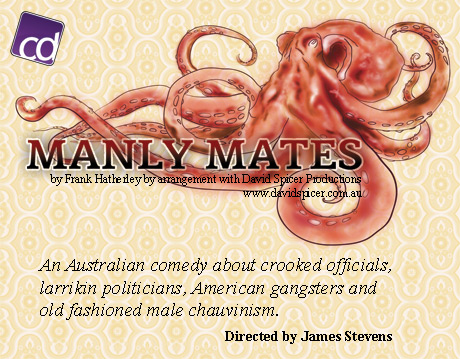
Sir Robert Askin was the longest-serving premier of New South Wales in the twentieth century… as long as you don’t count little Bobby Carr, who served eight months longer, but whose term unfortunately stretched into the twenty-first century. It will not be news to many that such petty distinctions actually matter to the ruling class. It certainly wasn’t to me; which is why, when Frank Hatherley’s play Manly Mates landed on my desk, I was keen to see it produced in Canberra.
A fictitious story based on posthumous accusations levelled at Askin, Hatherley’s play plonks the jovial premier into a hotbed of gambling, womanising and crime (sometimes consecutive, other times concurrent). Joined by stoners, journalists, cops and shonky American poker machine salesmen, the scene in the private Octopus Room at the Manly Hotel is all too reminiscent of more recent rumblings of the political machinery behind closed doors in both New South Welsh and federal politics.
For this production, which later came to be declared the last of Canberra Dramatics’ productions, I handed the reins to James Stevens, who has done a great job with an unwieldy script and a large cast on Tuggeranong’s small stage. The show rolls along from one laugh to the next, and on opening night, despite a slow start, they developed a full head of steam for the hilarious finale.
It is great to see Michael Miller, who has performed in many of Canberra Dramatics’ shows, reprise the role of Askin in the company’s final production; he has a swagger befitting any crooked premier, and is ably supported by Rebecca Nicholson, another veteran of Canberra Dramatics’ productions, as the enthusiastic Pat. Don Wilkinson also returned for this production, as did Robbie Matthews, and these friends were joined by a number of performers who had not performed with Canberra Dramatics before, most notably among them Margie Sainsbury who landed the enviable role of Lady Molly Askin, and lends her an air of forced grace.
Although I haven’t had a lot to do with this last production, it has been a pleasure to see some of the journey this cast and crew have taken. They struck me from the beginning as a very cohesive group, and I am especially glad that James Stevens took on the task of directing them. Cerri Davis, who has worked in a number of different capacities with Canberra Dramatics over the years, also did a fine job in her first role as Production Manager.
In all, it was a great pleasure to see this hilarious play staged in Canberra, and it is a great finale to five years of productions.
Tags: Australian Capital Territory, Canberra, Cerri Davis, corruption, Don Wilkinson, Frank Hatherley, James Stevens, Margie Sainsbury, New South Wales, Rebecca Nicholson, Robbie Matthews, Robert Askin, Tuggeranong
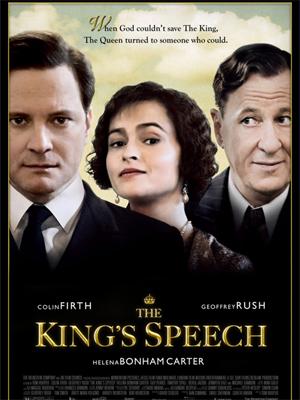
Don’t ask me why, but I’m a sucker for a title with a double meaning! Usually, though, they represent a pretty ordinary film, play or novel. In the case of The King’s Speech, the film is far more clever than its title.
Set in 1930s England, with the world on the brink of war, this is the story of an unfortunate chap with a speech impediment. Not a particularly big deal, perhaps, unless the unfortunate chap happens to be the king of a constitutional monarchy in which the only useful thing a king does is to speak to his subjects. In such circumstances, there is only one thing for it; run through the gamut of speech pathologists until you find one who has a bit of common sense. Such a personage, of course, would have to be an Australian. You just can’t make stuff like this up!
It’s true. The film, I mean; it’s a true story. And it’s not in any way dry or sombre or mundane as biographical films are prone to being; it’s a thoroughly engaging story, made all the more real by its heart-warming depiction of our queen in her childhood, her mother in her prime, and the relationships of this extraordinary family.
If you’ve not seen it, do so. If you don’t like it, you’re probably not human.
Tags: Academy Award, Australia, Bedlam Productions, Colin Firth, David Seidler, England, Geoffrey Rush, George VI of the United Kingdom, Helena Bonham-Carter, King's Speech, Monarchy, See Saw Films, Speech disorder, Tom Hooper
There’s a bit of a risk involved in seeing a show you’ve been involved with yourself. I did sound for a production of And Then There Were None in Theatre 3 back in 1998, when I first moved to Canberra, so there was no way I was going to miss seeing Rep’s production of it this year!
One thing that surprised me was how many lines I recalled. I had none previously, although there were plenty of cues. Still, you wouldn’t think I would recall them twelve years later with no contact with the play in the intervening years. And I really didn’t remember the outcome. Not a skerrick of it. At any rate, it was a trip down memory lane.
The risk, of course, is that my view of the play is coloured by my memories of the production I was involved with. Not that they should be compared. I was involved with a student production by CADS (the defunct Canberra Amateur Dramatic Society), directed by relatively inexperienced directors, whereas Rep’s production boasted the very deft hand of Duncan Ley as well as a host of experienced Canberra actors. And it showed. This was a great show that gave the play a lot more life than ours did. And it’s needed with Agatha Christie‘s dialogue. It gave the odd nod to Film Noir, which at times was just a little too much at odds with the text, but more often suited it well.
The set, as dark and gloomy as a stage set can be, didn’t seem to add much apart from making the Film Noir reference, but it suited the purpose and certainly gave room for the performers to die the most excellent deaths.
I love a play that doesn’t take itself too seriously, and this is quite true of Rep’s production of And Then There Were None. Really, no Agatha Christie play can be taken too seriously; they get awfully dry awfully quickly otherwise. This production manages to hold the attention marvellously.
Tags: Agatha Christie, Duncan Driver, Duncan Ley, Film Noir, Hannah Ley, Jayson Savage
How often have you wanted to have one of your heroes sit on your shoulder and tell you how to make decisions about your life? Wouldn’t it be nice, just occasionally, to have George Calombaris in the kitchen while you cook, chatting and offering helpful advice? Or to have the ever-so-experienced Henry VIII providing his support during a marital spat? Decision-making would be so much easier with such a support mechanism in place. As long as you were willing to surrender something of your own will to this mentor…
The rest of this post is published on Australian Stage.
Tags: Adolf Hitler, Dallas Bland, Elizabeth Avery Scott, George Calombaris, Hanna Cormick, Henry VIII of England, James Scott, Made in Canberra, PJ Williams
Growing organically from its warm minimal set in the cozy downstairs theatre at Belvoir, The Sweetest Thing is a sad and funny story about the intersection between love and family. Playwright Verity Laughton weaves a complex tale that focuses on the emotional journey of its characters very strongly thanks to being relieved of the burden of chronology. Despite a dynamic plot arc and potentially confusing time changes, the story of Sarah, played by the wonderful Diana Glenn shines through with excellent clarity.
The rest of this post is published on Australian Stage.
Tags: Arts Radar, B Sharp, Belvoir, Caroline Craig, Christopher Morris, cultural cringe, Diana Glenn, Lucy Wigmore, Thomas Conroy, Vanessa Downing, Verity Laughton
Despite a few moments where truth seems to win out over storytelling, The Social Network tells a genuinely engaging story and does so with some empathy for a diversity of characters. It does this with some rather dry historical material, and it does develop a very human story, although it is a little on the superficial side.
From the opening scene, which shows not only Zuckerberg’s dumping by girlfriend Erica Albright but also the reason for it, this film is distinctively about Mark Zuckerberg. He would be an awfully boring subject, though, without the rest of this impeccable cast. The standout is certainly Andrew Garfield‘s performance as Zuckerberg’s foil Eduardo Saverin, which almost singe-handedly salvages the damage done by the awkwardness of Jesse Eisenberg‘s Zuckerberg.
Eisenberg’s depiction of Mark Zuckerberg is discomforting. Of course, it is not an easy thing to depict a living celebrity, and this particular celebrity, as the king of geekdom, must be a particular challenge, but I was left wondering what kind of human being I was seeing. At times, he seemed to be dealing with a condition on the autism spectrum, rather than merely being socially awkward, and yet even this was not consistent. At times he would suddenly animate, then return to a morose obsessive. Perhaps this impression was what was intended. For all I know, this could be exactly what Mark Zuckerberg is like, but whatever the reason, it was disconcerting.
The major strength of this film is that although it’s a story about the development of Facebook intertwined with the story of a lawsuit, both of which threaten dullness, the human element is palpable and immediate. In fact (and I can’t believe I’m saying this about an American film), I think the story could have benefited from a little more pathos around its central characters. There is a very human story here, and it barely emerges from the more technical process of depicting historical events.
I suspect that this film will date quickly. I would guess that, unless some major legal battle puts an end to Facebook, this story will be told again and again, and the best expressions of it are still to come. Hopefully some of them will be written with more concern for the characters, and will be performed with greater clarity.
Tags: Aaron Sorkin, Andrew Garfield, Autism spectrum, David Fincher, Eduardo Saverin, Facebook, Jesse Eisenberg, Mark Zuckerberg, Social Network, Zuckerberg
 Shortis and Simpson’s brand is safe with this latest topical offering, which provides plenty of laughs and many gentle jabs at Canberra’s more itinerant population. Rhyming Gillard with ‘kill hard’ and pointing out some of the delicious ironies of our new parliament (such as the two Wyatts and one Wong), these veterans of the Canberra stage were as amusing as ever, keeping the audience enthralled throughout.
The rest of this post is published on Australian Stage.
Tags: Australia, Canberra, Government, John Shortis, Moira Simpson, Shortis and Simpson
It is unusual, I think, to hear about a play inspired by a statistic. It is not encouraging, either. Nonetheless, Bruce Hoogendoorn‘s play, The Clever Country, currently playing at The Street Theatre, takes as its theme Australia’s falling science enrolments, and does so—perhaps surprisingly, considering its inspiration—with great humour and an intriguing plotline…
The rest of this post is published on Australian Stage.
Tags: Australia, Brian Kavanagh, Bruce Hoogendoorn, David Villanti, Jaime Isfahani, Michelle Cooper, Performing arts, Theatre
Tomorrow When The War Began is an iconic piece of Australian literature renowned not so much for its story, characters or fantastic writing as for annoying the heck out of high school students. John Marsden wrote it specifically for the high school market, aiming it at schools in need of an easy read for young adolescents. This ambit was successful, and as a result it is one of the most read stories in Australia, despite being dull, poorly-written and full of implausible circumstances and pointless guff. Needless to say, I didn’t expect much from the film.
From inauspicious beginnings, apparently, great stories are born. The very act of adapting a story for film has a way of weeding out page-filling nonsense and implausible circumstances. A novel can get away with not mentioning visual elements, but scenarios undergo more thorough analysis in film. In the case of Tomorrow When The War Began, this process has thoroughly redeemed an otherwise unremarkable story.
The cast, who, with one exception, are far too old to be playing characters who need to ask their parents’ permission for anything, are otherwise superb. Led by the magnificent Caitlin Stasey in the role of Ellie, they personify Marsden’s characters better than Marsden did, and without any exception they sustain impeccable performances throughout the film. And yes, I even include a former Home and Away actor in this praise, which is remarkable in itself.
Like the age of the actors, the locations chosen for the film leave something to be desired, but are nonetheless redeemed. The Blue Mountains, instantly recognisable and distinctive, simply doesn’t cut it for a random bush hideaway near the fictional rural town of Wirrawee. The sandstone cliffs of the Megalong Valley are simply too familiar, and the familiarity detracts from the value of setting the story in a fictitious Australian town.
The film nonetheless survives these faults, and is certainly the best saleable film made in this country for many years. The plot, characters and actors combine to produce a film that is far better in all respects than the novel that spawned it, making the tongue-in-cheek line from the film that all books are better than their films deliciously ironic.
This film may not win huge numbers of awards, but thoughts that it may be the beginning of the most profitable film series in Australian history could be right on the money. I certainly hope so.
Tags: Australia, Blue Mountains, Caitlin Stasey, Chris Pang, Deniz Akdeniz, John Marsden, Lincoln Lewis, Marsden, Megalong Valley, Stuart Beatty, Tomorrow When The War Began, Wirrawee
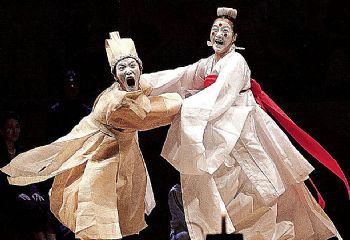
Having secured what I knew to be the last available ticket for Yohangza Theatre Company’s production of Hamlet, I was surprised to find myself sitting next to the South Australian Premier and his wife for the performance. The irony of watching a king’s downfall orchestrated through a theatre production while sitting next to the leader of a state government in a theatre was not lost on me, but I doubt that Mike Rann and his wife felt the same pangs of guilt as Gertrude and Claudius.
Played by Eun-Hee Kim, this Gertrude is perhaps not as guilt-ridden as some I have encountered. But whereas Gertrude is often portrayed with an underlying sense of her own moral corruption, Kim has given her an aloofness, lasting until Hamlet finally reveals his hand following the theatre scene. I prefer this change, as risky as it might be. It holds more weight with Shakespeare’s text, and in this production, in this context, it provides a profound shift in the character that is necessary to add depth for its Australian audience. This is not a criticism of the performers, but a play performed in Korean for a predominantly English-speaking audience can’t skimp on such details.
Hamlet certainly doesn’t. Played by Jung-Yong Jeon, his vacillations are as palpable as that fatal hit, and his descent into madness is beautifully paced; almost undetectable. Claudius could perhaps have emoted rather more; by both dress and demeanour he emerged more western than the rest of the cast. But in all, this cast expended enough energy and elicited enough pathos to warrant a standing ovation from the opening night audience (though the premier, notably, remained seated).
A minimalist set spares no effort, with a centre rostrum raised in the middle of what must be hundreds of kilos of rice, and surrounded by traditional Korean artworks, and Korean percussive instruments. These instruments are put to excellent use by the cast, whose timing and energy is perfectly synthesised. More intriguingly, Korean Shaman rites are used to ensure the story is at home in its Korean context.
This is a remarkably sensitive production of what I think is Shakespeare’s greatest work. It is faithful, if such a word can really be applied to any production of Shakespeare’s work later than the seventeenth century, to the characters, their motivations, fears and desires; as well as their circumstances. And it dispels in my mind any doubt that the stories of Shakespeare are absolutely universal in their application to humanity.
Tags: Claudius, Eun-Hee Kim, Gertrude, Hamlet, Jung-Yong Jeon, Mike Rann, Shakespeare, Theatre, William Shakespeare
To the extent that Americans love a good conspiracy theory, the Brits are equally keen on questioning the integrity of their Prime Minsters. Roman Polanski caters for both predilections in his magnificent new film, The Ghost Writer.
Ewan McGregor plays the titular character, a writer hired to massage the memoirs of a former British Prime Minister into shape following the mysterious death of another ghost writer. Gradually, and innocently (which is refreshing), he discovers a web of intrigue and finds himself reluctantly wrapped up in it, at his own peril.
However much I like this as a film, it’s the story, penned originally as a novel by Robert Harris, that I find so magnificently intriguing. Remaining almost entirely fictitious, and needing no awkward date stamp, this story draws a shocking parallelism from the circumstances surrounding the era of fear following the 9/11 attacks. And surprisingly, since it parallels so literally the Anglo-American response, it is as relevant here in Australia as in the US and UK.
I can’t say too much about it, lest I spoil it for you, but this is a great film, and you must go see it. That is all.
Tags: Australia, Ewan McGregor, Ghostwriter, Pierce Brosnan, Prime Minister of the United Kingdom, Robert Harris, Roman Polanski, Tom Wilkinson
Seeing Do Not Go Gentle was an experience. Not just because it’s a great show, but because I got the opportunity to meet Patricia Cornelius, the play’s writer, before the show opened. That, and the fact that fortyfivedownstairs is a fantastic venue with more character than a Shakespearean king.
Equally admirable were the performances of a fantastic cast, admirably lead by Rhys McConnochie, all bringing their characters to life in a way that should connect with audiences of all ages.
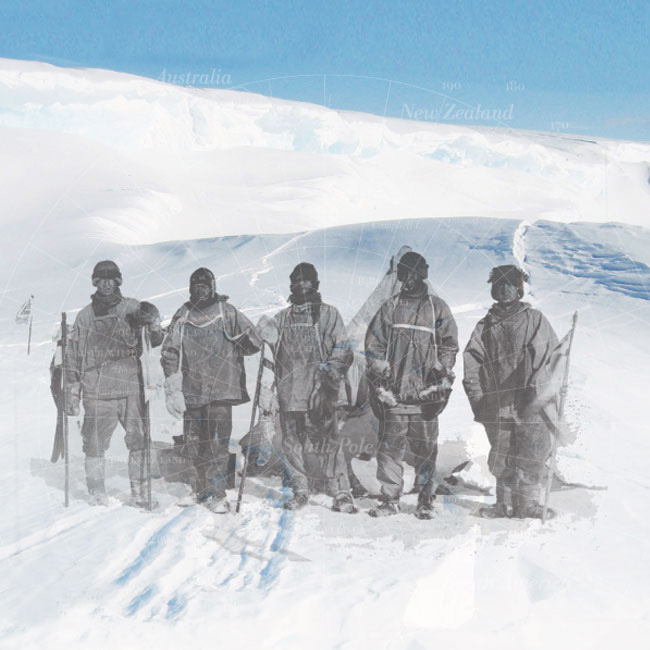
Freezing my way through a show is not normally my idea of fun, but it’s highly appropriate for Do Not Go Gentle, which focuses on Scott’s unsuccessful attempt to plant an Australian flag at the South Pole before the Norwegians got theirs there. And while fortyfivedownstairs may have been a bit of a cold place on the night, the lives of its characters are just as cold, but with a warmth that makes it all worthwhile.
The thing I enjoyed most about this play was its insistence that life is for living, a thesis well worth remembering on a cold Winter’s night in Melbourne.
Tags: Anne Phelan, Australia, fortyfivedownstairs, Jan Friedl, Julian Meyrick, Malcolm Robertson, Melbourne, Norwegians, Pamela Rabe, Patricia Cornelius, Paul English, Rhys McConnochie, South Pole, Terry Norris, William Shakespeare





 Foyer Talk