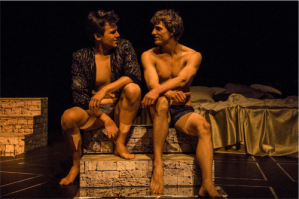
 Scandalous Boy is a brave piece of work with the ostensible objective of realigning western perspectives on homosexual love. It makes its point very clearly, and possibly succeeds as a polemic, but largely fails to deliver the pathos I yearn for from the stage.
It is principally the true story of the love between the emperor Hadrian, and Antinous, his Greek eromenos, but it is framed in a twenty-first century setting with the statue of Antinous coming to life in modern Australia to tell his story. He wants to assert for us that he is not the “shameless and scandalous boy” Christian historians have claimed he was, and assert the appropriateness of his choices and actions in a pre-Christian Roman Empire. He punctuates this by comparing modern and ancient attitudes to public nudity, but kindly dons a pair of sequined hotpants to relieve our discomfort.
Yes, it’s one of those history plays. Set in ancient Rome, but using the language of modern Australia, replete with references to Hollywood’s Golden Age and punctuated with the homo-pop vocals of Kylie Minogue and the like. Had I realised it was one of those, I may well have opted for Supa‘s production of La Cage aux Folles for my Golden Drink Voucher expenditure this week, but that’s just the way the marble crumbles I guess. It nonetheless delivers a striking story that is valuable for a modern audience and finely pointed as a polemic for an Australian government struggling to follow its people’s leadership.
David Atfield’s script unfortunately doesn’t deliver the emotional punch necessary to make this story fully relatable. The dialogue feels forced and its distinctive modern vernacular doesn’t help as much as I think Atfield hoped it would.
But I think the greatest fault lies in the narration. It leaves no space whatsoever for subtext. Every thought, every motivation, every thing the characters don’t say, is described to us, rather than shown to us. There is simply no space for intuition, and this, mounted so firmly in an Australian context, makes the play feel just too preachy.
Surprisingly, though, this doesn’t completely ruin the play. The characters retain some capacity for engagement and I really did care what happened to them, I just wanted to care more. I wanted to feel their pain rather than merely being aware of it.
Had Atfield followed the Golden Rule and shown us, rather than told us, I think perhaps this would be a very moving play that could, perhaps, just change a mind or two. As it is, it is simply affirming of the LGBTIQ polemic in an Australia that still discriminates between loves.
The character of the audience left no doubt in my mind that, on the night I went at least, Atfield was preaching to the choir (if you’ll pardon the Christian metaphor). The audience, well over 90% male, seemed to hurl itself outside at interval so they could all suck back a cancer stick; I have never seen The Street Theatre’s foyer so empty during interval with a full house! And on their return one of them was kind enough to call out “okay, quiet now” for us as the lights dimmed, because apparently none of us knew what that meant.
The unfortunate reality is that too much of the audience was probably attracted by the promise of the naked Ethan Gibson, and while they may be encouraged by this polemic to fight for the rights of the LGBTIQ community, I just think that the story deserves a more diverse audience than this is likely to attract.
Regardless of my misgivings, I am grateful to David Atfield, his cast and the creatives behind this brave production for staging it. Antinous’s story is one that should be told more often.
.
What the critics are saying:
Tags: Antinous, Dave Temme, David Atfield, Emma Strand, eromenos, Ethan Gibson, gay, Gillian Schwabb, Hadrian, homosexual, Imogen Keen, James Hughes, Julian Hobba, LGBTIQ, Liberty Kerr, Nicholas Eadie, Nick Delatovic, Peter Matheson, polemic, Raoul Craemer, Scandalous Boy, Seth Edwards Ellis, SpringOUT
 I was lucky enough to be able to sit in Central Park this afternoon and enjoy Barefoot Shakespeare’s The Two Gentlemen of Verona. I really can’t think of a better way to spend a Saturday afternoon than lazing about in a park while a bunch of very talented performers work very hard to entertain me!
Hard work is exactly what it looked like. The area they were performing in was a particularly busy area of the park, and contrary to the image New Yorkers like to project of their favourite open space, Central Park is not by any means an oasis of calm in the middle of the city’s bustle. To be heard, they had to compete with a loud concert barely 100 metres away, constant helicopters and sirens, and the occasional heckler. But they handled all of this with aplomb, especially Michael Pettey, in the role of Proteus, who improvised marvellously when a particularly rowdy bunch suddenly noticed that he was performing and announced it for all and sundry.
The rest of the cast also delivered an outstanding performance, and although I did struggle to hear above the hubbub of the park, I did manage to follow this play, which I was not very familiar with beforehand.
Courtney Moors also impressed with her portrayal of Silvia. The pathos in her responses resonated brilliantly above the hubbub of the park, and I was certainly taken along with her in her pursuit of Valentine (played by James Kivlen).
In all, a great way to encounter such a fun little play, and a great performance.
Tags: Barefoot Shakespeare, Barefoot Shakespeare Company, Brett Ashley Robinson, Central Park, Clare Solly, Courtney Moors, Danielle O'Farrell, Emily Gallagher, James Kivlen, Maya Close, Mel Ryan, Michael Pettey, Natalie Ann Harris, New York, NY, NYC, Paula Rossman, Rob Sniffin, Ryan Murvin, Shakespeare, Shakespeare in the Park, The Two Gentlemen of Verona, William Shakespeare
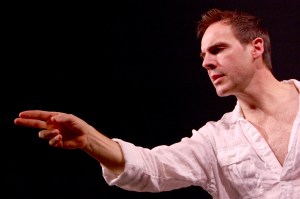 There really is an over abundance of plays derived from the stories that surround Shakespeare’s life. Though I am getting a little bored of them, I am nonetheless drawn to further explorations of the context in which the Bard lived, and speculations about his times.
Burbage has been one of the better ones I’ve seen lately. Essentially a one hour rant imagined from the realities of Richard Burbage’s life and the common themes of the actor’s existence, it explores these with some depth and develops a strong image of the man left behind as the great playwrights and actors of the Elizabethan era fell off the twig in the early seventeenth century.
Richard Burbage, for those who’ve either forgotten about him or never heard of him (really?), was an actor who performed lead roles in the premieres of many now-canonical works of Elizabethan drama. Playwrights such as Shakespeare and Marlowe wrote roles with him in mind, and he was owner of the Globe Theatre with his brother.
In this monologue, he engages an imaginary young actor, Tom, who is seeking to continue his acting career past the roles of his youth.
Neil McGarry’s greatest achievement in his performance is creating a believable ‘Tom’ in the auditorium. While I am not a fan of monologues, and the idea of an invisible and inaudible second character in a monologue usually seems extremely naff, I was impressed to find myself fully engaged in the reality of the piece. The result is an engaging performance that gives humble recognition to one of the artists who contributed so much to the golden age of English theatre.
Despite some oddities of accent (which I will happily forgive with the knowledge that the English of Burbage’s day sounded a little more like the modern American accent than modern Received Pronunciation), McGarry was entirely believable and made a strong connection with his audience.
This was the last performance at the New York Fringe, but it’s likely to pop up again with the Bay Colony Shakespeare Company, and is worth a look if you’re an artist.
Tags: Bard, Bay Colony Shakespeare Company, Boston, Burbage, Elizabethan Theatre, London, Marlowe, monologue, Neil McGarry, New York, New York Fringe, Nicolas Minella, nyfringe, Richard Burbage, Ross MacDonald, Shakespeare, William Shakespeare
 Costume designers, choreographers and technicians need to be reminded occasionally that nothing is more important than character and plot. Unfortunately, this clearly did not happen with this production, which largely fails to engage on the two substantive elements of dramatisation.
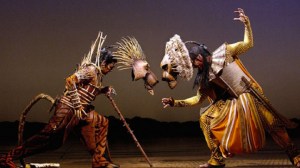
I don’t think it’s the book. The stage version adds a couple of numbers that seem rather superfluous and have no purpose other than to allow the promoters to differentiate it from the animated film, but they don’t really detract. And the costumes aren’t bad either, but when the audience erupted in tremendous applause for the mere appearance of a (magnificent) life-size elephant puppet, I started to get an idea of what this was about, or more importantly, what it was not about.
And there’s the rub. This show is just not about Simba. The Lion King is about Simba (or Hamlet (or even Joseph if you like)), but this show is about puppets and stunts. Simba and his story are a mere sideshow here, they’re not the main event at all.
I don’t know if it was a unique technical problem on the night, but the other contributing factor was the balance of the audio mixing. The singers were barely audible over the (brilliant) orchestra. Enrique Segura, playing Timon, certainly had his microphone turned on late a number of times, and occasionally cut out mid-song. But they all seemed to struggle with the crescendos of Tim Rice and Alex Menken’s music. I felt more and more deflated every time I heard a clipped attempt at emoting something of significance for the plot. It was clear the plot just didn’t matter.
But whether I liked The Lion King is another question. It is not bad as performance art, but it doesn’t quite commit. If you’re not going to bother with the characters, then how about some more acrobatics? If you don’t really care about the ebb and flow of the plot, why not bring the performers more fully into the space? If you’re going to reduce a dramatic masterpiece that is derived from one of Shakespeare’s greatest works and one of the most grandiose tales of the Judeo-Christian canon to a mere circus performance, why not do it with aplomb? It seems to me that the creators just didn’t quite decide whether this was theatre or circus. And that’s what left me feeling flat.
When’s a Canberra company doing this one? I think someone needs to show Broadway how it’s done.
My daughter posted about this show on our travel blog, Walkabout. You can see what she thought here.
Tags: Alex Menken, Bravita Threatt, Broadway, Chondra La-Tease Profit, Enrique Segura, Jaysin McCollum, Kimberly Marable, Minskoff Theater, Sandy Alvarez, The Lion King, Tim Rice
 After a false start yesterday, where the performers found out at the last minute that their venue wasn’t opening, I am incredibly glad we made it back to see this brilliant performance today. Unfortunately the alternate venue they had secured was an over 18s venue so I was unable to bring Offspring Number One along to that performance, and today we had to change our plans to get there, but get there we did, and it was well worth the effort.
The Peablossom Cabaret is cabaret improvised in response to conversations with the audience. And as such, it hinges entirely on the personalities and talents of the two performers, Dylan Townley as Mr. Pea, and Sylvia Bishop as Miss Blossom. These two consummate performers had their audience laughing before the show even started, and it only got better throughout with their clever banter, quick wit and charming voices.
The pair improvised a song about an audient’s sister reading her diary, then about a lad who admires his brother for not being boring. I could go on, but the very nature of improvisation means it would not be terribly interesting; you really have to be there. And the more people who are there the better; these splendid performers deserve all the applause they can get!
Tags: Cabaret, Dylan Townley, Edinburgh, Edinburgh Fringe, Miss Blossom, Mr. Pea, Peablossom Cabaret, Sylvia Bishop
 I wasn’t prepared for an immersive experience when I went to see In Your Face Theatre‘s production of Trainspotting, and when I realised there was no auditorium, I will admit to a little hesitation. The experience, however, was just as this incredibly grimy story needed it to be, and was only enhanced by not knowing where the performers were off to next.
The venue could not have been more appropriate. This former Masonic Lodge occasionally flashed up glimpses of the names of its members or phrases such as ‘trust in the lord’ all in a gold print that jarred eerily with Irvine Welsh’s confronting story of the lives of urban junkies.
Though I’ve not been able to find the names of the performers anywhere, they were all very impressive (and this is a very large cast). Rents, Sickboy and Tommy were at once pathetic and yet able to command my sympathy. And a chorus, accompanied by a very appropriate soundtrack from the last twenty years was not a mere addendum to the action, but was critically important in establishing the atmosphere and moving the audience to the appropriate part of the space (or distracting us from the set change).
While the script seemed to skim too quickly over some moments of character development, and though I felt the use of narration didn’t really suit this style of performance, in all, I was surprised at how closely this production elicited the same emotions in me as the novel and film did so long ago.
This is a story that has neither aged nor lost its edge, and remains as gritty as it was when it first saw the light of day in 1993.
Tags: Edinburgh, Edinburgh Fringe, In Your Face Theatre, Irvine Welsh, Scotland, Trainspotting
Disappointed twice in a week by productions that stem from Oscar Wilde’s The Importance of Being Earnest? I never thought it would be possible.
Bunbury is Dead is not really about the friend Algernon Moncrief makes up as an excuse for not performing his social duties in Wilde’s play, though the character does share much of Algernon’s DNA.
As the plot unravels, it is clear that Christopher Cutting’s script has a lot to offer. The concept is unique, new and engaging. Bunbury, a character who had to be created out of source material from Wilde’s plays, is every bit as strong as Wilde’s Algernon, and his butler is an equally fine creation. But just about all of the dialogue is borrowed from Wilde, and this I don’t understand.
The play is strong, and could be set in the 19th, 20th or 21st centuries perfectly well. The plot is relatable and the characters recognisable. Wilde’s words simply have nothing to offer here, and they become a distraction. As an inspiration for a lead, even Bunbury is perfect, but as far as I can tell, Cutting really doesn’t need Wilde’s help. The story would be more interesting without being interrupted by Wilde’s words.
It is unfortunate that this didn’t live up to its possibilities.
Tags: Algernon Moncrief, Bunbury, Christopher Cutting, Edinburgh, Edinburgh Fringe, Oscar Wilde, The Importance of Being Earnest, Tobacco Tea Theatre Company, Wilde
 I was pleased to find £10 tickets for The Importance of Being Earnest at the Harold Pinter Theatre, and I wasn’t even worried about the likelihood of finding a pillar in my view, but it wasn’t that far in that I felt I wanted at least £5 of my £10 back (and the £5 I was happy for them to keep was for the charming set).
This is not so much a poor production as it is a poorly conceived one. Oscar Wilde’s amazingly witty play is couched in a modern super-plot that turns the performance into a final rehearsal for a regional repertory society’s production.
In itself, it does bring some additional humour in the form of extra quips and some additional wit, but it adds nothing of value to Wilde’s play or its message, and I would argue that in so doing, it undermines the quality of Wilde’s work.
I’m no purist. I do like playing with the great works, and appreciate a novel setting or treatment for something as familiar as this, but the problem here lies in how far Wilde stretches our willingness to suspend our disbelief. Lady Bracknell is patently absurd, and yet when performed well, she is recognisable from life and is the engine for the play’s theme. Turning Lady Bracknell into an actor performing Lady Bracknell completely undermines her integrity, and entirely flattens Wilde’s play.
If there was a point being made by the extraneous setting, it may have worked, but it adds nothing worthwhile, and ought to have been eschewed.
The best production I have seen remains Rhys Holden’s Canberra production with Free Rain Theatre in the early noughties, which retained Wilde’s words but provided an entirely modern setting, enlivening the play brilliantly.
This production doesn’t even hold a candle to it. Particularly disappointing.
Tags: Cherie Lunghi, Free Rain Theatre, Harold Pinter Theatre, Lucy Bailey, Martin Jarvis, Nigel Havers, novelty, Oscar Wilde, purist, Rhys Holden, Siân Phillips, The Importance of Being Earnest, William Dudley, willing suspension of disbelief
 When I was a backpacker in London in 1995 I donated £10 for a brick for the reconstruction of Shakespeare’s Globe Theatre. It took me 19 years, and even after arriving in London I still found circumstances conspiring against me, but I have finally been to a show in the magnificent reconstruction.
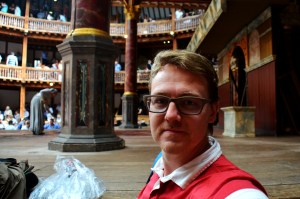
I can’t comment too intelligently on the show. Partly because I had no familiarity with Julius Caesar before today, but mostly because of the amazing novelty of being a groundling in Shakespeare’s Globe. I think I would have to see quite a few shows before I could concentrate on the show and not the venue, and even then the number of tourists who are there for the novelty would still be a distraction.
For the unaware, Shakespeare’s Globe is a relatively accurate reconstruction of the Globe Theatre that stood on the South Bank of the Thames when Shakespeare’s work was at its peak. It stands very close to the position of the original, and was constructed using sixteenth century building techniques as much as possible (though it does have the odd modern feature for practicality’s sake like steel drainpipes, safety equipment and a few halogen lights). Like Shakespeare’s Globe it has three balcony levels, where patrons pay according to the view of the stage, and a pit directly in front of the stage where common folk like me can stand and get amongst it all as ‘groundlings’ for a mere £5. It is an outdoor venue, with roofing over the stage and the upper balconies, but none over the pit. And yes, it did rain, which was perfect.
I really would not have enjoyed my day quite as much had I paid for a seat; there are just too many advantages in being a groundling. One of the techniques used to draw the audience’s attention in this context where the house lights don’t turn off on cue and there are no lights for the stage or any curtain to speak of, is for the action to burst into the pit amongst the groundlings, which is exactly how Julius Caesar opens. The performers just burst in pushing a way through the crowd and get everyone focused on the action. This worked extremely well, and really created an atmosphere appropriate to Ancient Rome, which you would be completely outside of if you were sitting.
The main inconvenience in being a groundling is the sky above. It belongs to London, and therefore leaks. Most of the time the leaks are small, but I happened to come on a day when the heavens ope’d and spewed forth their watery bounty. I had secured a spot next to the stage, where I had some respite. I had also forked out for a garbage bag with a hood, which are sold at the door, and offer enough protection to allow you to enjoy the performance, which of course carries on regardless (although the heavens did seem to open and close at the right times to change the meaning of quite a few lines, much to everyone’s enjoyment (including the wet ones)).
 I hope you’re starting to get an idea of why I wasn’t paying as much attention as I normally do to what is going on on stage.
The performance was impeccable, I think. I may have been overwhelmed by the novelty of the theatre, but I certainly enjoyed the murder of Caesar, and Marc Antony’s speech was remarkable. Likewise, the friendship of Brutus and Cassius was palpable in this wooden O (sorry, couldn’t resist).
I only regret waiting so long to come see something here. I will be back again and again until I don’t notice the novelty of the space and the tourists annoy me because I’m no longer one of them.
Tags: Brutus, Cassius, Julius Caesar, Luke Thompson, Marc Antony, Shakespeare, Shakespeare's Globe, Tom McKay, William Shakespeare
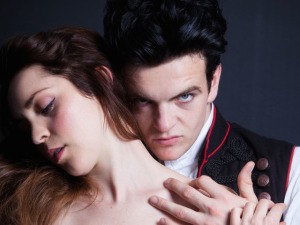 Dracula is one of those brilliant stories that just never gets old. Its universal themes seem to always thrive in the present, presenting new insight into humanity. And different wonderful people just keep imagining brilliant new ways to bring this story to life. The one I saw tonight is the work of Action to the Word, and they certainly made an impression.
Perhaps it was just Zoe Koperski’s steampunk design that made this such a memorable production. Or maybe it was the in-your-face indie rock the whole cast blasted out into the auditorium. Either way, it was an aggressive and courageous take on Bram Stoker’s gothic horror novel, and I loved it.
Despite a few prop hiccups (and did I possibly detect a line drop?), the performers were genuinely brilliant. Jonno Davies‘ Count Dracula struck just the right balance between inciting a come hither and a piss off, while Henry Bauckham’s Jonathan Harker was at once noble and vulnerable. But it was the women who genuinely shone. Olivia Bromley, Rachel Bright and Claire Petzal played Mina Murray, Lucy Westenra and Jack (here Johanna) Seward respectively and all three deserved the ovation one enthusiastic member of the audience in front of me tried to give them for their remarkable performances.
However highly polished and professional these performers were, there was one thing they couldn’t compensate for, and that was a lack of focus on character and plot. In the effort to create a great spectacle (and a great spectacle it was), Alexandra Spencer-Jones’ adaptation didn’t allow enough depth for the characters to be fully engaged, and at the end no matter how much I enjoyed the spectacle, I certainly didn’t feel I’d encountered a story.
And as a rendition of Bram Stoker’s Dracula? Well, you would do well to have another read before you go to ensure you have the plot clear. I was stretching my memory once or twice trying to remember how the plot went, and I’m a fan.
Nonetheless, this really is a great show, even if just for the sake of enjoying the cast’s amazing music and the brilliant steampunk design, and it deserves a great deal of attention in Edinburgh.
Tags: Action to the Word, Adam Clifford, Alexandra Spencer-Jones, Bram Stoker, Charlie Morgan-Jones, Claire Petzal, Dracula, Edinburgh, Edinburgh Fringe, gothic, Henry Bauckham, Henry Douthwaite, Jo Chichonska, Jonno Davies, Lyndsay Clark, Marc Rhys, Olivia Bromley, Patrick Gleeson, Rachel Bright, steampunk, Tom Whitelock, vampire, Zoe Koperski
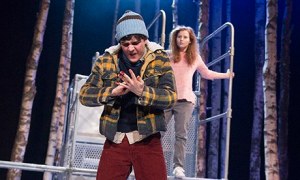 There is so much to love about Let the Right One In that I really don’t know where to start. Jaunty dialogue that belies its heavier themes; deep, rich characterisation that lets you into its world without making it too easy; and a challenging plot unafraid to embrace the darkness of the human spirit combine to make a show that is as engaging and heart-warming as it is confronting and horrifying.
Thinking about it, the plot could have emerged from the cheesiest of Hollywood blockbusters. But it is in fact Swedish in origin, and characteristically so, given its classy combination of high- and low-brow imagery.
The story is centred on Oskar and Eli, played respectively by Martin Quinn and Rebecca Benson. The pair form an uneasy friendship that develops into something much more. As Oskar faces the tormenting of his school bullies, Eli faces an uncertain future as a vampire who hides in the forest with her carer who undertakes the odd murder from time to time to provide her with sustenance.
It’s at this point that I would have flicked the page if I was reading this synopsis looking for a show to see. Luckily, I refrained from reading too much and just booked the bargain ticket I’d seen advertised on Facey. As I’ve found in the past, the less I knew about the play, the better the result.
There is an understated intensity to this play. It sits lightly on the stage but the heaviness of its themes rear their heads constantly through the music that filmically punctuates the action, and in the occasional gory scene (some of which I think would even make Shakespeare blush).
The set is almost as much a star as the great performers. Okay, so I have a thing for birch trees, and the set has them, so I like the set. But no, I mean I love the set! There is such a lightness in the way the trunks dominate the space, and the indoor scenes, indicated with nothing more than a piece of furniture, are enhanced by the air the trees imply. I’d probably have liked it almost as much if they had used something else, but birch were definitely the right choice.
I really couldn’t have picked a better play had I tried, and I’m so glad I got the chance to see this. Brilliance.
Tags: Angus Miller, Apollo Theatre, Ólafur Arnaulds, Chahine Yavroyan, Christine Jones, Clive Mendus, Cristan Ortega, Gareth Fry, Gary Mackay, Gavin Kean, Graeme Dalling, Jack Thorne, Jessica Bastick-Vines, John Ajvide Lindqvist, John Tiffany, Let the Right One In, Mairi Cowieson, Martin Quinn, National Theatre of Scotland, Padraig Lynch, Rebecca Benson, Susan Vidler, Tom Gillies
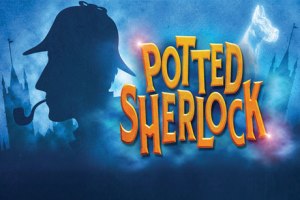 Since Shakespeare’s Compleat Works were abridged by the Reduced Shakespeare Company, similar treatment has been given to a range of original sources, with mixed results. Dan Clarkson and Jeff Turner have apparently been pottering about with Harry Potter in this antipode while I’ve been in the other one, and have now turned their attention to one of my favourite series, Sherlock Holmes.
When it comes to the still-novel-ish notion of condensing a bunch of great works into an hour’s romp, character is not king. If you wanted to engage with Conan-Doyle’s characters at all, you’d be sorely disappointed as this is really all about Dan and Jeff (and the girl who doesn’t seem to be credited anywhere). Similarly if you wanted to see any of the stories, you’d leave just as ignorant (they speak of them but don’t really get around to showing them). But for a little romp, it’ll do just nicely. These three brilliant performers maintain a giddy energy, keeping the laughs rolling both within the script and without it.
I think the concept’s days are numbered. Really, nothing quite measures up to the genius of the Compleat Wrks of Wllm Shkspr (Abridged), and ultimately these are forumlaic productions. How many times can we really take a series or theme and abridge them into a farce before it becomes de rigeur? Well, I guess Hollywood, Broadway and the West End have been doing little more than that for the last couple of decades, but it hardly makes for interesting theatre after it’s been done a few times.
Nonetheless, for the time being, this is a great formula and the raconteurs can probably squeeze a few more good ones out before the Webberesque machine drains it of life and starts selling tickets for over £100. See these guys before they transfer!
Tags: Arthur Conan Doyle, Comedy, Compleat Wrks of Wllm Shkspr (Abridged), Complete Works, Dan Clarkson, derivative, derivative theatre, farce, formula, Jeff Turner, Potted Pirates, Potted Potter, Reduced Shakespeare Company, Sherlock Holmes, Watson
 Having left the safe confines of Canberra’s tightly-knit theatre community, London posed certain challenges. Not least of which is where to make connections in the world’s theatre capital. Performing in The Inner Life of Sophie Taylor was a great start, but I was also lucky to have found very early in my time here Actors and Writers London.
AWL holds moved readings of full length plays every fortnight, and provides an environment for actors and writers to meet and share their work. They’re also a friendly and welcoming community, who made me feel very welcome right from the beginning.
At the end of each season, they hold a competition for ten minute plays, and given how much I have enjoyed being part of the Short+Sweet festivals in Australia, I of course put in a piece.
Out of quite a number of plays, Jimmy and Cook was selected to be among the eight read in the Summer competition, which was a great boost to my confidence. They organised a cast and a director, and we all showed up before the meeting on Monday and ran through it a few times. I’m not sure I was a great accent coach for Ben Owora‘s Aboriginal Australian English, but I was pretty impressed with the final result after such a quick rehearsal.
Amongst the other finalists there was one play that really stood out to me, which was Liam O’Grady‘s Tea With Aunty Suzy. Bravely stepping out from the comic mould that plagues writers of ten minute plays, O’Grady wrote a great script focused on a younger person’s visit to her aunt with dementia. The play evoked some deep emotions, possibly largely to do with my own experiences with my grandmother in her later years, and was a courageous and impressive piece in this context.
Most of all, it was great to find myself in the middle of such a great group. The atmosphere reminded me most of our Crash Test Drama nights in Canberra, and I felt just at much as home as I do there.
If you would like to read the script for Jimmy and Cook, it’s available on my Scripts page.

Tags: Ben Owora, Hedley England, Jimmy and Cook, Kenneth Michaels, Trevar Alan Chilver
 When I left my job at the ACT Chamber of Commerce in March, my colleagues kindly presented me with some cash with which I was to take my daughter to a West End show when we arrived in London. Although I fully intended to do this anyway, it was hardly going to be possible to see every show worth seeing here. The decision, I’m almost ashamed to admit, came down to celebrity. Once I’d seen Tim Minchin‘s name, there was no doubt about whether I would see this show.
I booked for a date early in June shortly after arriving in London, but then found myself cast in The Inner Life of Sophie Taylor, and the performance dates clashed. Reorganising myself around the production company’s overly draconian ticketing rules, I tried again for early July, and promptly forgot about the booking until a little message popped up on my phone a couple of days beforehand. It really is nice to encounter surprises you plant for yourself!
My girl wasn’t all that keen in the lead up. She is, after all, almost a teenager, and therefore doesn’t like things planned for her. I attempted to appeal to her baser instincts by locating a purveyor of chips and gravy (a rare find in London, and never of notable quality), but even then, as we queued for the cheap seats in the nose-bleed section, I endured the Scorn of the Adolescent. Right up until the show started, of course. For a girl who is accustomed much more to fringe and pro-am theatre, it was an engaging spectacle, and the show held her attention throughout (though she denies it).
As one would expect from a show that sells premium tickets in the £100+ range, it was technically brilliant. The continual transformation of the set was enthralling, the performers were almost as hilarious and engaging as Tim Minchin usually is, and though I’d never encountered this particular Roald Dahl tale in literary form, it conveyed all the magic of his other works. Best of all, it was absolutely hilarious! Though the theme is serious, and delivers a strong message about personal efficacy and justice, it is nonetheless an absolute romp.
Matilda does suffer from some of the more common ills of musicals. The characters could use more development, and spectacle sometimes overtakes the story. Nonetheless, I could certainly relate the image of the headmistress, Miss Trunchbull, to my frustrations with my daughter’s current school, and their staff’s attitude to students. It opened up some conversation afterwards about the poor behaviour of her teachers, which was of course valuable, as I was able to remind her that teachers aren’t always right and utilise Matilda’s admonition that sometimes you’ve got to be a bit naughty.

We two, before going in.
I would love to have been able to engage with the character of Matilda more fully, though. As much as I felt her journey, I wanted to see more humanity, and I have to hold myself back from excusing this shortcoming simply because the actor, Cara Jenkins, is barely 10 years old. Her performance is impeccable in technical terms, and of course that alone is an achievement at such an age, but as much as she had me on her side, I didn’t quite engage with her as a character as much as I engaged with her as an actor. And that’s a real problem. That there is the crux of the matter; to suspend disbelief we must forget that there is an actor involved at all; otherwise it’s a mere spectacle, and not a story.
But maybe I saw her on a bad night. Jenkins is otherwise the living embodiment of Matilda’s line “you mustn’t let a little thing like ‘little’ stop you”, and gets ten points just for that. She is cheering on my side and though the performance may not have moved me at the gut level as it might have, she absolutely engaged me as an educator disgusted by the modern obsession with denying students their humanity. The story’s railing against the mock latin motto by which the British and Australian Ministers for Education pursue their evil plans, bambinatum est maggitum, or ‘children are maggots’ is entirely necessary. It really was a spectacular evening overall, and unlike most musicals, it tells a necessary story.
My Musical Theatre playlist just got bigger, and by the time I return to Oz, I expect I will have the best numbers memorised.
My daughter’s post is over on our walkabout blog.
Tags: Alex Gaumond, Amy Thornton, Antonio Magro, Antony Lawrence, Arthur Yamaguchi, Arts Council England, Ashton Henry Reid, blockbuster, Cambridge Theatre, Cara Jenkins, Claudia-Rose Carlier, Colby Mulgrew, David Rudin, Dennis Kelly, education, Eithne Cox, Ellie Botterill, Evie Sneath, Fabian Aloise, Gabriel Werb, Gary Murphy, George King, Goergia Farrow, Haley Flaherty, Harry Tunningley, Hollie Taylor, Ilana Blu Kneafsey, Jaime Adler, James Clyde, Joseph Davenport, Joshua Lay, Joshua Wyatt, Juliet Gough, Katie Lee, Kay Murphy, Kira Caple, Lara Denning, Lauren Marler, Lisa Davina Phillip, Lollie McKenzie, London, Lottie Sicilia, Mike Denman, Oliver Loades, Psalms Nissi Myers-Reid, Roald Dahl, Rory Fraser, Royal Shakespeare Company, Ruby McNamara, Sam Varley, Samuel Small, school, Sebastian Croft, Tallulah Treadaway, Thomas Berry, Tim Minchin, Tommy Sherlock, Verity Bentham, William Price
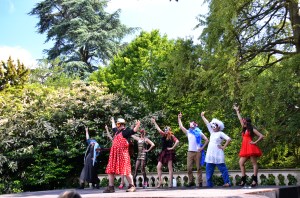 So of course I couldn’t come to England without making a pilgrimage to the Bard’s hometown. Of course the lure of Shakespeare’s Birthplace, Holy Trinity Church and a clever little exhibition of props from the Royal Shakespeare Company’s collection were too much to resist, but with the throng of tourists getting in the way of the atmosphere, the most pleasant part of our afternoon was definitely plonking ourselves down in The Dell with a pint of cider for a lively performance of The Merry Wives of Windsor.
The company, Greater Fool, was formed specifcally to perform for the Royal Shakespeare Company at The Dell in Stratford Upon Avon, and they certainly deliver. Lewis Allcock worked up a sweat playing four different characters, and David Rankine’s brilliantly angsty Mister Ford had the eager audience in stitches.
Possibly the only decision that left me wondering whether it was a good one was the decision to utilise the fame of Modern Family to improve accessibility. Taya De La Cruz‘s Mistress Page was highly amusing as a Mexican housewife, but the reference was heavy-handed and I just wondered if there was a more nuanced way to achieve the same effect. My twelve-year-old daughter has never seen much Modern Family, so the references went over her head, but she still engaged with the story well, despite having had no exposure to this play before either.
Whether this was too much or not was neither here nor there in the end, as the performance was light, engaging, and thoroughly entertaining. Falstaff (Adam Diggle) was suitably depicted as a football-obsessed larrikin, and his engagement with the audience flowed into the atmosphere of the outdoor space, punctuated, as it was, during the performance we attended, by loud speaker announcements from across the river and actual real-life larrikins who had already removed their jerseys to soak up the sunshine and talk on their phones behind the stage. The cast, however, were impressive in their determination to hold our attention, and their toil paid off. These are perhaps the most undervalued performers in England (it was free, though they do pass a basket around afterwards).
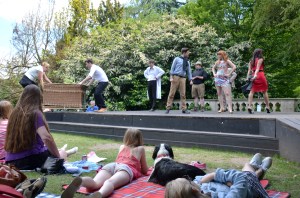 I did consider swapping our days so we could be at Stonehenge for the solstice, but I actually think this was the best activity for summer’s longest day ever devised. And to enjoy a play is a much more suitable activity for a visit to Stratford than battling to catch a glimpse of the bed in Shakespeare’s parents’ room over the shoulders of other pilgrims.
Tags: Adam Diggle, Anna Swan, Avon, Becky Wingham, Bell Shakespeare Company, Callum Hale, David Rankine, Emrys Matthews, Greater Fool, Holly Renaut, Lewis Allcock, Merry Wives of Windsor, Nicole Webb, Roger Parkins, Royal Shakespeare Company, RSC, Shakespeare, Stratford, Stratford Upon Avon, Taya De La Cruz, The Dell, tourism, William Shakespeare
 It is always refreshing to see a new take on an old theme, especially when the characters involved manage to shine through more clearly because of that new take. So with Sandel, I was impressed to find a play that told a story about three people’s love in circumstances where politics would normally get in the way, but are surprisingly held at bay.
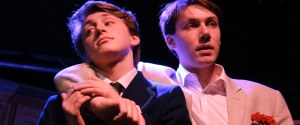
Sandel is a stage adaptation of a 1960s novel by Angus Stewart that tells the story of a love affair between an Oxford college undergraduate, David Rogers, and a choirboy, Antony Sandel, with an intriguing subplot featuring Rogers’ friend Bruce, who is also in love with Rogers.
I suspect this script skims over some of the novel’s more intriguing moments, and while this treatment might be fine for film, I think there are some elements of the relationship between Rogers and Sandel that warranted a deeper exploration for the stage (by which I am suggesting a more courageous departure from the novel might have better represented the characters’ experiences). However, the performances delivered by Ashley Cousins and Joseph Lindoe certainly make the most of a solid script with witty dialogue.
Ashley Cousins’ voice was entirely appropriate for Sandel, though its high-pitched demands did start to grate by the end of the play. This, though, added to the climax that developed gently as the play progressed. This voice not only demanded the attention of Rogers; accompanied by the very rich characters drawn by all three performers, it held me in its grip and gave me that experience that makes theatre worthwhile; I had to know what was going to happen.
Sandel is a noteworthy play, mostly, I think, because it focuses solidly on the human experiences of its protagonists without excessive moralising or even legitimising. The legal and moral circumstances, though considered, are almost a side note to the depth of empathy the story elicits for its protagonists, and this is where it really stands out. I was enthralled throughout.
Tags: Angus Stewart, Ashley Cousins, Calum Fleming, choirboy, Glenn Chandler, Joseph Lindoe, Oxford, Sandel
It has felt like something of a whirlwind for me, being caught up in a production pretty much as soon as I arrived in London. When I saw an ad on Arts Jobs at the end of April for actors with Prams in the Hall, I was immediately struck by the aims of the company and how necessary this kind of opportunity is for parents. Of course at that stage I wasn’t familiar with Roisin Rae’s play, and how much the story resonated with both the aims of the company, and my own experience as a father who, by necessity, has needed to treat his greatest passion, playwriting, as a hobby for so long.
For my friends back in Canberra, who were all too lazy to come to the antipodes to see the play, The Inner Life of Sophie Taylor presents the story of an artist who has put her career on hold to raise children. A new opportunity draws out her inner, artistic life, and shakes up this lifestyle. So the play explores how she pursues this opportunity and the impact that pursuit has on her and her family.
Sound familiar? Those who know me know that I’ve had to deal with similar challenges, just like many of the creatives I’ve worked with over my years in Canberra.
For me, the production wasn’t an easy one. Two of the four characters I played presented substantial challenges. Andrew, husband to Sophie, had to be presented in a way that made him neither guilty nor innocent in the difficulties Sophie faced, and his similarity to my own circumstances often made it difficult for me to allow for a reading of the script hat wandered from my own experience.
And the other challenging character, their son, was five! While I had thought it would be fun to play a child since seeing a documentary about Company B’s London run of Cloudstreet over a decade ago, I hadn’t expected I would actually do so. It was, of course, a lot of fun. And a number of rehearsals were genuinely cathartic, as Karin Fisher-Potisk, our movement director, helped us discover our children by taking us back to childhood memories. I found myself quite wistful following one rehearsal in particular, due to the vividness with with I was able to remember my father, who I lost almost a decade ago now.

The Space
The performance venue was likewise both challenging and exciting. The Space is a performance venue on London’s Isle of Dogs, a former Presbyterian church repurposed as a theatre. It is full of character and has a quaint little stage with a marvellous proscenium. In the week before our performance I came with my daughter to see a production of Romeo and Juliet where the space was used in reverse, with the audience crossing the stage to enter it; it really is a nice performance space, even if you need to put up with the noise of a busy cafe kitchen in the wings!
I certainly didn’t expect that I would be treading the boards during my short stint in London, but I’m glad I did. This experience introduced me to some great creatives and the production was a blast from start to end.

Cast plus director for The Inner Life of Sophie Taylor.
Tags: Abigail Kessel, Anna Ehnold-Danailov, Arts, Elisa Terren, hobby, Karin Fisher-Potisk, Nadia Nadif, parenting, Prams in the Hall, Rob Hart, Roisin Rae, Sarah Winn, Trevar Alan Chilver
 In less than a week I will be taking the stage in London for the first time at The Space on the Isle of Dogs. The Space is a quaint repurposed venue full of character and the first thing I noticed on my arrival was that Romeo and Juliet is currently in production, so of course I had to pop along.
I love Romeo and Juliet principally, I think, because though its plot plays hard and fast with the willing suspension of disbelief, its characters are drawn with impeccable honesty.
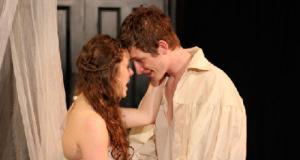
Tonight, I was treated to one of those brilliant experiences where the familiar becomes new again. The performers delivered deliciously light renditions of Shakespeare’s characters, while also delving richly into the great stock of pathos Shakespeare provided.
I was particularly taken with Lucy Bailey, who took us on the Nurse’s amusing and moving journey of joys and sorrows. Juliet was also given an unusually engaging lightness by Rebecca Burnett that provided the space for joining her on her highs and lows.
There was some novel (and very clever) casting in the form of turning Benvolio into a Benvolia, and Gregory also underwent a sex change. Both characters benefited from finding their feminine side, I thought, though it didn’t seem to serve much of a purpose other than utilising the eternal glut of female actors and relieving the difficulty of fielding a male cast.
And herein lies my one reservation about this production. Despite a couple of interesting choices such as this, and despite some commendable performances, there’s no spark of brilliance to make it truly noteworthy.
These qualities don’t quite compensate for a rather staid envisioning of a text with such broad possibilities. It just seemed far too constrained to its conventional setting, and despite the freshness of the performances, I just wanted something more to sink my teeth into.
Tags: Adam Milford, Amber Elliott, Angus Howard, Benvolio, Dilaila Colasuono, Ethan Chapples, Henry Heathcote, Isle of Dogs, Jennifer Shakesby, Juliet, London, Lucy Bailey, Rebecca Burnett, Romeo, Romeo Juliet, Sally Preston, Shakespeare, Stephen Harakis, The Space, Tim Fordyce, Tom Blyth

Naoné Carrel and Elaine Noon in Calendar Girls, along with that amazing smile
My Facebook feed is awash this morning with tributes to the very deserving Naoné Carrel. I didn’t have the pleasure of knowing her as well as most of these friends did, but hers has been one of the faces that I have associated most closely with great nights in foyers and great moments in auditoria.
I met Naoné when she was President of Canberra Rep, and I had turned up early to a meeting of the Network of Amateur Theatre Organisations feeling rather like a very small fish in a very big pond. Her face beamed as she welcomed me and suddenly I felt like the pond was much smaller.
I had seen her on stage, of course, much earlier than that. I first saw her last century in The Dresser. And also while I was an undergrad I recall being enthralled with her performance in Death of a Salesman at the ANU Arts Centre.
The theatre community here is the richer for having had not only a performer of her calibre, but also an individual whose smile would light up the room. She will be missed.
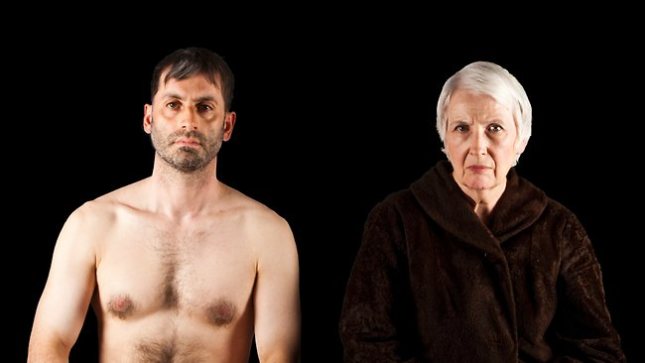
Naoné Carrel and Raoul Craemer in a promo shot from To Silence
For the big picture, here’s a sampling of reviews of Naoné’s shows:
Tags: Calendar Girls, Canberra Rep, Death of a Salesman, Doubt, Elaine Noon, Naoné Carrel, NATO, Raoul Craemer, vale
 La Mama’s Explorations series is a season of new and often experimental works that challenge theatrical boundaries and process and explore new ideas.
Virginia and Some of Her Friends is one of this year’s offerings, and while it is not especially innovative in style, it does combine theatrical techniques that are not often seen in harmony.
This piece sits somewhere between the musical and the play with music. Like a musical, the songs deliver a substantial component of the character and some plot. But like the play with music, the songs jar, altering the flow of action and realigning the audience’s attention not unlike Brecht’s verfremdungseffekt.
As for plot, there is little…
The rest of this post is published on Australian Stage.
Tags: Amelia Carroll, Andi Snelling, Bertolt Brecht, Brecht, Chloe Reid, Claire Nicholls, Dindy Vaughan, Distancing effect, Faye Bendrups, Guillermo Anad, La Mama, La MaMa Experimental Theatre Club, Marysia Green, Mia Landgren, Peter Green, Ponch Hawkes, Rebecca Etchell, Theatre, verfremdungseffekt



 Foyer Talk